
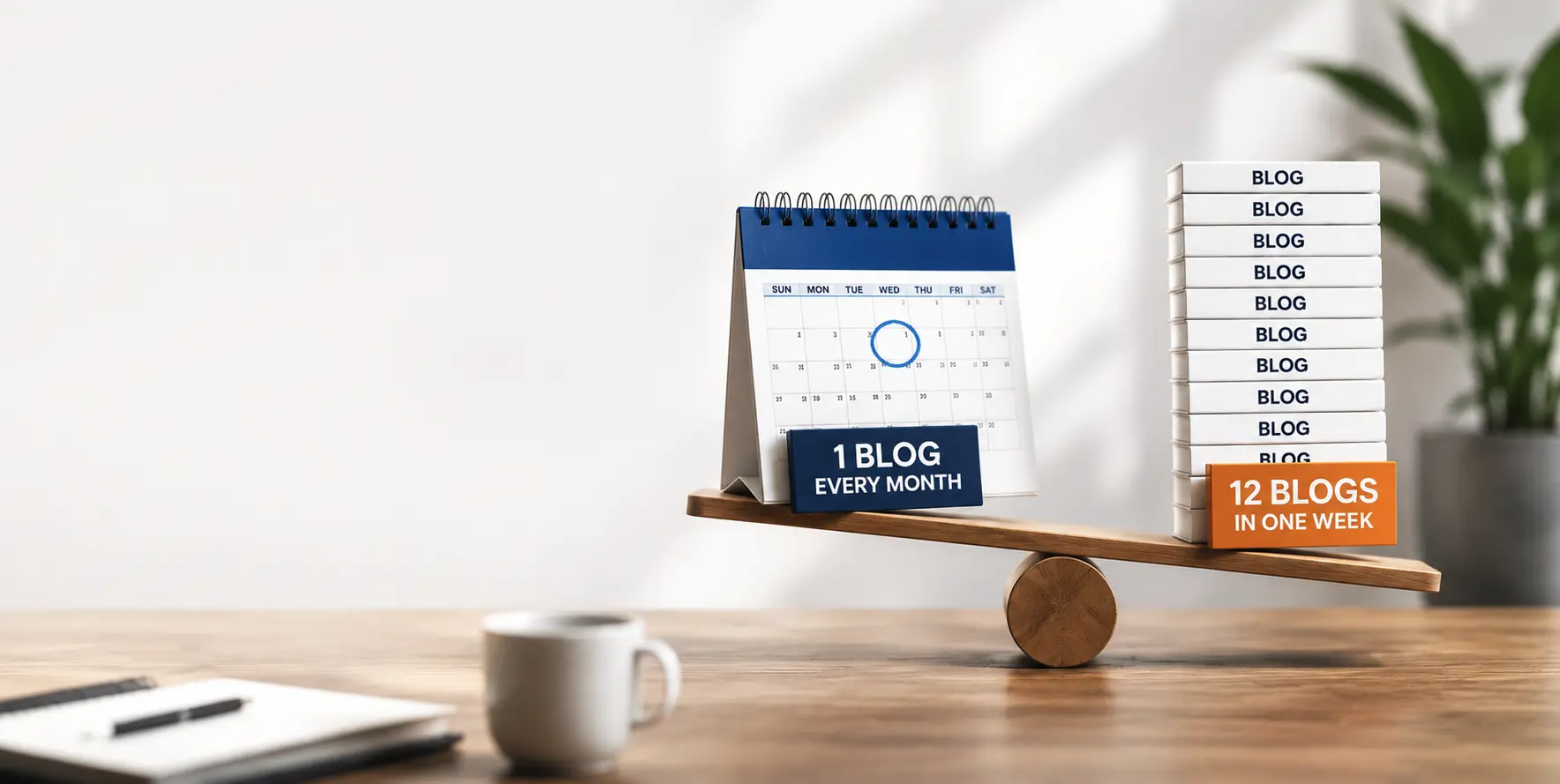
A doctor who decides to take content seriously often starts with a burst of effort - a weekend set aside, a dozen articles written and published together. It feels productive. It feels like the job is done. But a year later, that doctor is usually behind a peer who did something far less dramatic: one blog a month, every month, without fail. The reason is not about effort. It is about how discoverability is actually built.
Why the burst feels right but works poorly
Publishing twelve blogs in one week is satisfying because it looks like progress. The work is visible, finite and finished. But it misreads how patients and search engines respond to content.
A search engine reads a sudden burst followed by a long silence as exactly that - a one-time event, not an active presence. Twelve articles published together also compete with each other for attention on the same few days, then quietly age together. And the doctor, having spent the effort all at once, usually has nothing planned for the eleven months that follow. The burst is a spike. What discoverability rewards is a signal, sustained.
Why consistency is the real signal
Search engines favour presences that are alive. A doctor publishing one well-structured article every month sends a steady, repeated signal: this is an active, current, growing source of credible medical content. That signal, repeated twelve times across a year, is worth far more than twelve articles delivered once and then stopped.
Consistency compounds in another way too. Each month’s article is a new permanent page, a new entry point, a new question answered, added to a presence that is visibly still growing. Twelve months of steady publishing builds a body of work that strengthens with every addition. Twelve articles in one week builds a single moment that immediately begins to age. Same number of articles, entirely different outcome.
Why a sustainable rhythm survives real life
A doctor’s first responsibility is clinical. Any content rhythm that ignores that will fail and this is the quiet, practical reason the burst approach collapses. It is not built for the life of a practising doctor.
One thoughtful article a month is sustainable. It fits around clinics and procedures and on-call. It can be maintained for years without strain. Twelve in a week depends on a rare free stretch of time and a burst of motivation and when neither recurs, the content programme simply stops. The best publishing rhythm is not the most ambitious one. It is the one a doctor will still be keeping a year from now. A modest pace sustained beats an intense pace abandoned, every time.
Quality follows the steady pace
A monthly rhythm does not only survive better, it produces better work. One article a month gives a doctor room to choose a question that genuinely matters to patients, to answer it carefully, and to publish it properly structured. Twelve articles forced out in one week are written under time pressure, and it usually shows: thinner answers, repetition, less care.
This is the case for steady publishing in full. It sends the active signal search engines reward. It builds a compounding body of work. It survives the reality of a doctor’s schedule. And it protects the quality of each article. None of this requires a dramatic effort; only a sustained one. A doctor does not need to publish a great deal. They need to publish steadily, under their own name, for a long time. One blog a month, kept up, quietly outbuilds any burst.