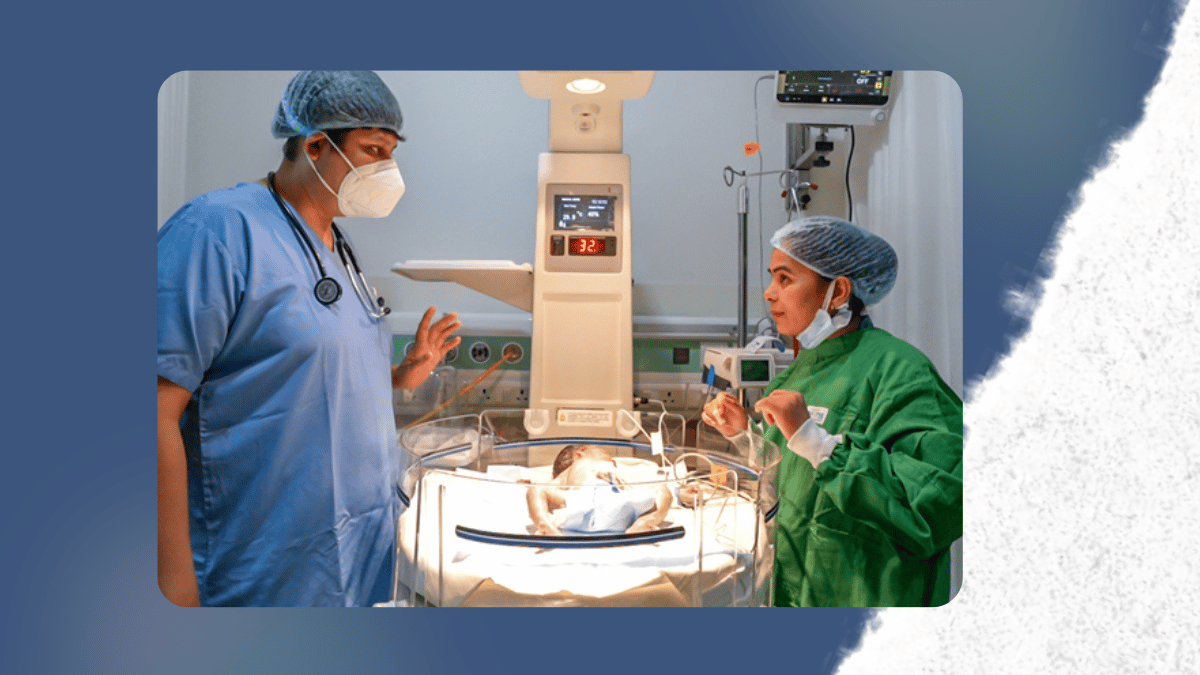
The neonatal period, defined as the first 28 days of life, is the interval of highest vulnerability in the entire human lifespan. More deaths occur in this period than at any other equivalent span of time in childhood. The physiological transitions a newborn must complete in the first hours and days after birth, from placental to pulmonary respiration, from passive maternal glucose supply to independent metabolic regulation, from foetal circulation to neonatal circulation, are remarkable in their complexity and their speed. When any of these transitions is incomplete or compromised, the clinical consequences can develop rapidly and require immediate assessment and management. My Fellowship in Neonatology at Rangadore Memorial Hospital, Bengaluru, one of Karnataka's respected institutions for neonatal training, provided dedicated clinical exposure to the full range of neonatal conditions: normal newborn assessment and care, management of jaundice, feeding support, respiratory difficulties in the newborn period, and the identification of the newborn who appears well but whose clinical trajectory is moving in the wrong direction. At Araike Kids Clinic and Allergy Center, Tumkur, this neonatal training is what I bring to every new family who arrives with their baby in the first days and weeks of life. For families in Tumkur and across the district, having a neonatologist-trained paediatrician who can assess a newborn with the clinical precision that a fellowship provides is a level of access that was previously available only in larger cities.
Jaundice, Feeding, and the Clinical Assessment That Matters Most in the First Week
Neonatal jaundice is the single most common clinical concern in the first week of a newborn's life, affecting more than half of term newborns and an even higher proportion of late preterm infants. It arises from the breakdown of foetal haemoglobin, which produces bilirubin at a rate that the newborn liver is initially too immature to conjugate and excrete efficiently. The visible yellowing of the skin and whites of the eyes that jaundice produces is a reliable clinical indicator, but the clinical assessment of jaundice in a newborn requires more than looking at skin colour. The rate of rise of bilirubin, the age of the newborn in hours rather than days when the jaundice appears, the presence of any haemolytic process accelerating bilirubin production, and the gestational age and feeding status of the newborn all determine whether a particular bilirubin level requires monitoring, phototherapy, or investigation for an underlying cause. Jaundice appearing in the first 24 hours of life is never physiological and always requires investigation. Jaundice persisting beyond two weeks in a term newborn warrants assessment for causes beyond the typical physiological and breastfeeding jaundice patterns. The clinical skill that neonatal fellowship training builds is the ability to read each jaundiced newborn in context rather than applying a bilirubin number to a chart: knowing which babies require serial measurements, which require phototherapy, and which require urgent investigation is a clinical judgement that goes beyond the chart. Feeding in the first week is equally critical. A newborn who is not feeding effectively, whether at the breast or from a bottle, is a newborn whose jaundice will be more severe, whose weight loss will exceed the expected range, and whose dehydration risk is higher. At Araike Kids Clinic, Tumkur, breastfeeding assessment and support, latch correction, and the early identification of feeding problems are part of every neonatal consultation.
Warning Signs That Require Immediate Attention, Not Watchful Waiting
Every parent who takes a newborn home from hospital should know the warning signs that require the same-day assessment rather than monitoring until the next scheduled visit. These are the clinical red flags that indicate a newborn whose trajectory is concerning and who cannot wait: a baby who is difficult to rouse or who is unusually floppy or limp; a baby who is not feeding at all for two or more consecutive feeds; a baby who appears to be breathing fast, whose chest is moving in a laboured way, or who has nostrils that are flaring with each breath; a baby whose jaundice appears before 24 hours of life or that is visibly extending to the legs and feet rather than only the face and upper body; a baby whose temperature is below 36.5 degrees Celsius or above 38 degrees Celsius; a baby with a central blue discolouration of the lips or tongue; and any parent whose instinct says that their newborn is not right, even when they cannot specify what is different. The parent who has been with the newborn continuously, who knows their normal feeding pattern, their normal sleep pattern, and their normal level of alertness, is the most sensitive clinical monitoring system available for that baby. At Araike Kids Clinic and Allergy Center, Tumkur, my role as the neonatology-trained paediatrician is to support that parental monitoring with the clinical framework and access that ensures any concern is assessed quickly and accurately.
To book a consultation with Dr. Madhusudan B S at Araike Kids Clinic and Allergy Center, CSI Layout, 2nd Cross, B H Road, near Malabar Gold, Tumakur, Karnataka 572102 (Monday to Saturday, 10:30 AM to 2:00 PM and 6:00 PM to 8:30 PM), call 6364530175 or 9663335968, or visit linqmd.com/doctor/madhusudan-b-s
Written by Dr. Madhusudan B S, MBBS (Sri Devraj Urs Medical College), DCH (Mysore Medical College), DNB (Pediatrics, Vijaya Health Center, Chennai), Fellowship in Neonatology (Rangadore Memorial Hospital), AASC (Allergy Asthma Specialist Course, Medtrain), Consultant Pediatrician and Neonatologist, Specially Trained in Allergy, Araike Kids Clinic and Allergy Center, CSI Layout, 2nd Cross, B H Road, near Malabar Gold, Tumakur, Karnataka 572102. Monday to Saturday, 10:30 AM to 2:00 PM and 6:00 PM to 8:30 PM. 12+ years. 10,000+ patients. Phone: 6364530175 / 9663335968.
Related reading
Meet Dr. Madhusudan B S : Preventive Paediatrics, Allergy Care, and a Commitment to Getting It Right

Add a Comment