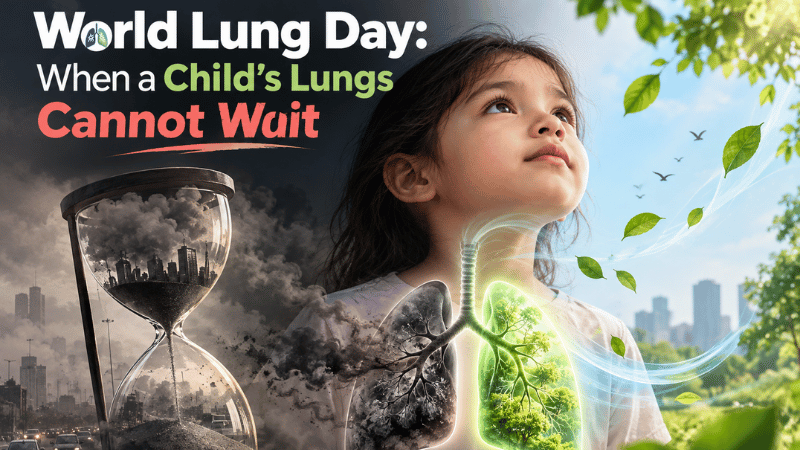
Most conversations on World Lung Day, 25 September, begin with prevention and awareness. That is where they should begin. But I want to approach it from a different direction: from the end of the spectrum where we hope children never arrive, the paediatric intensive care unit.
My IAP Fellowship in Paediatric Intensive Care, completed at I.P. Apollo Hospital New Delhi, gave me a front-row view of what happens when childhood lung disease is not identified early, not managed consistently, or not taken seriously until a crisis forces the issue. Over 30 years of practice in Jorhat, that picture has stayed with me and shaped everything about how I approach a child with a respiratory symptom.
What the ICU Teaches About Missed Diagnoses
A child in acute severe asthma is frightening to witness. The effort of breathing becomes visible in every muscle of the chest and neck. Oxygen saturations fall. The child is too tired to cry. Families who bring a child to the emergency room in this state often describe months of recurrent cough, repeated courses of antibiotics, and a label of "chest infection" that was applied again and again without a proper underlying assessment.
This is not a failure of families. It is a failure of the system to identify the condition early enough. And it is precisely what a well-managed diagnosis at the outpatient stage is designed to prevent.
The patterns I saw most consistently in children who reached the ICU with respiratory crises included:
A history of recurrent wheeze that had not been formally assessed or diagnosed
Families who had been told not to use inhalers, or who had stopped them fearing dependence
No written asthma action plan, so families did not know when to escalate care
Triggers in the home environment, including dust, mould or smoke, that had never been discussed
Why Jorhat Needed a Dedicated Asthma Centre
When I established the first advanced Asthma Centre in Jorhat, the goal was straightforward: to bring structured, objective asthma and allergy assessment to a region where children were otherwise travelling long distances for specialist care or going without it entirely.
Spirometry, allergy testing and a proper diagnostic pathway should not be available only in metropolitan hospitals. A child in Jorhat deserves the same quality of assessment as a child in Delhi or Bangalore. That principle has guided the work of the centre since its founding.
From Intensive Care to Prevention
My training in critical care did not pull me away from outpatient allergy and asthma work. It pushed me toward it. Every child who reaches the ICU in acute respiratory distress is a child who, in most cases, could have been kept stable with early diagnosis, consistent medication, correct inhaler technique and a plan that the family understood and trusted.
This World Lung Day, that is the message I want to leave with every parent who has a child with recurrent cough, wheeze or breathing difficulty: the ICU is not where these stories have to go. A proper evaluation, a confirmed diagnosis and a management plan written with your family in mind can change the trajectory entirely.
What You Can Do Today
If your child in Jorhat or anywhere in Assam has been treated repeatedly for chest infections, wheezes at night or during exercise, or struggles to keep up with physical activity, please seek a respiratory and allergy assessment. At Sanjivani Hospital and Care Allergy and Asthma Centre, we provide spirometry, skin prick testing and structured management for children with asthma and allergic airway disease.
The lungs of a child are worth protecting from the first sign of trouble, not only when they are in crisis. That is what World Lung Day means to me, and it is what 30 years of paediatric practice, from the ICU to the outpatient clinic, continues to reinforce.
Add a Comment