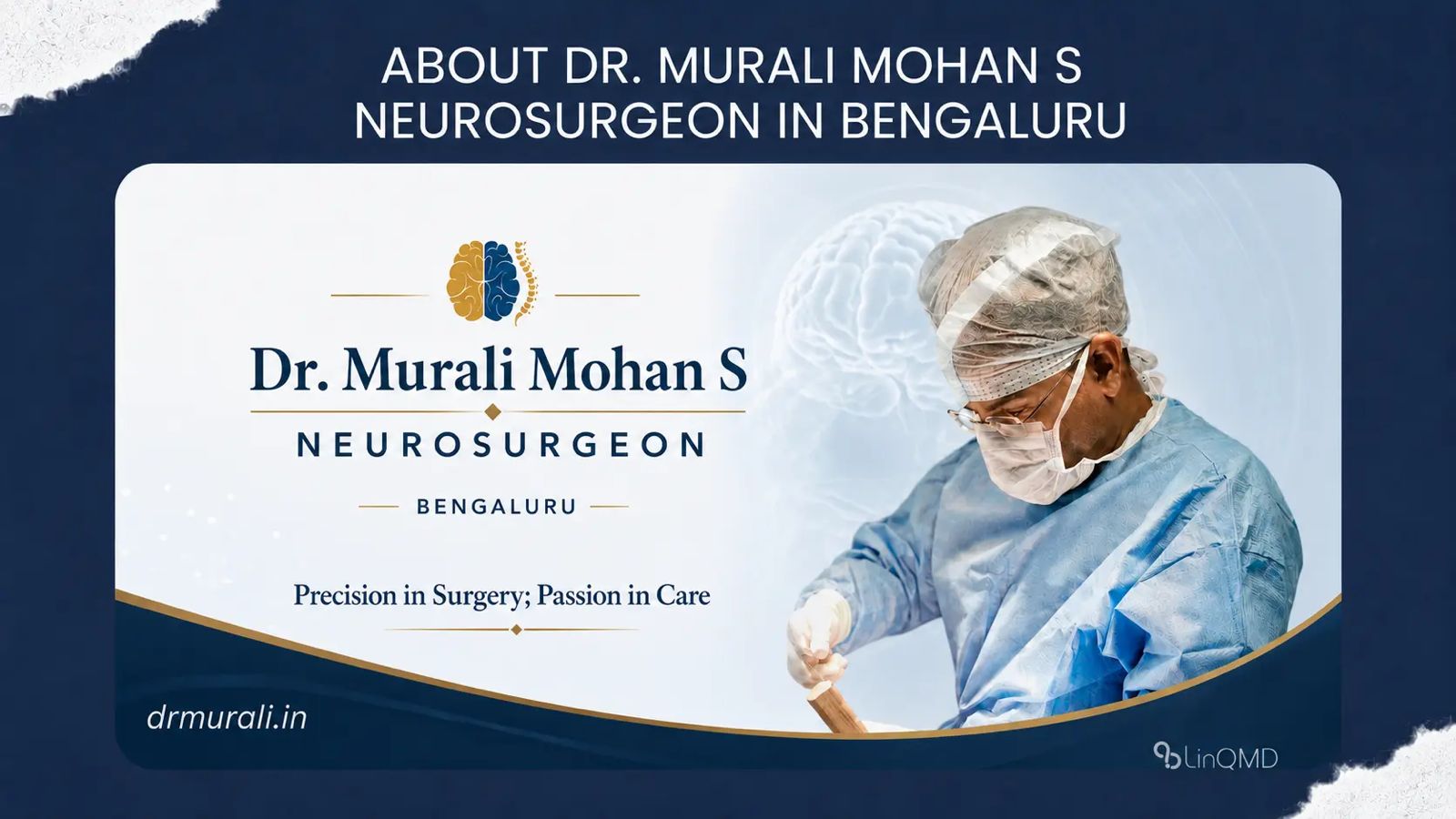
Dr. Murali Mohan S is a consultant neurosurgeon based in Bengaluru. He serves as Lead Consultant, Neurosciences at SPARSH Hospital, Hennur, and also consults at Synapse Clinics in Jayanagar and Yelahanka. His clinical work covers brain and spine surgery, including brain tumours, complex spine conditions, spinal deformity, paediatric neurosurgery, head injury, neuro ICU care, and rehabilitation-oriented follow-up.
For patients and families, a neurosurgeon is often met at a difficult moment.
A scan has shown a brain tumour. A spine problem has not improved. A child has a spinal deformity. A head injury has changed the course of a day. A family is trying to understand words they have never heard before. In such moments, the doctor’s role is not only to operate. It is also to explain, guide, listen, and help patients and families make informed decisions.
This profile introduces Dr. Murali Mohan S, his areas of clinical work, where he practises, how patients can reach him, and the larger body of work he has built around neurosurgery, communication, research, innovation, and structured patient access.
Who is Dr. Murali Mohan S?
Dr. Murali Mohan S is a Bengaluru-based consultant neurosurgeon with experience across brain and spine surgery.
He has performed more than 8,000 brain and spine surgeries over the course of his career. His practice includes adult, paediatric, and geriatric neurosurgery, with work across brain tumours, skull base conditions, craniovertebral junction disorders, complex spine surgery, spinal deformity, minimally invasive neurosurgery, head injury, neuro ICU care, and neurological recovery.
He currently serves as Lead Consultant, Neurosciences at SPARSH Hospital, Hennur, Bengaluru. He also consults at Synapse Clinics in Jayanagar and Yelahanka.
Alongside clinical practice, Dr. Murali has been involved in clinical research, medical innovation, public education, and healthcare technology. He holds a patent for an indigenous stereotactic frame, founded Dr. Klinisch Research Pvt. Ltd., and created LinQMD, a healthcare platform focused on structured doctor identity, patient access, and continuity of care.
Where does Dr. Murali Mohan S practise?
Dr. Murali Mohan S practises in Bengaluru.
His main hospital practice is at:
SPARSH Hospital, Hennur, Bengaluru
Lead Consultant, Neurosciences
He also consults at:
Synapse Clinics, Jayanagar, Bengaluru
Synapse Clinics, Yelahanka, Bengaluru
Patients are advised to check the current consultation schedule before visiting, as hospital and clinic timings may change.
For appointment-related information, patients may use the official appointment channels listed on drmuralimohan.com, the hospital’s official channels, Synapse Clinics channels, or the relevant LinQMD profile page.
What conditions does Dr. Murali Mohan S treat?
Dr. Murali’s clinical work covers a wide range of brain, spine, and nervous system conditions.
His areas of work include:
- Brain tumours, including benign and malignant tumours.
- Skull base surgery.
- Craniovertebral junction disorders.
- Complex cervical and lumbar spine conditions.
- Spinal deformities, including scoliosis and kyphosis.
- Paediatric brain and spine conditions.
- Hydrocephalus, neural tube defects, and craniosynostosis.
- Head injury and emergency neurosurgery.
- Deep brain stimulation and functional neurosurgery in selected conditions.
- Vascular neurosurgery, including aneurysms and AVMs.
- Spine infections and brain infections.
- Neuro ICU care and neurological recovery.
- Rehabilitation-oriented follow-up after brain and spine conditions.
Not every patient with a brain or spine condition needs surgery. Evaluation usually involves understanding the symptoms, examination findings, imaging, neurological status, general health, and treatment options. In many patients, the role of the neurosurgeon is to decide whether surgery is needed, whether it can wait, whether non-surgical care is appropriate, or whether another specialist should be involved.
What is his approach to patient care?
Dr. Murali’s approach places importance on clarity, realistic counselling, and careful decision-making.
Neurosurgery often involves uncertainty. A brain tumour may be benign or malignant. A spine problem may or may not require surgery. A head injury may change rapidly. A child with scoliosis may need observation, bracing, rehabilitation, or surgery depending on the curve and growth. Patients and families need time and explanation to understand these decisions.
In consultation, the focus is usually on explaining the diagnosis, reviewing scans, understanding symptoms, discussing options, and helping the patient and family understand the risks and benefits of each path.
Where surgery is advised, the discussion includes why surgery is being considered, what it aims to achieve, what risks exist, what recovery may involve, and what follow-up may be needed.
Clear communication is part of responsible medical care. A patient should not leave a consultation only with medical words. The patient and family should leave with a clearer understanding of the condition and the next step.
What is his training background?
Dr. Murali completed his MBBS from M.S. Ramaiah Medical College, Rajiv Gandhi University of Health Sciences, Karnataka, and DNB Neurosurgery from the National Board of Examinations, New Delhi.
He trained in neurosurgery in the school of Prof. B. Ramamurthi, one of the most respected figures in Indian neurosurgery, along with senior neurosurgeons at the Post Graduate Institute of Neurological Surgery, ALNC, VHS Hospital, Chennai.
He later gained further exposure under senior neurosurgeons in India and trained in spine surgery under Dr. Thierry Marnay in Montpellier, France.
This training background shaped his work across brain and spine surgery, with particular interest in complex decision-making, microsurgical precision, spinal deformity, and patient-centred counselling.
Why is communication an important part of his work?
Communication is one of the recurring themes in Dr. Murali’s work.
He has spoken publicly on doctor-patient communication, including through TEDx. His view is that communication is not a soft addition to medicine. It is part of care.
A patient facing a neurosurgical diagnosis may not remember every medical term. But the patient is likely to remember whether the doctor listened, explained, allowed questions, and helped the family understand the situation without unnecessary fear or false reassurance.
This is especially important in neurosurgery, where decisions often involve the brain, spine, movement, speech, memory, consciousness, pain, recovery, disability, and quality of life. In such situations, the doctor’s words carry weight. They can either add confusion or create clarity.
Dr. Murali’s writing and public education work come from this belief: medicine becomes more meaningful when patients understand it.
What is his work in innovation and research?
Dr. Murali has worked beyond routine clinical practice in medical innovation and clinical research.
He holds a patent for an indigenous stereotactic frame. A stereotactic frame is a neurosurgical device used for precise targeting within the brain. His innovation work reflects an interest in building solutions that are relevant to Indian healthcare realities, where cost, access, simplicity, accuracy, and workflow all matter.
He also founded Dr. Klinisch Research Pvt. Ltd., focused on clinical research. Research is an important part of medical progress because it helps organise experience, test ideas, validate decisions, and improve care over time.
His work in research and innovation remains connected to neurosurgery and to the larger goal of improving patient care.
What is LinQMD’s connection to his work?
LinQMD was created by Dr. Murali Mohan S after observing a common problem in healthcare: many good doctors are not easily found by the patients who need them.
Earlier, patients found doctors mainly through referrals, family networks, hospital reputation, and word of mouth. These still matter. But patients now also search online, compare information, read doctor profiles, watch videos, check maps, and increasingly rely on AI-generated answers before making a healthcare decision.
LinQMD was built to help doctors create a structured, authentic digital presence, improve patient access, and support continuity of care. Its philosophy is that technology should support the doctor-patient relationship, not replace it.
In this profile, LinQMD acts as the editorial and publishing platform. The focus remains on Dr. Murali’s clinical work, practice locations, patient education, and the information patients may need before seeking care.
How can patients reach Dr. Murali Mohan S?
Patients can reach Dr. Murali Mohan S through his official website and listed practice locations.
Website: drmuralimohan.com
Practice locations include SPARSH Hospital, Hennur, and Synapse Clinics in Jayanagar and Yelahanka, Bengaluru.
Appointment-related information may be available through the official website, hospital channels, clinic channels, or the relevant LinQMD profile. Patients should use official contact points for current timings, availability, and appointment confirmation.
In emergencies such as head injury, sudden weakness, seizures, drowsiness, severe headache, loss of consciousness, or rapidly worsening neurological symptoms, patients should seek emergency medical care rather than waiting for a routine appointment.
How can patients prepare for a consultation?
Patients do not need to worry if they do not have all reports or previous records.
If any previous medical documents are available, it is helpful to carry them, because they allow the doctor to understand the full picture more clearly. These may include earlier scans, reports, prescriptions, discharge summaries, blood tests, nerve tests, surgery notes, or treatment records from other hospitals.
For brain and spine problems, previous MRI, CT, X-ray, or scan films can be especially useful because they help compare the present condition with earlier findings. A list of current medicines, details of symptoms, and any questions the patient or family wants to ask can also make the consultation more useful.
The purpose of bringing records is not to create pressure. It is simply to help the doctor see the patient’s journey as a whole, rather than as one isolated visit.
What does Dr. Murali write about?
Dr. Murali writes on brain and spine health, neurosurgery, patient communication, healthcare innovation, digital health, and continuity of care.
His educational articles are meant to help patients and families understand medical conditions in a calm and structured way. Topics include brain tumours, scoliosis, spine surgery, neurosurgical decision-making, doctor-patient communication, and the future of healthcare.
These articles are for awareness and education. They are not a substitute for an in-person medical consultation. The purpose is to help patients ask better questions, understand their condition more clearly, and approach care with less confusion.
What should patients remember?
Dr. Murali Mohan S’s work is centred on brain, spine, and nervous system care.
A consultation usually involves understanding the patient’s symptoms, reviewing available scans and reports, explaining the diagnosis, discussing treatment options, and deciding whether observation, medicines, rehabilitation, surgery, or another specialist’s involvement is appropriate.
Neurosurgical care is not only about an operation. It often involves diagnosis, counselling, risk assessment, surgical judgement, recovery planning, and long-term follow-up.
Alongside clinical practice, Dr. Murali has also been involved in clinical research, medical innovation, public education, and healthcare technology through LinQMD. These interests are connected by a common purpose: helping patients access clearer information, better guidance, and more structured care.
For patients and families, the useful starting point is simple: seek care when symptoms are concerning, carry available records if possible, ask questions clearly, and use official hospital or clinic channels for appointment-related information.



Add a Comment