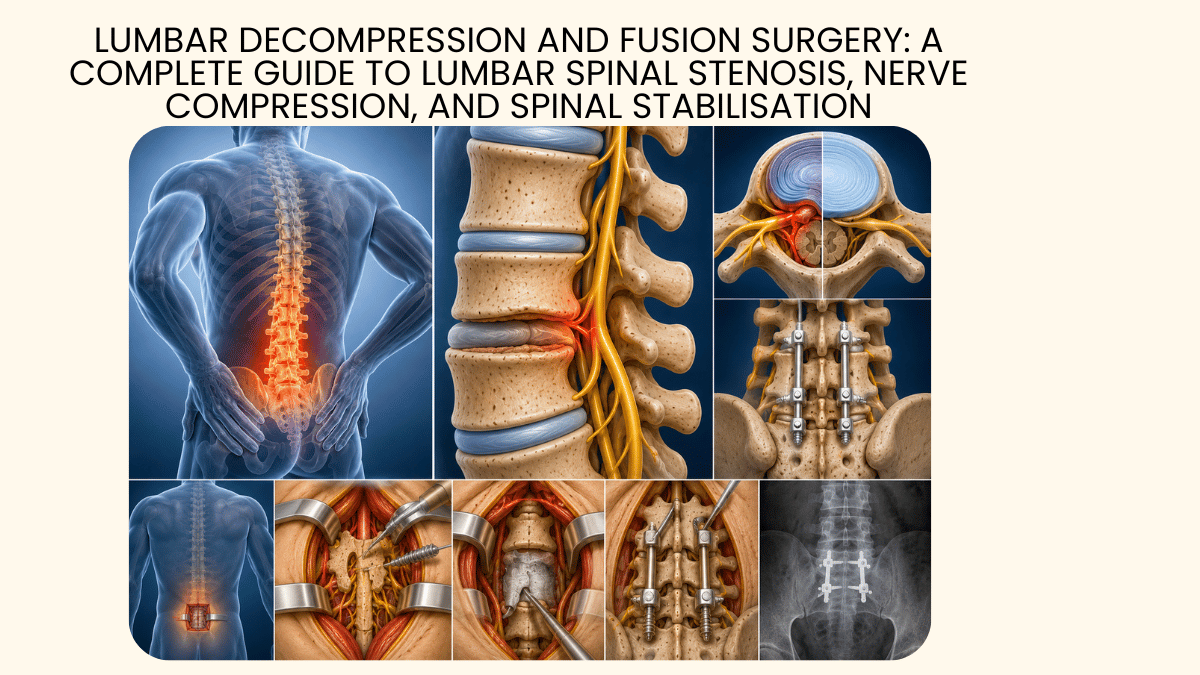
Lower back and leg symptoms are among the most common reasons patients come to see me at Royal Preston Hospital. As a Consultant Neurosurgeon specialising in spinal surgery, I see many patients who have lived with worsening lumbar spinal stenosis for months or years before being referred for specialist assessment. When symptoms become disabling and conservative treatments no longer provide sufficient relief, surgery may be considered.
This guide explains the conditions that may require surgery, the operation itself, the potential benefits and risks, and what recovery realistically involves. My aim is to give you the information you need to make a well-informed decision about your care.
How does the lumbar spine work and why does it matter?
The lumbar spine forms the lower part of the backbone and consists of five vertebrae, labelled L1 to L5. These vertebrae are separated by intervertebral discs which act as shock absorbers and permit movement. The lumbar spine performs several important functions: supporting body weight, allowing bending and twisting, protecting the spinal nerves, and providing structural stability. Within the spinal canal lies a bundle of nerves known as the cauda equina, which supplies the legs, bladder, bowel, and sexual function. When these nerves become compressed, significant symptoms can develop.
What is lumbar spinal stenosis?
Lumbar spinal stenosis refers to narrowing of the spinal canal or the spaces through which nerves travel. It is most commonly caused by age-related degenerative changes, including thickening of ligaments, enlargement of facet joints, disc bulging, bone spur formation, and degenerative instability. As narrowing progresses, nerves become compressed, particularly during standing and walking.
What is degenerative spondylolisthesis?
Degenerative spondylolisthesis occurs when one vertebra gradually slips forward relative to another. This commonly develops due to disc degeneration, facet joint arthritis, and age-related instability. The slip may contribute to back pain, nerve compression, spinal instability, and progressive deformity. In some patients, stabilisation surgery may be required in addition to decompression.
What symptoms can lumbar stenosis cause?
Symptoms often develop gradually over several years.
Leg pain
Pain may radiate into the buttocks, thighs, calves, and feet. Unlike sciatica caused by a disc prolapse, symptoms frequently affect both legs.
Neurogenic claudication
This is one of the hallmark symptoms of lumbar stenosis. Patients often describe leg pain when walking, heaviness in the legs, numbness, and weakness. Symptoms typically improve with sitting down, leaning forward, or bending over a shopping trolley. This pattern of neurogenic claudication distinguishes lumbar stenosis from vascular causes of leg pain.
Numbness and tingling
Compression of nerves can produce altered sensation in the legs and feet.
Weakness
Long-standing nerve compression may lead to muscle weakness in the legs.
Back pain
Many patients also experience lower back pain due to degenerative changes within the spine.
When should I seek specialist assessment?
You should seek specialist assessment if you develop persistent leg pain, walking limitation, progressive weakness, increasing numbness, difficulty standing upright, or symptoms affecting your quality of life.
Urgent assessment is required if symptoms include loss of bladder or bowel control, saddle numbness, or rapid neurological deterioration. These may indicate cauda equina syndrome, which requires emergency treatment.
How is lumbar stenosis diagnosed?
Clinical assessment
A detailed assessment includes a full symptom history, walking tolerance, neurological examination, and functional assessment.
MRI scan
MRI is usually the most important investigation. It demonstrates nerve compression, spinal stenosis, disc degeneration, and spondylolisthesis.
CT scan
CT scanning provides excellent detail regarding bone anatomy, facet joints, and previous surgery, and is particularly useful for spinal fusion assessment.
Dynamic X-rays
Flexion-extension X-rays may be used to identify instability between vertebrae.
Can lumbar stenosis be treated without surgery?
Yes. Many patients benefit from conservative treatment. Options may include physiotherapy, exercise programmes, weight management, pain medication, neuropathic medication, epidural injections, and pain management services.
Surgery is usually considered when symptoms persist despite appropriate non-surgical treatment or when neurological deficits develop.
When is surgery recommended?
Surgery may be considered when walking becomes significantly limited, when nerve compression causes disability that significantly affects quality of life, when progressive weakness develops indicating ongoing nerve damage, when instability contributes to both back pain and nerve compression, or when conservative treatment has failed after appropriate trial.
What does lumbar decompression surgery involve?
Lumbar decompression aims to create more space around compressed nerves. The operation is performed through an incision in the back. I remove the structures responsible for narrowing, which may include thickened ligaments, overgrown joints, bone spurs, and disc material. The objective is to relieve pressure on the nerves while preserving as much normal anatomy as possible.
Why is fusion sometimes necessary?
In some patients, decompression alone may not provide sufficient stability. Fusion may be recommended when there is degenerative spondylolisthesis, mechanical instability, recurrent stenosis, significant deformity, or where extensive decompression requires stabilisation. Fusion aims to permanently join two or more vertebrae together.
What is instrumented fusion?
Instrumented fusion uses implants to stabilise the spine while fusion occurs. The implants typically consist of pedicle screws, connecting rods, bone graft, and in some cases an interbody cage.
Titanium pedicle screws are inserted into the vertebrae. Connecting rods link the screws and provide immediate stability. Bone graft encourages the vertebrae to grow together and form a solid fusion. Where used, a cage is inserted into the disc space to support fusion and restore spinal alignment.
What are TLIF and PLIF procedures?
You may hear the terms TLIF surgery, Transforaminal Lumbar Interbody Fusion, or PLIF surgery, Posterior Lumbar Interbody Fusion. Both involve removing the disc and inserting a cage through a posterior approach to promote fusion. I will determine which technique is most appropriate based on your anatomy and specific pathology.
What are the goals of surgery?
The primary objectives are to relieve nerve compression, reducing leg pain, numbness, and neurological symptoms; to improve walking capacity; to stabilise the spine and prevent abnormal movement; and to improve quality of life, allowing a return to normal activities and greater independence.
What symptoms improve most reliably?
Leg pain, neurogenic claudication, and nerve-related symptoms usually improve most reliably. Numbness, weakness, and walking distance may also improve. Long-standing back pain and chronic neurological deficits are less predictable. It is important to understand that surgery is often more effective at treating leg symptoms than back pain.
What are the risks of lumbar decompression and fusion surgery?
All spinal surgery carries risk. Although serious complications are uncommon, they can occur. I discuss all relevant risks individually with each patient before any decision to proceed.
Specific risks include infection, bleeding, cerebrospinal fluid leak, nerve injury, implant-related complications, failure of fusion, adjacent segment disease, epidural fibrosis, and recurrent symptoms. Paralysis is a recognised but rare complication. General anaesthetic risks include heart complications, pneumonia, deep vein thrombosis, and pulmonary embolism.
Fusion does not always occur successfully. Risk factors for non-union include smoking, diabetes, osteoporosis, and multi-level fusion. Revision surgery may occasionally be necessary.
What happens after surgery?
Following surgery you will spend time in the recovery area before returning to the ward. You will be encouraged to mobilise early with support from nursing staff and physiotherapists. Pain relief will be carefully managed. Depending on the complexity of surgery and the number of levels treated, hospital stay is commonly between three and five days.
How long does recovery take after lumbar fusion surgery?
Recovery following lumbar fusion surgery is generally longer than after a simple discectomy. In the first two weeks, wound healing is the priority and walking is encouraged with a gradual increase in activity. Between two and six weeks, mobility improves and pain reduces as independence increases. Between six weeks and three months, many patients return to routine activities with progressive strengthening. Between three and twelve months, the fusion process continues and functional improvement progresses. Driving should only resume when you can safely perform an emergency stop, are no longer taking medication that impairs driving, and comply with DVLA guidance and your insurer's requirements.
Questions patients ask me most often
Will fusion make my spine completely rigid?
No. Only the operated segment is fused. Most patients retain good overall mobility.
How successful is lumbar fusion surgery?
For appropriately selected patients, lumbar decompression and fusion surgery can meaningfully improve leg symptoms, walking capacity, and quality of life. Results depend on the severity of the condition, the number of levels treated, and individual patient factors.
Will my back pain disappear?
Back pain often improves, but complete resolution cannot be guaranteed. Surgery tends to be more reliable for leg symptoms than for back pain.
How long does fusion take?
The fusion process continues for several months and may take up to a year to mature fully.
If you are experiencing leg pain, walking limitation, or symptoms suggestive of lumbar spinal stenosis or instability, I would be happy to assess your situation and discuss whether surgical or non-surgical management is appropriate for you. To book a consultation with Mr. Anantharaju Prasad at Royal Preston Hospital, Preston, call 01772 522740
Written by Mr Anantharaju Prasad, MBBS, DNB (Neurosurgery), FRCS (SN), Consultant Neurosurgeon, Royal Preston Hospital, Sharoe Green Ln, Fulwood, Preston PR2 9HT, United Kingdom.

Add a Comment