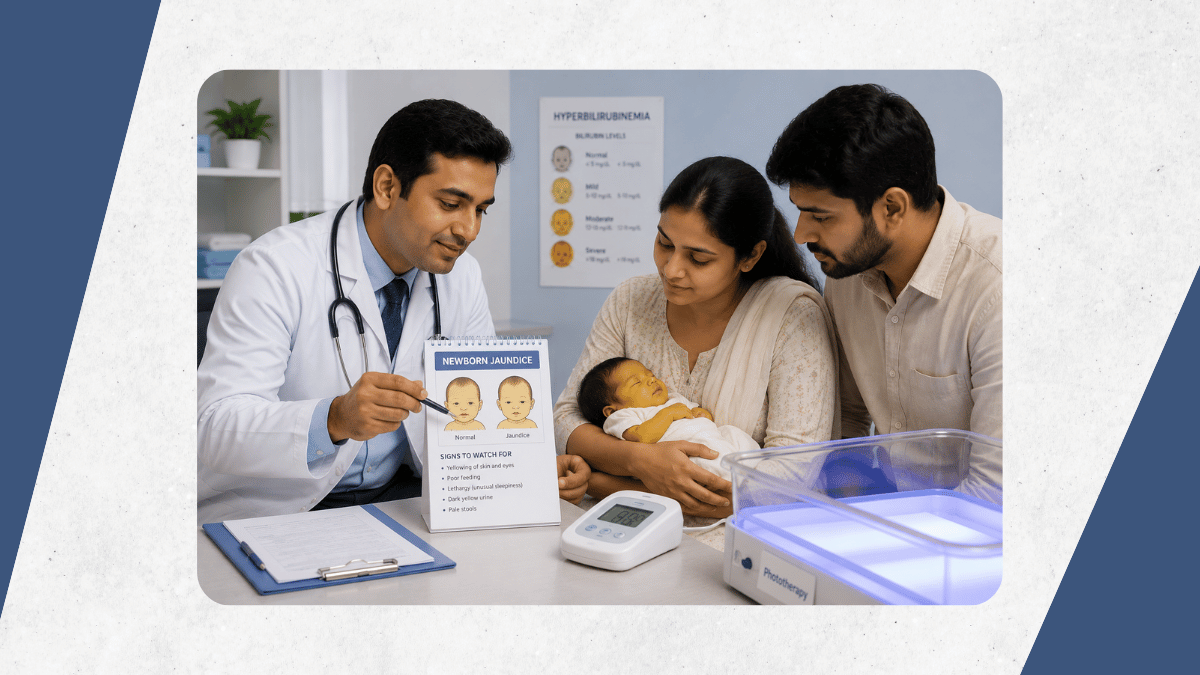
Neonatal jaundice is the single most common reason a newborn is readmitted to hospital after discharge, and in forty years of paediatric practice at Vatsalya Children's Hospital, Varanasi, it is also one of the conditions I have seen cause the most avoidable harm. The harm is avoidable because jaundice is visible, measurable, and treatable - and because kernicterus, the brain injury that results from severely elevated bilirubin, is entirely preventable when jaundice is identified and managed in time. Most jaundice in newborns is harmless and requires no treatment at all. The clinical challenge is distinguishing physiological jaundice from patterns that need prompt assessment and measurement, which is what this guide is about.
Physiological jaundice versus jaundice that needs assessment
Bilirubin is produced when red blood cells are broken down. Newborns have a high red blood cell turnover after birth and an immature liver that processes bilirubin less efficiently than an adult liver. This produces a predictable rise in bilirubin in virtually all newborns, which is called physiological jaundice. It appears after 24 hours of life, peaks around days three to five, and clears by the end of the second week in a full-term baby. This pattern, this timing, requires monitoring but usually no treatment.
Jaundice that falls outside this pattern raises concern. Jaundice appearing within the first 24 hours of life is always pathological and requires urgent bilirubin measurement and investigation for its cause - which may include blood group incompatibility between mother and baby, infection, or a metabolic condition. Jaundice that deepens rapidly, that spreads below the chest and into the abdomen and thighs, that extends to the palms and soles, or that persists beyond two weeks in a full-term baby (or three weeks in a breastfed baby) all warrant a bilirubin measurement rather than watchful waiting. Jaundice alongside pale, chalky stools and dark urine suggests a liver problem and requires urgent evaluation.
How to check jaundice at home and when a measurement is needed
The pillar guide on newborn warning signs describes the skin-press test: press gently on your baby's skin in natural daylight with one finger, release, and observe the colour that appears beneath. In a jaundiced baby the underlying skin will appear yellow rather than returning to normal skin colour. This test gives a rough indication of jaundice but it is not a substitute for measurement. Visual assessment is unreliable, particularly in babies with darker skin tones, and bilirubin levels can rise faster than the visible change in skin colour suggests.
When jaundice appears, the right question is not 'does this look like too much?' but 'has the bilirubin been measured against the baby's age in hours?' Bilirubin nomograms plot a baby's bilirubin level against their age in hours and define whether the level requires phototherapy, closer monitoring, or reassurance. This is why a measurement matters even when the baby seems otherwise well: a level that appears borderline on day two may be well above the phototherapy threshold on day one, because the clinical risk changes with age. At Vatsalya Children's Hospital, we measure bilirubin using both serum sampling and transcutaneous bilirubinometry, and we plot every result against age-specific thresholds before making a treatment decision.
Phototherapy, when it is needed, and what it does
Phototherapy uses blue-spectrum light to convert bilirubin in the skin into a form that can be excreted in urine and stool without passing through the liver. It is safe, effective, and the standard first-line treatment for jaundice that has reached the treatment threshold for the baby's age. A baby receiving phototherapy lies under the lights with eyes protected, and feeds are continued normally. Most babies receiving phototherapy for physiological jaundice see their bilirubin level fall within 24 to 48 hours and do not require any further intervention.
The question I am asked most often by families is whether phototherapy is necessary or whether sunlight will achieve the same result. Sunlight is not a substitute for phototherapy. The intensity and spectral quality of the light used in phototherapy units is calibrated specifically for bilirubin photoisomerisation. Window-filtered sunlight does not achieve comparable intensity, and exposing a newborn to direct sunlight carries real risks of sunburn and overheating. If your paediatrician recommends phototherapy, the right response is to proceed with it rather than to attempt a home alternative. Bilirubin-related brain injury, kernicterus, is entirely preventable - the only requirement is that jaundice is taken seriously and treated at the right time.
To book a consultation with Dr. Rajendra Pathak at Vatsalya Children's Hospital, Mahavir Road, Orderly Bazar, Varanasi, call +91 9838585111.
Written by Dr. Rajendra Pathak, MBBS, MD (Pediatrics), Senior Consultant Paediatrician and Founder-Director, Vatsalya Children's Hospital, Mahavir Road, Orderly Bazar, Varanasi, Uttar Pradesh 221002. Phone: +91 9838585111.
Related reading
Newborn Warning Signs Every Parent Must Know: A Complete Guide to the First 30 Days
Neonatal Care Essentials: Managing Premature Babies and Newborn Complications
Importance of Early Diagnosis in Pediatric Diseases for Better Recovery Outcomes
Pediatric Critical Care: Early Signs, Treatment & Life-Saving Interventions in Children


Add a Comment