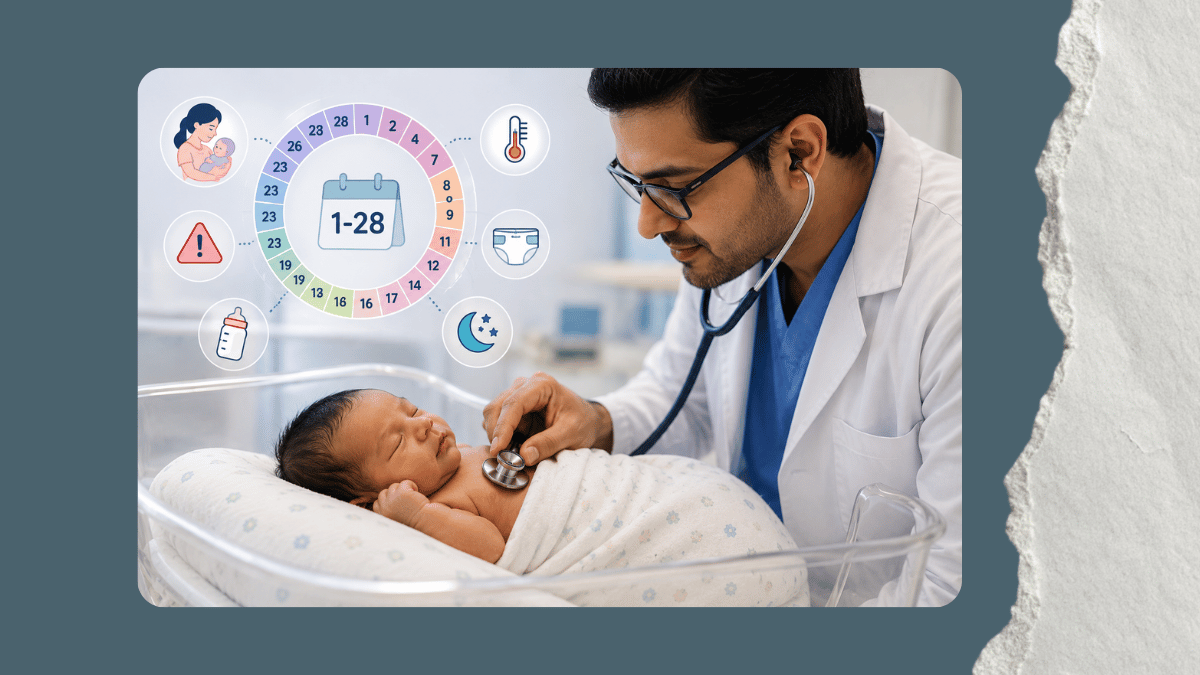
The first twenty-eight days of a baby's life - what we call the neonatal period - are unlike any other time in human development. More physiological changes happen during these four weeks than in any comparable period afterwards. The baby transitions from a warm, fluid-filled environment where every need was met by the placenta, to a world where the lungs must breathe, the gut must feed, the liver must process, the immune system must engage, and the brain must begin to organise its experience of a completely new sensory world. I am Dr. Shrikant Giri, Neonatologist, Director of Shri Shishu Bhawan, and Coordinator of the DNB Postgraduate Institute in Bilaspur, Chhattisgarh. As a Registered NRP Instructor for both IAP and NNF, State Basic NRP Coordinator, and Regional Advanced NRP Instructor with over 20 years of newborn care experience, I have spent my career supporting families through these critical first weeks. This guide is written for every parent who wants to understand what a normal newborn looks like, what changes warrant attention, and what should never be waited on.
The First Hours: What Happens When Your Baby Arrives
The transition from womb to world begins in seconds. At birth, the umbilical cord is clamped, and for the first time, the baby must oxygenate its own blood through its own lungs. The lungs, which were filled with fluid throughout pregnancy, must clear that fluid and begin exchanging oxygen and carbon dioxide within minutes. In a healthy term baby, this happens almost invisibly - a few vigorous breaths, a cry, and the transition is underway. The colour changes from bluish-purple to pink as oxygenated blood circulates. Body temperature begins to drop, which is why immediate skin-to-skin contact with the mother is so important - it stabilises temperature, calms the baby, and initiates early breastfeeding. At Shri Shishu Bhawan, our NICU team is present for every high-risk delivery, and our MATRIARCH Hospital ensures that normal deliveries receive the same careful newborn assessment that allows us to catch early concerns before they escalate.
The Apgar score, assessed at one minute and five minutes after birth, gives a rapid numerical summary of the baby's respiratory effort, heart rate, muscle tone, reflex response, and colour. A score of seven or above at five minutes is reassuring. Lower scores prompt immediate clinical response. This assessment, used universally around the world, was designed to standardise what an experienced clinician does instinctively - and in our hands, it remains a valuable first signal.
Normal Newborn Appearance: What Parents Should Know
New parents are sometimes alarmed by how their baby looks in the first hours and days - and understandably so, because a newborn's appearance is quite different from what most people expect. Most of this is entirely normal.
Skin and colour
A newborn's skin may appear mottled, blotchy, or have a bluish tinge to the hands and feet in the first day or two, which is called acrocyanosis and is usually normal. The body itself should be pink. Jaundice, a yellow tinge to the skin and whites of the eyes, commonly appears from day two or three and is discussed in detail below. Vernix, a white waxy coating, may cover parts of the body at birth. Lanugo, fine downy hair, may be present on the back and shoulders. All of these are normal. What is not normal is persistent central blueness - affecting the face, lips, and trunk rather than just the hands and feet - which requires immediate assessment.
Head shape
The baby's head may appear cone-shaped or asymmetrical after a vaginal delivery due to moulding during passage through the birth canal. This typically resolves within a day or two. A soft spot on the top of the head, the anterior fontanelle, is normal and should feel flat when the baby is calm and upright. A bulging fontanelle is a warning sign.
Weight loss in the first week
It is completely normal for a newborn to lose up to 10 percent of their birth weight in the first few days as they lose fluid and establish feeding. Most babies regain their birth weight by 10 to 14 days. Weight loss greater than 10 percent, or failure to regain birth weight by two weeks, warrants a feeding assessment.
Feeding in the First 28 Days
Feeding is the central activity of the neonatal period, and getting it right is one of the most important things families can do for their baby's health. Breast milk is the optimal first food for almost all newborns. It contains the right balance of nutrients, antibodies that protect against infection, growth factors that support gut development, and bioactive components that influence the developing immune system in ways that formula cannot replicate.
Establishing breastfeeding
Early breastfeeding, ideally within the first hour after birth, supports milk production and helps the baby learn effective latch and suckling. The first milk, colostrum, is thick, yellowish, and produced in small volumes - and this is correct. The newborn's stomach is tiny at birth, and colostrum is exactly what it needs. Mature milk comes in between day two and five. Signs that breastfeeding is going well include: the baby is feeding eight to twelve times in twenty-four hours, the baby can be heard swallowing during feeds, the baby has at least six wet nappies per day by day four, stools are transitioning from dark meconium to yellow by day four to five, and the baby appears settled after feeds and is gaining weight from around day 5.
When formula is needed
There are specific clinical situations where formula supplementation or full formula feeding is medically indicated - very low birth weight babies, babies who cannot breastfeed due to certain maternal medications, or situations where breastfeeding is not possible. This decision should be made with your paediatrician based on individual clinical circumstances, not because of feeding difficulties that a lactation consultant could address.
Neonatal Jaundice: What's Normal and What Isn't
Jaundice is one of the most common conditions I see in newborns, affecting more than half of all term babies in the first week of life. It is caused by bilirubin, produced when the normal breakdown of red blood cells occurs after birth. A newborn's immature liver cannot always process bilirubin fast enough, causing it to accumulate and produce the characteristic yellow tinge to the skin and eyes.
Physiological jaundice - the normal kind - appears after 24 hours of life, peaks around day three to five, and resolves by two weeks in term babies. Jaundice appearing before 24 hours of life is always pathological and requires urgent evaluation. Very high bilirubin levels, if untreated, can cause brain injury through a condition called kernicterus - which is entirely preventable with timely treatment. Premature babies require treatment at lower bilirubin levels than term babies because their brains are more vulnerable. At Shri Shishu Bhawan, I use transcutaneous bilirubin measurement alongside serum bilirubin levels to monitor jaundice without unnecessary blood tests - this approach is supported by my published research on bilirubin measurement in preterm neonates. Treatment with phototherapy is safe, effective, and when started promptly, prevents the need for exchange transfusion in the vast majority of cases.
Breathing Patterns in Newborns
Newborns breathe differently from older children and adults. Normal newborn breathing is irregular - they may breathe fast for a few breaths, then slow, then pause briefly before resuming. This pattern, called periodic breathing, is normal in healthy term babies. What is not normal is a sustained respiratory rate above 60 breaths per minute, visible use of the neck, chest wall, or abdominal muscles to assist breathing, a grunting sound with each breath, nasal flaring, or skin drawing in between the ribs or below the ribcage with each breath.
These signs of respiratory distress require immediate evaluation. They can indicate infection, fluid in the lungs, low blood sugar, or other conditions that are manageable when identified early. As a Regional Advanced NRP Instructor, I train healthcare professionals across Chhattisgarh in recognising and responding to neonatal respiratory problems, and the same principles apply to parents at home: any visible effort to breathe in a newborn is a reason to seek care urgently.
Umbilical Cord and Skin Care
The umbilical cord stump, where the cord was clamped and cut at birth, dries and typically falls off between one and three weeks after birth. It should be kept clean and dry. Some normal appearance changes include gradual darkening and shrinking - this is the cord drying naturally. Signs of infection include redness spreading onto the skin of the abdomen around the base, warmth, swelling, discharge with an unpleasant smell, or a baby who appears unwell. Cord infection, or omphalitis, can spread rapidly in newborns and requires prompt medical attention.
Newborn skin needs minimal intervention. Sponge baths are appropriate until the cord falls off. Avoid using adult soaps, talcum powder, or strongly scented products. Most newborn skin rashes in the first month are benign, including erythema toxicum, which is a blotchy red rash that comes and goes in the first few days, and milia, tiny white spots on the nose and cheeks. Neither requires treatment. A rash associated with fever, pustules, or a baby who appears unwell is a different matter and requires professional assessment without delay.
Understanding Newborn Sleep
Newborns sleep between 14 and 17 hours per day in fragmented cycles, waking every two to three hours to feed. Their sleep cycles are shorter than adult cycles and contain proportionally more active or REM sleep, which is believed to support brain development. Parents should not expect consolidated overnight sleep in the neonatal period, and any advice suggesting a newborn should sleep through the night is not appropriate for this age.
Safe sleep practices in the neonatal period are critically important. Place the baby on their back for every sleep, on a firm flat surface, without soft bedding, pillows, bumpers, or loose items in the sleep space. Room-sharing without bed-sharing is recommended. The relationship between safe sleep positioning and sudden infant death is well established, and back sleeping has dramatically reduced SIDS rates in populations where it is consistently practiced.
Vaccinations in the First Month
The first vaccinations a baby receives, BCG and the first dose of Oral Polio Vaccine, are given at birth. Hepatitis B vaccination is also recommended at birth in the National Immunisation Schedule of India. These vaccines are safe and important - BCG specifically protects against severe forms of tuberculosis in infants, which remains a real concern in India, including in Chhattisgarh. Mild reactions at the BCG injection site, including a small lump that may develop into a pustule and eventually a scar, are expected and are signs that the vaccine has worked. The Hepatitis B birth dose is particularly important for babies born to mothers with hepatitis B infection, where it substantially reduces the risk of vertical transmission from mother to child.
Warning Signs: When to Seek Emergency Care Immediately
Twenty years of neonatal medicine and NRP instruction have given me a very clear sense of which signs in a newborn require a family to act immediately rather than wait and see. I want every parent reading this to know these signs. Do not wait for morning, do not call a relative first, do not search online - go to a hospital.
Seek emergency care immediately if your newborn has any of the following:
A blue or grey colour to the face, lips, or trunk. Breathing that is very fast (above 60 per minute), very laboured, or that has stopped. Fits or seizures - rhythmic jerking, eye deviation, or stiffening. Extreme limpness or a baby who cannot be roused. Bulging of the soft spot on the top of the head. Fever of 38 degrees Celsius or higher in a baby under 3 months. Inability to wake for feeds over an extended period. Projectile vomiting, particularly after every feed. Blood in the stool or vomit. Jaundice appearing in the first 24 hours, or jaundice that looks very intense and is spreading to the palms and soles.
These are not situations for observation at home. Newborns deteriorate faster than older children, and what is a manageable problem at presentation can become a critical one within hours. At Shri Shishu Bhawan, our NICU and emergency team are available for exactly these presentations, and early arrival changes what is possible.
Newborn Screening: What Should Be Tested
Newborn screening programmes identify conditions that are present at birth but not yet symptomatic, allowing treatment to begin before the baby is harmed. In India, the recommended screenings include hearing assessment using Otoacoustic Emissions testing, pulse oximetry to screen for critical congenital heart disease, and metabolic screening where available. Congenital hypothyroidism is one of the most important conditions screened for - it is common, causes intellectual disability if untreated, and is straightforward to treat with thyroid hormone replacement when caught early. I encourage all families at Shri Shishu Bhawan to complete the recommended newborn screenings before discharge.
Developmental Milestones in the First Month
By the end of the first month, a healthy newborn is making real developmental progress, even if it does not look dramatic from the outside. The baby will begin to briefly lift the head when placed on the tummy. The baby will fix on faces and track a slowly moving object. The baby will respond to sound, turning toward a voice or startling at a loud noise. The baby will begin to show social smiling toward the end of the month - though this is variable. These are not things to test relentlessly or worry about if they happen a day or two later than expected in a particular baby. They are signs that the brain is developing its connections and that the baby is beginning to engage with the world outside the womb.
The Role of the Neonatologist: When to Involve a Specialist
In most cases, a well baby at term will be managed through the first month by a paediatrician, with the family playing the central role at home. A neonatologist becomes involved when the baby was born premature, has a condition identified in the NICU, has warning signs that require specialist evaluation, or has a condition such as HIE, sepsis, or significant respiratory distress that needs intensive care.
I have published research on therapeutic hypothermia for hypoxic-ischaemic encephalopathy, on cranial ultrasonography in newborns, and on POCUS guidance for umbilical vein catheterisation - techniques that are directly relevant to the most critically ill newborns I manage. At Shri Shishu Bhawan, we also provide structured NICU follow-up after discharge, which is important because premature and sick newborns benefit from ongoing developmental and medical monitoring beyond the neonatal period. As Mentor and Facilitator for SNCUs in tribal districts of Chhattisgarh, I have worked to extend this level of care to families in areas where access to specialist neonatal services has historically been limited. The first 28 days are not just the beginning of a baby's life. They are the foundation on which everything that follows is built. Getting the support right in this period - clinical, educational, and emotional - changes outcomes in ways that last a lifetime.
To book a consultation with Dr. Shrikant Giri at Shri Shishu Bhawan or MATRIARCH Mother and Child Hospital, Bilaspur, Chhattisgarh (Monday to Saturday 9 AM to 5 PM and 7 PM to 9 PM, Sunday 12 PM to 2 PM), call +91 93009 89803.
Written by Dr. Shrikant Giri, MBBS (Pt. J.N.M. Medical College, Raipur, 1999), MD Paediatrics (Gandhi Medical College, Bhopal, 2002), Fellowship in Critical Care (IAP, 2003), DPAA, FAAP, Registered NRP Instructor (IAP and NNF), State Basic NRP Coordinator, Regional Advanced NRP Instructor, Director - Shri Shishu Bhawan, Coordinator - DNB Postgraduate Institute, Bilaspur, Chhattisgarh.
Related reading
Know Your Doctor: Paediatric Allergy and Asthma Specialist in Bilaspur | Dr Shrikant Giri
The Power of Trust: Building Strong Partnerships Between Parents and Doctors
Raising Resilient Children in a Digital World: Lessons Every Parent Should Know




Add a Comment