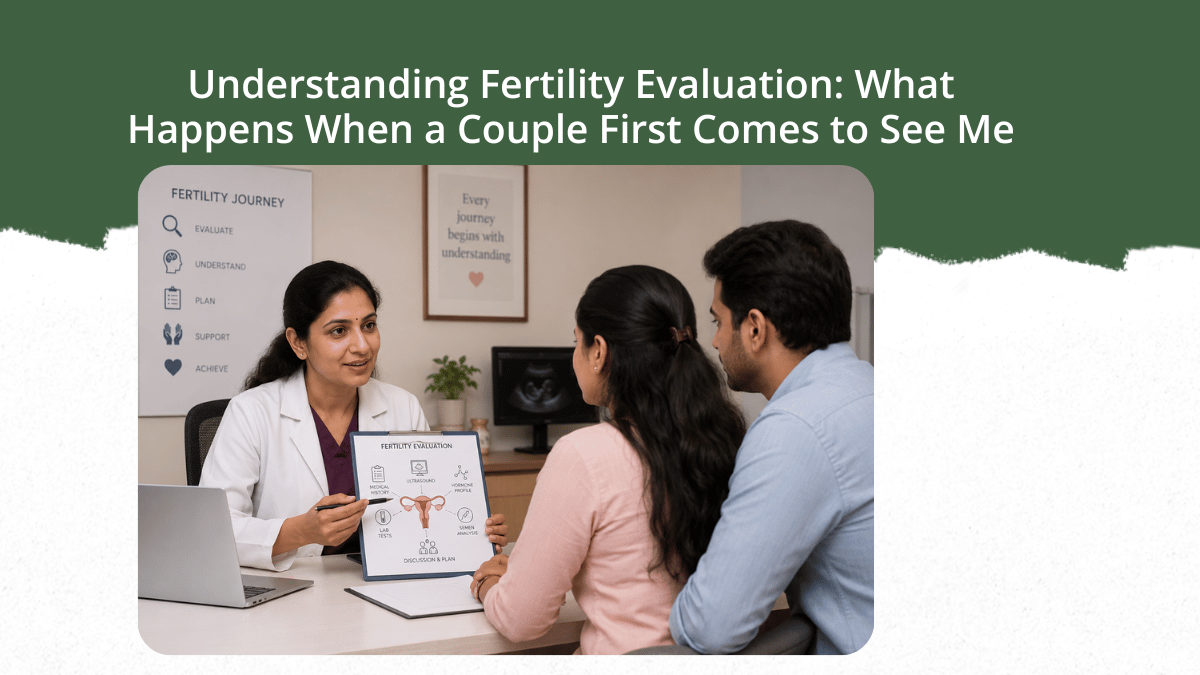
When a couple walks through the door at Birthright Fertility by Rainbow Hospitals, Banjara Hills, Hyderabad, the first thing I want them to feel is that they are being heard. Behind every fertility consultation is a story - months or sometimes years of trying, hoping, and worrying. The first step in helping any couple is not a test or a procedure. It is a careful, thorough conversation. In over 28 years of practice, I have found that the information a couple shares in that first consultation gives me more clinical insight than almost anything else. The fertility evaluation process begins here, and what I am learning during this conversation shapes every decision that follows.
What we talk about in the first consultation
I ask about how long the couple has been trying, because the definition of infertility — typically one year of regular unprotected intercourse without conception, or six months if the woman is over 35 — matters in deciding how urgently to investigate. I ask about the regularity of the woman's menstrual cycle, because a regular cycle is a good indicator of ovulation, while irregular cycles may point toward conditions like PCOS or thyroid dysfunction. I ask about any coital difficulties, because these can sometimes be the entire explanation. I ask about lifestyle - smoking, alcohol, body weight, stress, the nature of their daily routines - because lifestyle factors in fertility are modifiable and often overlooked. I also take a history of any previous pregnancies, investigations, or treatments, and ask about medical conditions in both partners that may be relevant.
Physical examination and investigations
After the consultation, a thorough general physical examination is done for both partners. For the female partner, a pelvic ultrasound is performed to evaluate the uterus and ovaries. This tells me about the integrity of the uterine cavity, the presence of fibroids, polyps, or adenomyosis that might impair implantation, the appearance of the ovaries, and crucially the antral follicle count - the number of small resting follicles visible on ultrasound, which is one of the most reliable indicators of ovarian reserve. Any pelvic pathology such as ovarian cysts, hydrosalpinx, or features suggesting adhesions is also noted.
The next step is assessing the fallopian tubes and uterine cavity. A hysterosalpingogram (HSG) or sonosalpingogram (SSG) is performed to confirm that the uterine cavity is clear and that the fallopian tubes are open and capable of allowing the egg and sperm to meet. Blocked tubes are one of the most common causes of infertility, and this investigation identifies them clearly.
Hormonal tests are an essential part of the assessment. I routinely check FSH and LH (which together reflect pituitary signalling to the ovaries), TSH (thyroid function, as thyroid disorders are a common and treatable cause of infertility), prolactin (elevated levels can suppress ovulation), and AMH (anti-Mullerian hormone, a direct measure of ovarian reserve that complements the antral follicle count on ultrasound). For the male partner, a semen analysis is performed to assess sperm count, motility, morphology, and other parameters. Male factor infertility contributes to approximately half of all infertility cases, and the semen analysis is non-invasive and essential.
Taken together, this evaluation — the history, examination, ultrasound, tubal patency test, hormonal profile, and semen analysis — gives a comprehensive picture of the couple's reproductive health and points clearly toward the most likely cause of their difficulty in conceiving. Treatment is then planned based on these findings, not on assumptions. Every couple is different, and the evaluation ensures that every treatment plan is built on an accurate diagnosis.
To book a fertility evaluation consultation with Dr Sudharani Bairraju at Birthright Fertility by Rainbow Hospitals, Banjara Hills, Hyderabad, call 07337390606.
Written by Dr Sudharani Bairraju, MBBS (Sri Venkateswara Medical College, Tirupathi, 1997), DNB Obstetrics and Gynaecology (St Theresa's General Hospital, Hyderabad, 2007), Postgraduate Certification in Clinical Embryology, Fellowship in Minimally Invasive Surgeries, Fellowship in Advanced Gynaecological Endoscopy, Senior Consultant Obstetrician and Gynaecologist, Infertility (IVF) Specialist and Laparoscopic Surgeon, Birthright Fertility by Rainbow Hospitals, Banjara Hills, Hyderabad.
Related reading
AGE MATTERS Declining Fertility with Age
How Lifestyle Choices Impact Fertility – A Doctor’s Perspective from the Frontlines
What Is Unexplained Infertility Insights from a Fertility Expert

Add a Comment