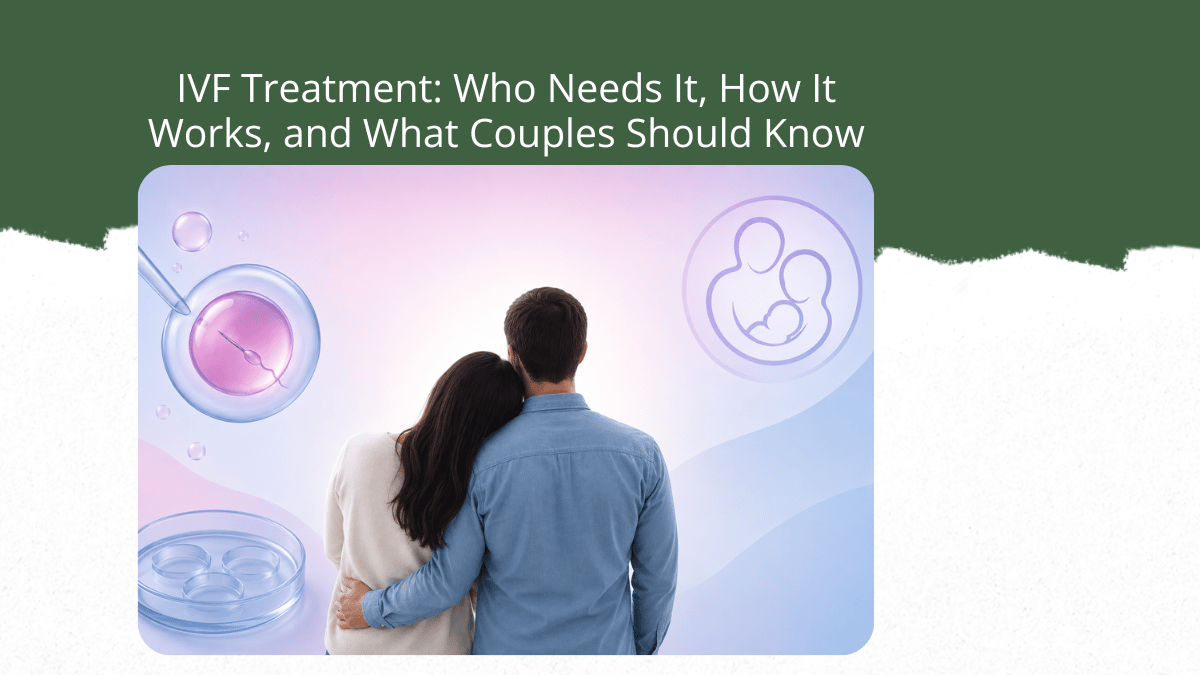
In my practice, I meet many couples who are emotionally exhausted, confused, and uncertain about when IVF is truly necessary. For many couples, IVF is not just a medical treatment but an emotional decision. Empathetic counselling plays a significant role in alleviating their anxiety and makes them receptive to the treatments suggested.
Having performed more than 500 IVF procedures and with additional training in Clinical Embryology, I believe fertility treatment should always balance medical science with ethical and individualised decision-making.
Who needs IVF and who may not need it immediately?
Not every couple struggling with infertility requires IVF immediately. The decision for IVF depends on the age of the woman, ovarian reserve, sperm quality, duration of infertility, and previous treatment responses.
IVF is indicated in the following conditions:
- Tubal blockage
- Severe male factor infertility
- Advanced endometriosis
- Reduced ovarian reserve with advanced age of the woman
- Unexplained infertility with previous multiple failed IUI cycles
- Fertility preservation (Oocyte freezing)
Ovulation induction and simpler fertility treatments are suggested as the first option for young women less than 37 years, with good ovarian reserve, patent tubes, normal semen analysis, and shorter duration of infertility with no previous treatments taken.
These may include:
- Ovulation induction and timed intercourse guidance
- Intravaginal insemination (IVI) if there is a performance difficulty
- Intrauterine insemination (IUI)
My approach to fertility treatment
I go with individualised fertility care. My decision of treatment depends not only on the results of their fertility evaluation but also their social and psychological aspects. I explain and make the patient understand as to why that particular treatment is suggested to them. I believe that patients will be comfortable and receptive when they are involved in decision making.
Comprehensive fertility evaluation helps identify the underlying cause of infertility and supports individualised fertility treatments.
What does a fertility evaluation of a couple include?
At the initial consultation, a complete thorough history is taken. General physical examination is done which includes checking their height, weight, BMI, Pulse, BP, SpO2, and systemic examination of heart, lungs, and abdomen. In addition, pelvis is examined in women. Later individual tests are advised.
Female fertility assessment may include hormonal profiling — FSH, LH, TSH, Prolactin, and AMH — along with ultrasound evaluation of the uterus and ovaries, ovarian reserve assessment, and uterine cavity and tubal testing (Sonohysterosalpingogram or Hysterosalpingography).
Male fertility assessment mainly includes semen analysis which covers details about sperm count, motility, morphology etc. Hormonal assessment and scrotal Dopplers in selected cases.
Couple-based evaluation helps in diagnosis and treatment planning.
What does the IVF process involve?
IVF treatment involves multiple coordinated stages including ovarian stimulation, egg retrieval, fertilisation, embryo development, and embryo transfer. The treatment usually starts from the 2nd or 3rd day of the menstrual period.
A baseline ultrasound is done to check for the number of follicles in each ovary, for presence of any cysts, and for a clean shedding endometrium. Hormone tests are done to ensure they are at baseline levels. Consent forms are signed for the procedure.
Once the reports are known, the dose of medication (injections) for stimulating the development of follicles is started. The growth of follicles is monitored regularly by ultrasound and hormone tests. Based on which, the dose adjustment and addition or change of injections is done. The patient visits the clinic for a minimum of 3 to 4 times in these 10 to 12 days for monitoring.
Once the follicles reach a mature size, under short anaesthesia, all the eggs are retrieved through the vaginal route — a procedure called egg retrieval. They are fertilised with the husband's sperm by the embryologist either by conventional IVF or ICSI. The progress of these developing embryos is further monitored in the IVF laboratory.
Post egg retrieval, the patient is discharged in 2 to 3 hours after ensuring complete recovery. She is prescribed supportive medication and all the precautions are explained.
On day 3 or day 5 of development, the embryos are transferred into the woman's uterus under ultrasound guidance. Before the transfer, the doctor discusses the quality and number of embryos available, the number to be transferred, and the number for freezing with the couple. Two weeks after the embryo transfer, the pregnancy test is done.
Ovarian stimulation
Ovarian stimulation is a process where hormonal injections are given to stimulate development of multiple follicles in the ovaries. The stimulatory injections are given for approximately 10 to 12 days. The dosage and the type of injections are decided based on the age, ovarian reserve, hormonal values, previous ovarian response, and BMI of the patient. Minor side effects like headaches, dizziness, and emotional disturbances are commonly seen in a small percentage of women.
My PG Certification in Clinical Embryology has strengthened my approach toward embryology oversight, embryo assessment, and laboratory coordination during IVF treatment.
Embryo transfer
Embryo transfer involves placing a selected embryo into the uterus using a thin catheter under ultrasound guidance. Embryo transfer can be done in the same cycle post oocyte retrieval, or the embryos are frozen to be transferred at a later time — this is called a frozen embryo transfer.
When is a frozen embryo transfer advised?
- Women at risk of ovarian hyperstimulation syndrome where multiple follicles are developed and embryo transfer in the same cycle may worsen the condition if she conceives
- When the hormones are very high
- When optimising the medical condition is needed
- Fertility preservation
The procedure is usually painless and does not require anaesthesia. Following transfer, hormonal support is continued until the pregnancy test is done.
Steps involved in frozen embryo transfer (FET)
Preparation of the endometrium is done either with hormonal medication or by the naturally developing follicle. Serial ultrasound monitoring is done to check the endometrial thickness until it reaches 7mm and above. This process is central to a successful frozen embryo transfer.
Once a sufficient thickness of endometrium is achieved, progesterone hormones are started. The number of days of progesterone depends on the day of embryo. A day 3 embryo requires 3 days of progesterone followed by embryo transfer and a day 5 embryo requires 5 days of progesterone followed by an embryo transfer.
Written by Dr Sudharani Bairraju, MBBS, DNB (OBG), Fellowship in Minimally Invasive Surgeries, Fellowship in Advanced Gynecological Endoscopy, PG Certification in Clinical Embryology, Senior Consultant Obstetrician, Gynaecologist and IVF Specialist, Birthright Fertility by Rainbow Hospitals, Banjara Hills, Hyderabad.
Related reading
linqmd.com/doctor/sudharani-bairraju/blog/iui-treatment-banjara-hills-hyderabad
linqmd.com/doctor/sudharani-bairraju/blog/unexplained-infertility-banjara-hills-hyderabad
linqmd.com/doctor/sudharani-bairraju/blog/recurrent-pregnancy-loss-banjara-hills-hyderabad
linqmd.com/doctor/sudharani-bairraju/blog/age-fertility-decline-banjara-hills-hyderabad
To book a consultation with Dr Sudharani Bairraju at Birthright Fertility by Rainbow Hospitals, Banjara Hills, Hyderabad, call 07337390606 or visit linqmd.com/doctor/sudharani-bairraju


Add a Comment