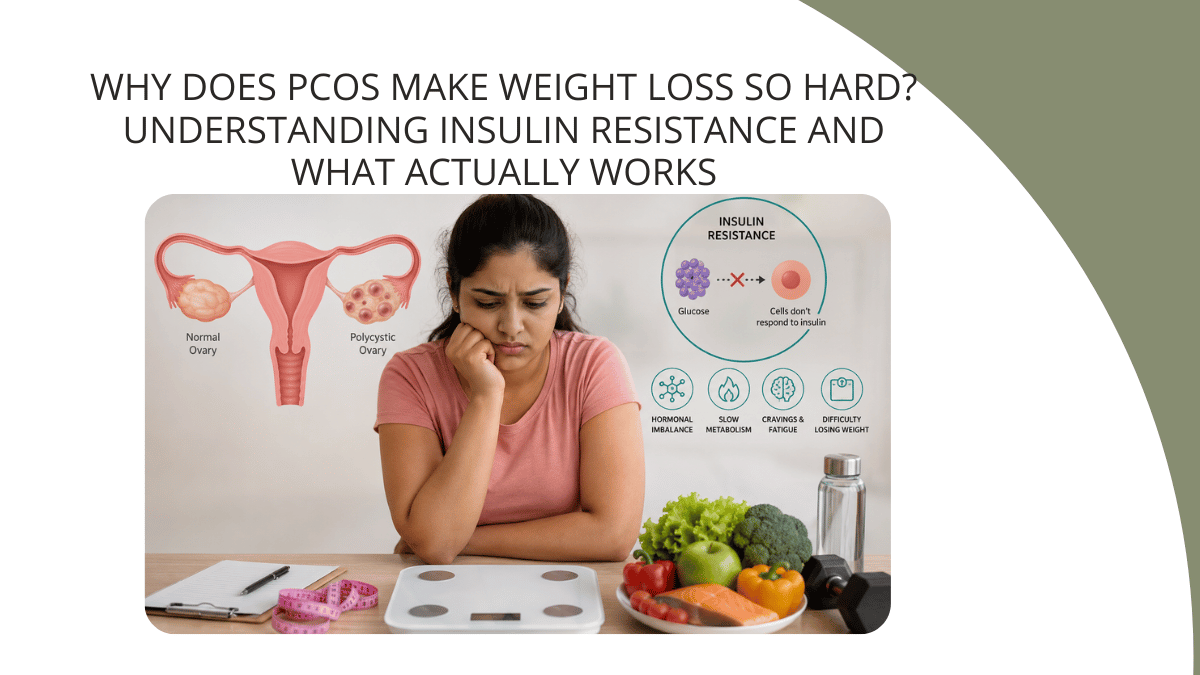
One of the most frustrating things I hear from women with PCOS is that they are doing everything right and still cannot lose weight. They are eating less, walking more, and yet the scales barely move. This is not a failure of willpower. It is a consequence of the way PCOS affects metabolism, and understanding the mechanism is the first step to doing something genuinely effective about it.
Why standard weight loss advice often does not work in PCOS
Most weight loss advice assumes the body processes carbohydrates normally. In PCOS, it frequently does not. Elevated insulin levels, a direct consequence of insulin resistance, cause the body to store fat more readily, particularly around the abdomen, and to resist releasing it even during caloric restriction. The pancreas is producing more insulin than it should to achieve normal blood glucose levels, and this chronically elevated insulin environment actively works against fat loss. Standard dietary advice, reducing calories but not specifically addressing insulin resistance in PCOS, often produces minimal results because the underlying hormonal driver remains unaddressed.
What the evidence actually supports
The dietary approach with the strongest evidence in PCOS is one that reduces the insulin response to eating, not simply one that reduces total calories. This means prioritising low glycaemic index carbohydrates over refined ones, distributing carbohydrate intake across meals rather than concentrating it, increasing protein and fibre at each meal to slow glucose absorption, and avoiding the blood glucose spikes that drive further insulin release. Resistance exercise, which builds muscle mass and directly improves insulin sensitivity, has a more meaningful impact on PCOS weight management than aerobic exercise alone for most women. Even modest weight loss of five to ten percent of body weight can produce measurable improvements in insulin sensitivity, hormonal balance, and menstrual regularity in women with PCOS.
Where lifestyle measures are insufficient, medication that directly addresses insulin resistance, particularly metformin, can be a useful adjunct. I discuss this option at Kiran Speciality Hospital, Hassan, with women whose PCOS-related metabolic dysfunction is not responding adequately to diet and exercise alone.
If you have PCOS and are struggling with weight despite consistent effort, the problem is likely hormonal rather than behavioural. A proper metabolic evaluation identifies what is driving the resistance and allows a treatment plan that actually targets the cause. To book a consultation with Dr Vineetha Kiran at Kiran Speciality Hospital, Hassan, call +91 9986619191.
Written by Dr Vineetha Kiran, MBBS, MS (Obstetrics and Gynaecology, Gold Medalist, KMC Mangalore University), Consultant Obstetrician and Gynaecologist, Kiran Speciality Hospital, Hassan, Karnataka.
Related reading
PCOS (PMOS) in Women: Symptoms, Causes, and Long-Term Management



Add a Comment