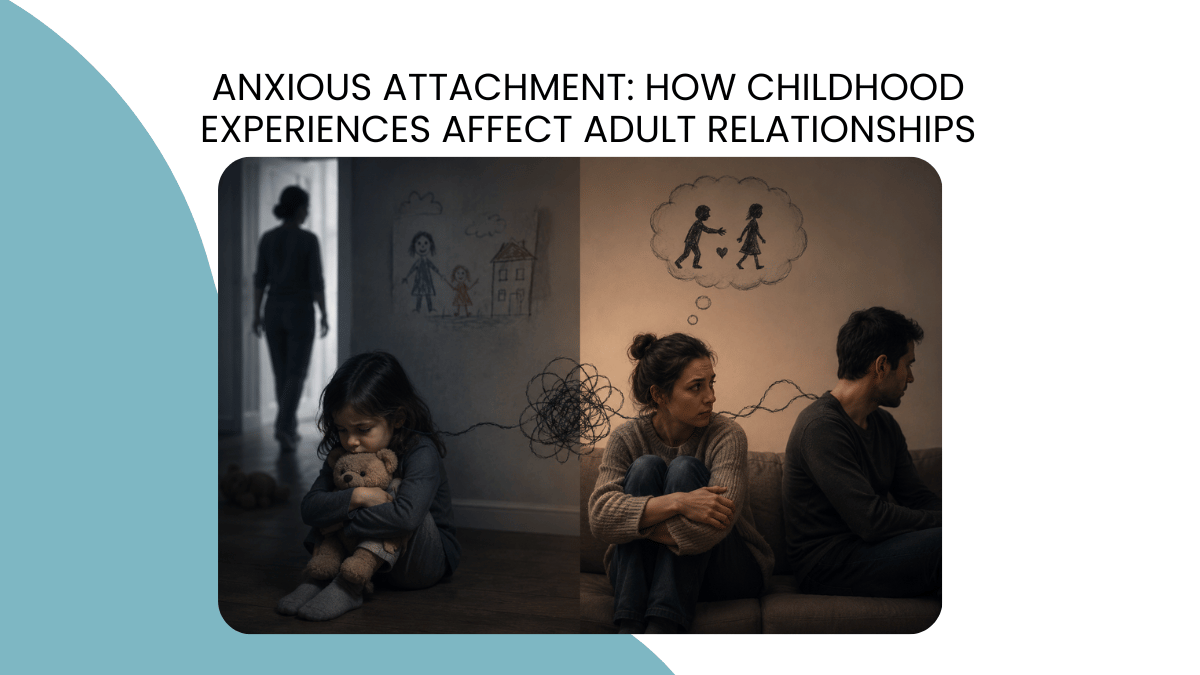
Many adults find themselves repeating the same pattern in relationships: needing constant reassurance, fearing abandonment after small conflicts, or feeling unsettled when a partner needs space. These reactions often feel illogical in the moment, yet they follow a consistent pattern that traces back to childhood, specifically to anxious attachment.
In my practice, I often meet adults who feel exhausted by repeated relationship struggles. Many describe intense anxiety when a partner becomes distant, even briefly. Over time, we often discover that these reactions are connected to attachment patterns formed much earlier in life.
What Is Anxious Attachment?
Anxious attachment is a relational pattern characterised by a deep need for closeness and reassurance, paired with a persistent fear that connection could be withdrawn at any moment. It is one of several recognised attachment styles, alongside secure, avoidant, and disorganised attachment, each shaped by the quality and consistency of early caregiving. People with an anxious attachment style often experience relationships as something to be protected and monitored, rather than simply trusted.
How Childhood Experiences Shape Attachment Styles
Anxious attachment develops early, often in response to inconsistent caregiving. A child whose caregiver was sometimes warm and responsive, and at other times distracted, dismissive, or unpredictable, learns that love and safety cannot be relied upon. The child adapts by becoming hyper-attuned to the caregiver's moods and availability, constantly scanning for signs of disconnection. This is one of the core patterns I work through with adults experiencing relationship anxiety.
This adaptive strategy, useful for a child trying to stay close to an inconsistent caregiver, becomes the template for how that same person reads closeness and distance in adult relationships. The nervous system essentially carries this early blueprint forward, applying it to partners, friends, and sometimes colleagues, long after the original caregiving relationship has changed or ended.
Signs of Anxious Attachment in Adult Relationships
In adulthood, this often shows up as a heightened sensitivity to a partner's tone, response time, or mood. A delayed text reply can trigger genuine anxiety, not because the situation is objectively alarming, but because the nervous system has learned to treat ambiguity as a threat. Many adults with this pattern describe needing frequent reassurance, struggling to feel secure even in a stable relationship, or feeling a flood of relief disproportionate to a partner simply explaining they were busy.
Why Anxious Attachment Is Not a Personality Flaw
A common misconception is that this pattern reflects a character flaw, being too needy or too sensitive. In practice, it reflects a learned survival strategy rather than a personality defect. Recognising this distinction matters, since shame tends to entrench the pattern further, while understanding its origin opens the door to actually shifting it. This is something I address early in CBT for anxious attachment, since reframing the pattern away from self-criticism is often the first real turning point.
One pattern I see often in practice is that anxious attachment is frequently mistaken for caring too much about the relationship, when it is actually the nervous system's alarm system working overtime. Helping a client see the difference is often the first real turning point in therapy, since it shifts the work from self-criticism toward genuine pattern recognition.
Can Anxious Attachment Be Changed?
The good news is that attachment style, while rooted in early experience, is not fixed. Through cognitive behavioural therapy, adults can learn to recognise the early-warning thoughts that trigger anxious reactions, build tolerance for ambiguity without needing immediate reassurance, and develop a more secure internal sense of safety that does not depend entirely on a partner's behaviour in any given moment.
Recognising your own pattern is the first practical step. Ask whether your reactions to a partner's distance are proportional to what actually happened, or whether they are responding to an old, learned fear. That gap between the present moment and the past pattern is exactly where change becomes possible, and it is often where therapeutic work makes the most meaningful difference.
When to Seek Help From a Clinical Psychologist
If you frequently experience relationship anxiety, fear of abandonment, or difficulty feeling secure in close relationships, professional support can help. Ms. Anagha Pandit, Psychologist at Child Central Clinic, Koramangala, Bengaluru, works with adolescents and adults to understand attachment patterns and develop healthier, more secure relationships.
Written by Ms. Anagha Pandit, B.A, M.A (Clinical Psychology), Fellowship in Psychology, Psychologist, CBT Practitioner, and NLP Master Practitioner, Child Central Clinic, Koramangala, Bengaluru.
👉 To book a consultation with Ms. Anagha Pandit at Child Central Clinic, Koramangala, Bengaluru, call +91 80500 35925.

Add a Comment