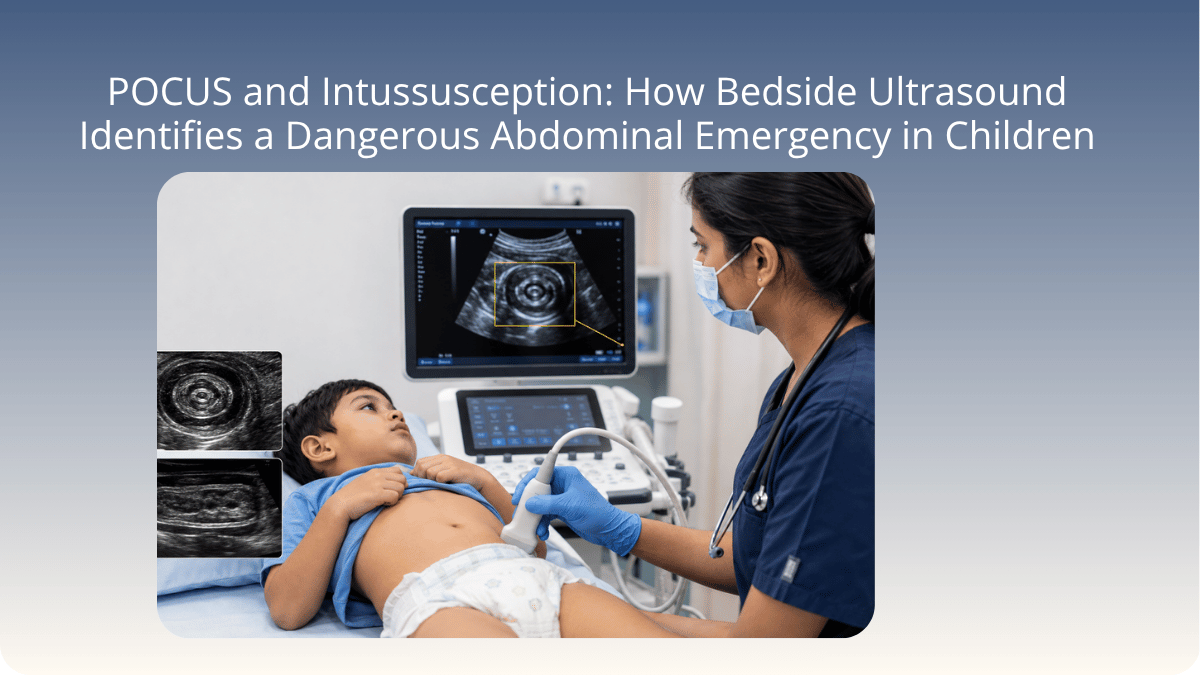
Of all the situations where Point-of-Care Ultrasonography has made the most immediate and consequential difference in my paediatric practice at Vatsalya Children's Hospital, Varanasi, intussusception stands out. It is a condition that presents deceptively, deteriorates unpredictably, and carries a narrow window for non-surgical treatment. It is also a condition where bedside POCUS identifies the diagnosis in minutes, without waiting for formal radiology, without radiation, and without moving a sick infant from the emergency department. Understanding why this matters requires understanding what intussusception is and why it is so dangerous when missed.
What is intussusception and why does it look like something else?
Intussusception occurs when one segment of the bowel telescopes into the adjacent segment, the way one section of a collapsible telescope slides inside another. As this happens, the blood supply to the invaginated bowel segment is progressively compromised. The bowel can become ischaemic and, if untreated, necrotic. In infants between 6 months and 3 years of age, intussusception is the most common abdominal surgical emergency. The classic presentation is episodic, severe abdominal pain - an infant who draws up the knees and screams inconsolably for a few minutes, then appears completely well between episodes. This pattern of colicky pain with normal intervals is characteristic. What makes intussusception dangerous is that as the condition progresses, the inter-episode intervals lengthen and the infant becomes increasingly lethargic and pale, sometimes passing a red currant jelly stool of blood-stained mucus. At this stage, bowel necrosis may already be occurring. The earlier presentation, where the infant appears relatively well between episodes, is when intervention is most effective and least risky.
The target sign and what POCUS shows
When intussusception is present, abdominal POCUS reveals a characteristic appearance that is immediately recognisable once trained: a doughnut or target sign on transverse scanning, produced by the outer and inner walls of the telescoped bowel creating concentric rings of alternating echogenicity. This sign has high sensitivity and specificity for intussusception, and when it is present, the diagnosis is established at the bedside without any other investigation. In my clinical experience at Vatsalya Children's Hospital, this finding has on numerous occasions directed immediate referral to a paediatric surgeon and arrangement of therapeutic air or hydrostatic enema, which is the first-line treatment in uncomplicated cases and successfully reduces intussusception without surgery in the majority of patients when performed promptly.
The importance of this in the context of Eastern Uttar Pradesh cannot be overstated. Families bringing a child with unexplained colicky pain to our emergency at night, having travelled from districts two or three hours away, cannot wait until morning for a formal radiology ultrasound. Without POCUS, the differential diagnosis of colicky pain in a young infant is broad, and a child with intussusception may be observed for several hours before the diagnosis is considered. With POCUS at the point of first contact, the target sign is either present or it is not - and if it is present, the management pathway begins immediately, not after a radiology wait.
To book a consultation with Dr. Chhaya Pathak at Vatsalya Children's Hospital, Mahavir Road, Orderly Bazar, Varanasi, call +91 9838585111.
Written by Dr. Chhaya Pathak, MBBS, MD (Pediatrics), Senior Consultant Paediatrician, Neonatologist and Intensivist, Pioneer of Paediatric POCUS in Eastern Uttar Pradesh, Co-Founder, Vatsalya Children's Hospital, Mahavir Road, Orderly Bazar, Varanasi, Uttar Pradesh 221002. Phone: +91 9838585111.
Related reading
POCUS in Paediatrics: How Bedside Ultrasound Is Changing the Way Children Are Diagnosed and Treated


Add a Comment