Patients arrive at my allergy clinic in Porvorim, Goa, with allergy test results in hand more often than I used to see even five years ago. The growth of panel testing, both blood-based and skin testing, offered in general clinics and diagnostic laboratories without specialist interpretation has created a specific clinical problem: a patient who has a list of twenty allergens to which their blood test shows positive IgE, but who does not have symptoms to more than two or three of them, does not know which results are clinically relevant, and has been told to avoid foods and environments that are contributing nothing to their symptoms. With 35 years of allergy practice, Fellowship in Allergy and Clinical Immunology, and as co-author of the IAP Rational Allergy Practice Guidelines published in Indian Pediatrics in 2026, the most important clinical principle I apply to every allergy test result is that the test does not make the diagnosis. The clinical history and the pattern of symptoms make the diagnosis. The test confirms or refines it.
What the Different Allergy Tests Measure
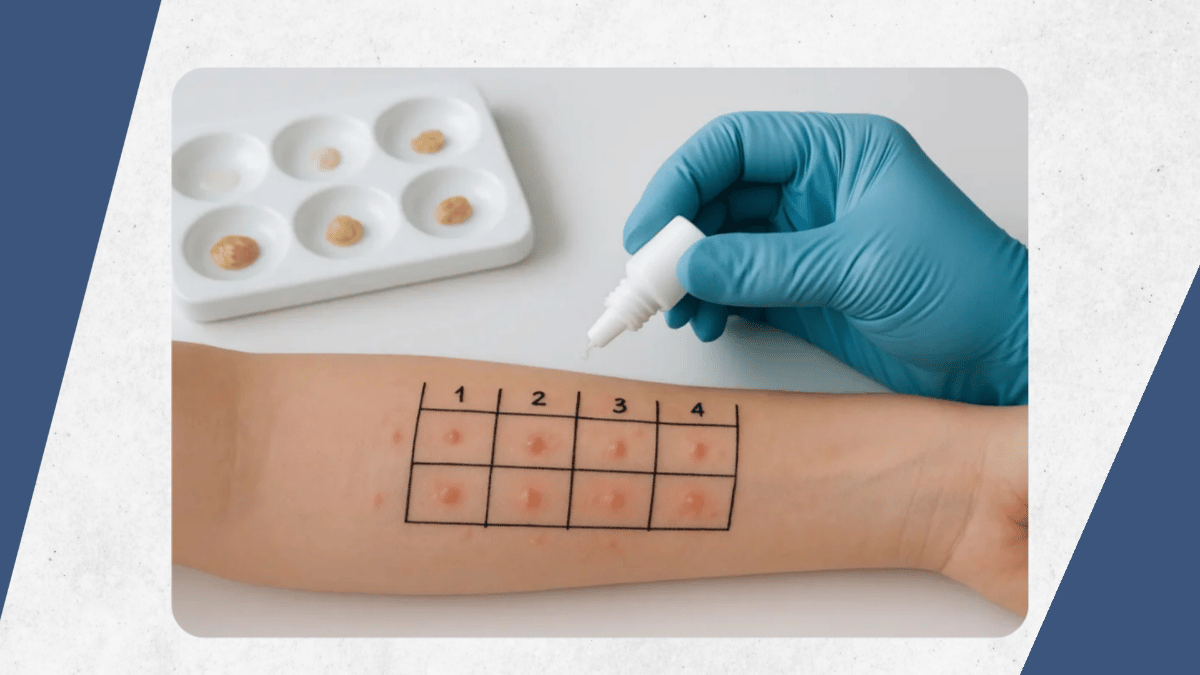
The skin prick test is the gold standard for identifying IgE-mediated allergen sensitisation and is the investigation I use most frequently in my allergy clinic in Goa. A drop of allergen extract is placed on the forearm and a fine lancet introduces a microscopic amount through the skin. After 15 to 20 minutes, the skin is read for a raised, reddened wheal response. A positive wheal at an allergen site indicates sensitisation to that allergen: the immune system has produced IgE antibodies in response to past exposure. Skin prick testing provides results within the same appointment, uses standardised allergen extracts for reliable comparison, and is well tolerated by patients of all ages including children. The serum-specific IgE blood test, commonly known as the RAST or ImmunoCAP test, measures the same IgE antibodies in a blood sample. It is preferred when skin testing is not possible, for example when the patient is on antihistamines that cannot be stopped, when there is extensive eczema on the forearms, or when the history suggests a risk of severe reaction. Patch testing is a different investigation entirely: it identifies delayed, T-cell mediated contact hypersensitivity reactions, relevant to contact dermatitis and certain drug reactions, and uses a different panel and reading schedule from IgE-based testing. Selecting the right test for the right clinical question is one of the most important decisions in allergy diagnosis, and in my Goa practice, this decision is always guided by the clinical history rather than a standard panel applied uniformly.
Why Interpreting Results Without Clinical Context Gets Patients the Wrong Answers
The most common consequence of allergy testing without specialist interpretation is unnecessary avoidance. A patient with a positive house dust mite IgE result who does not actually have dust-triggered symptoms does not benefit from encasing their mattress and washing their bedding in hot water weekly. A patient with multiple positive food IgE results who is asymptomatic after eating those foods does not need to eliminate them from their diet, and doing so may have nutritional consequences, particularly in children. Conversely, a patient with a negative standard panel result but a clear history of reactions to a specific food or environmental trigger needs further evaluation rather than reassurance that they have no allergy. The advanced allergy diagnosis training I completed, accredited by the Karnataka Medical Council, covers precisely these scenarios: how to use extended panels, component-resolved diagnostics, and provocation testing when standard testing does not match the clinical picture. At Dr. Dhanesh Volvoikar's Allergy Clinic, Porvorim, Goa, every allergy test result is interpreted in the context of the patient's full clinical history, symptom pattern, and response to previous treatments, because the number on the test report means nothing without the patient's story to give it clinical significance.
To book a consultation with Dr. Dhanesh Volvoikar at Dr. Dhanesh Volvoikar's Allergy Clinic, Shree, Oval Park, Azad Bhavan Road, Porvorim, Goa 403521 (Monday to Saturday, 10:00 AM to 1:00 PM and 5:00 PM to 8:00 PM), call +91 86695 52679.
Written by Dr. Dhanesh Volvoikar, MBBS, DPH, DCH, Fellowship in Allergy and Clinical Immunology (Saveetha Medical College, Saveetha University, Chennai, 2016), Advanced Course in Diagnosis of Allergy and Immunotherapy (Bengaluru, accredited by Karnataka Medical Council), Consultant Allergy Specialist, Dr. Dhanesh Volvoikar's Allergy Clinic, Shree, Oval Park, 15, Azad Bhavan Marg, Pundalik Nagar, Alto Porvorim, Porvorim, Goa 403521. Monday to Saturday, 10:00 AM to 1:00 PM and 5:00 PM to 8:00 PM. 35+ years. 30,000+ patients. Phone: +91 86695 52679.
Related reading
Know Your Doctor: Dr. Dhanesh Volvoikar, Allergist and Allergy Specialist in Goa



Add a Comment