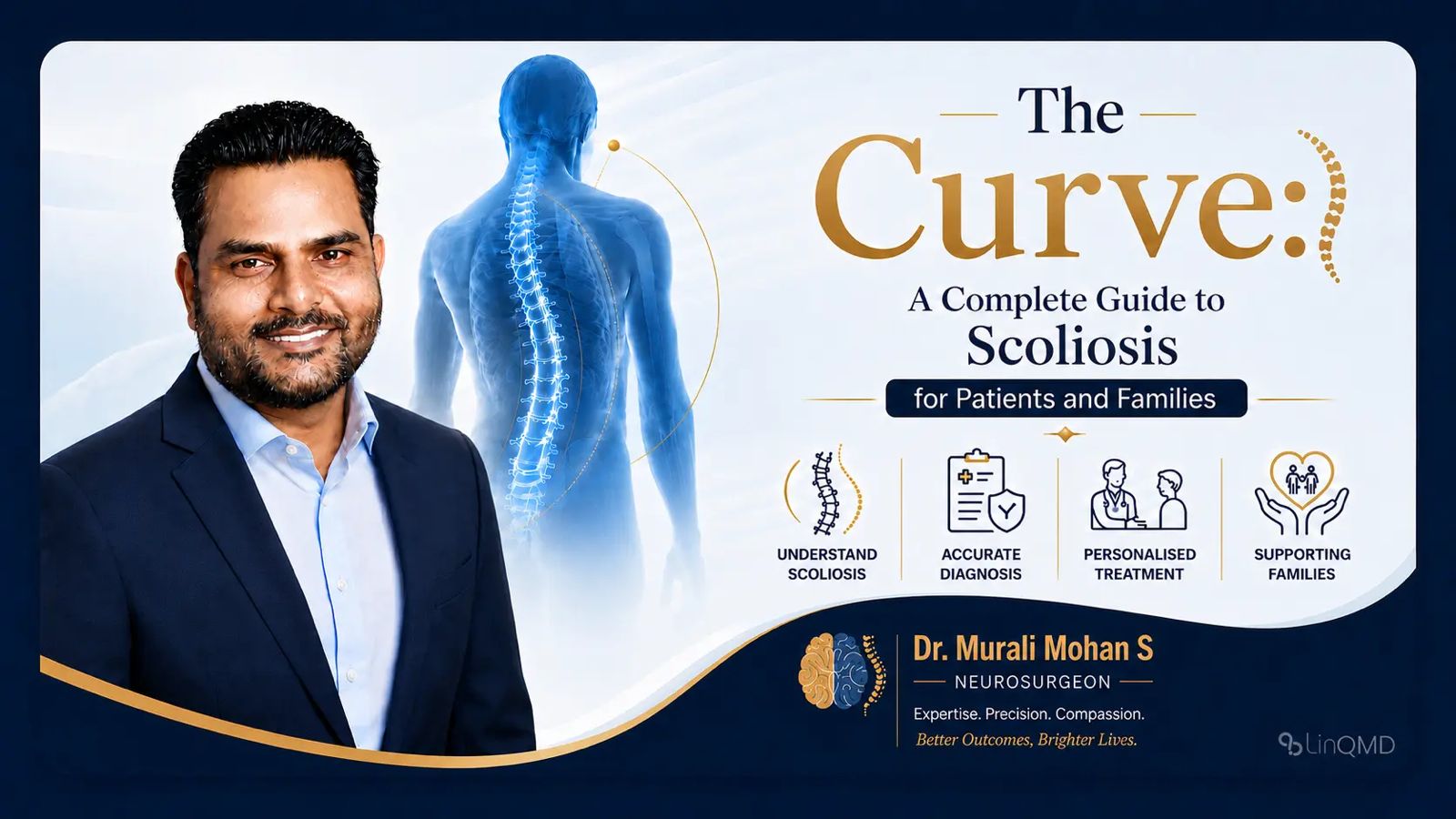
Scoliosis is a sideways curvature of the spine. It may appear in childhood, adolescence, or adulthood, and the appropriate treatment depends on the type of curve, the patient's age, remaining growth, symptoms, spinal cord findings, and whether the curve is progressing. Many curves only need observation. Some need bracing. A smaller number need surgery.
A spine is never just a column of bones.
It is the central frame of the body, the support for posture, the bridge between movement and balance, and the protective house of the spinal cord. When the spine begins to curve sideways, the change may first appear small. A shoulder may look higher. One side of the waist may seem deeper. Clothes may not sit evenly. A parent may notice that the child leans slightly to one side. A teacher may see asymmetry when the child bends forward.
This is often how scoliosis enters a family’s life.
Quietly.
For many children, especially teenagers, scoliosis does not begin with pain. It begins with shape. The child may be active, studying, playing, dancing, running, or attending school as usual. The curve may be discovered during a school screening, a routine check-up, or by a parent who notices a subtle difference during a growth spurt.
The diagnosis can be unsettling because the spine is emotionally connected to posture, appearance, confidence, movement, and the future. Parents often worry not only about treatment, but about how the child will feel, whether the curve will worsen, whether surgery will be needed, and whether life will remain normal.
The purpose of this guide is to replace panic with understanding.
What is scoliosis?
Scoliosis is an abnormal sideways curvature of the spine, usually described as an S-shaped or C-shaped curve when the spine is viewed from the back.
A normal spine has natural curves when seen from the side. These curves help with balance and shock absorption. Scoliosis is different. It is a sideways curve that may also involve rotation of the vertebrae. This rotation is why some children develop a rib prominence or “rib hump” when they bend forward.
Doctors measure scoliosis on an X-ray using something called the Cobb angle. A curve of more than 10 degrees is generally considered scoliosis. The number matters, but it is not the only thing that matters. A 20-degree curve in a child who is still growing may be more concerning than the same curve in a fully grown adult. A small curve with spinal cord abnormalities may need more detailed evaluation than a simple posture change. A larger curve that is stable may be managed differently from one that is rapidly progressing.
Scoliosis is therefore not understood by the angle alone. It is understood by the child, the curve, the cause, the growth pattern, the symptoms, and the full spine and nervous system.
Why does scoliosis occur?
Scoliosis can occur for various reasons, and in many children the exact cause is unknown.
The most common form in teenagers is adolescent idiopathic scoliosis. “Idiopathic” means there is no single identifiable cause. It is not caused simply by poor posture, laziness, or carrying a heavy school bag. It often appears during the rapid growth phase around puberty and may be noticed more commonly in girls.
There may be genetic, growth-related, hormonal, muscular, and biomechanical factors involved, but in most cases, families should not blame themselves. A parent noticing scoliosis late does not mean the parent caused it. A child having scoliosis does not mean the child did something wrong.
Some scoliosis is congenital. This means the child is born with structural differences in the vertebrae. One part of the spine may not have formed normally, or two vertebrae may not have separated properly during development. These curves can behave differently from adolescent idiopathic scoliosis and may need closer evaluation.
Some scoliosis is neuromuscular or neurogenic. In these cases, the curve develops because the muscles and nerves that support posture are affected by an underlying condition. This may happen in children with cerebral palsy, spinal muscular atrophy, muscular dystrophy, spinal cord problems, or other neurological conditions. These curves may progress because the trunk muscles are not able to hold the spine upright.
In adults, scoliosis may be a continuation of a curve that began earlier in life, or it may develop because of age-related degeneration of discs and joints. Adult scoliosis is often discussed differently because pain, nerve compression, walking difficulty, and spinal stenosis may become more important than appearance alone.
The word scoliosis is one word. But the reasons behind it are many.
What are the types of scoliosis?
Scoliosis is usually classified according to cause and age.
Adolescent idiopathic scoliosis is the most commonly recognised type. It appears in children and teenagers, usually around the adolescent growth spurt. Many children with this type are otherwise healthy and active. The main concern is whether the curve will progress as the child grows.
Infantile and juvenile scoliosis occur in younger children. These require careful follow-up because the spine has many years of growth remaining. The younger the child, the more important it becomes to understand the cause and monitor the pattern of progression.
Congenital scoliosis is due to abnormal development of the vertebrae before birth. These curves may be associated with other spinal or systemic abnormalities. Some congenital curves remain stable, while others progress with growth.
Neuromuscular scoliosis occurs in children or adults with underlying nerve or muscle conditions. In these cases, the curve is often part of a larger medical picture that may include weakness, sitting imbalance, breathing challenges, difficulty with care, and reduced mobility.
Syndromic scoliosis occurs as part of broader genetic or connective tissue conditions. These patients may need multidisciplinary evaluation because the spine may be only one part of the condition.
Adult degenerative scoliosis develops in a mature spine because of ageing, disc degeneration, arthritis, imbalance, or collapse of spinal segments. Adults may present with back pain, leg pain, numbness, walking difficulty, or posture imbalance.
The type of scoliosis matters because treatment is never one-size-fits-all.
How does scoliosis present?
Scoliosis often presents as asymmetry rather than pain, especially in children and adolescents.
Parents may notice that one shoulder is higher than the other, one shoulder blade is more prominent, one side of the waist is more curved, one hip appears higher, or the child leans to one side. Clothes may hang unevenly. During the forward bend test, one side of the rib cage or back may rise more than the other.
In many adolescents, there may be no major pain in the early stages. This can make the condition easy to miss. A child may continue normal activities while the curve slowly progresses.
In more severe curves, or in adults, symptoms may include back pain, muscle fatigue, imbalance, difficulty standing for long periods, nerve pain, numbness, weakness, or walking difficulty. Very severe curves, especially thoracic curves, may affect breathing mechanics, though this is not common in mild adolescent scoliosis.
In neuromuscular scoliosis, presentation may be different. The child may have difficulty sitting upright, may lean in the wheelchair, may develop pressure areas, may tire easily, or may have worsening breathing comfort. In such children, the curve is not only a spinal issue. It can affect daily care, feeding position, chest function, comfort, and dignity.
Scoliosis can therefore present through the mirror, through pain, through posture, through walking, or through the practical difficulties of daily life.
When should a child or adult be evaluated?
A medical evaluation is advisable when spinal asymmetry is persistent, progressive, associated with pain, or accompanied by neurological symptoms.
Parents should seek evaluation if they notice uneven shoulders, uneven waist, one shoulder blade sticking out, leaning to one side, a rib hump on forward bending, or a visible curve in the back. Evaluation is especially important during growth spurts, because curves may progress more quickly when the child is growing rapidly.
Urgent attention is needed if scoliosis is associated with weakness, numbness, walking difficulty, bladder or bowel symptoms, severe pain, rapidly worsening deformity, or signs of spinal cord involvement.
In adults, evaluation is useful when the curve is associated with persistent back pain, leg pain, nerve symptoms, walking limitation, or progressive imbalance. Adult scoliosis often needs assessment not only of the curve, but also of nerve compression, disc degeneration, bone quality, and general health.
Early evaluation does not mean early surgery. It means understanding the condition before fear, delay, or misinformation takes over.
How is scoliosis evaluated?
Scoliosis evaluation begins with listening and examination.
The doctor asks when the curve was noticed, whether it is worsening, whether there is pain, whether the child is still growing, whether puberty has begun, whether there are neurological symptoms, and whether there is a family history. In adults, the history may include pain pattern, walking distance, leg symptoms, previous treatments, and general medical conditions.
The physical examination looks at posture, shoulder and waist symmetry, trunk balance, walking pattern, flexibility, neurological function, and signs of associated conditions. The forward bend test is commonly used to look for rib or back prominence caused by spinal rotation.
Standing X-rays are usually required to measure the curve using the Cobb angle and to assess overall spinal balance. In growing children, X-rays may also help estimate skeletal maturity. This matters because a child with more growth remaining has a higher chance of curve progression.
MRI may be advised in selected cases. It is particularly important when scoliosis is congenital, rapidly progressive, painful, associated with neurological signs, seen in very young children, or when there is suspicion of spinal cord abnormalities such as tethered cord, syrinx, or split cord malformation.
CT scans may be used selectively to study complex bony anatomy, especially in congenital deformities or pre-surgical planning. Pulmonary function tests may be needed in severe curves or neuromuscular scoliosis, where breathing mechanics are part of the treatment decision.
Good evaluation is not about ordering every test. It is about asking the right question and choosing the test that answers it.
How is scoliosis treated?
Scoliosis treatment depends on the type and size of the curve, the patient's age, remaining growth, symptoms, risk of progression, neurological findings, and impact on life.
Many mild curves are observed. Observation means regular clinical review and periodic imaging when needed. It is not neglect. It is a planned decision to watch a curve that may not require active intervention.
Bracing is mainly used in growing children and adolescents with curves at risk of progression. A brace does not usually "cure" scoliosis or make an existing curve disappear. Its purpose is to reduce the chance of progression while the child is still growing. Bracing works best when it is prescribed for the right curve at the right time and when the child is supported emotionally and practically to wear it as advised.
Physiotherapy and scoliosis-specific exercises may help posture, strength, breathing awareness, flexibility, and confidence. Exercises should not be sold as magical correction for every curve, but they can play an important role in selected patients, especially as part of a structured care plan.
Pain management may be important in adults or in children with discomfort. This may include activity modification, supervised therapy, medications when appropriate, and evaluation for other causes of pain.
Surgery is considered when the curve is severe, progressive, functionally significant, neurologically complex, or likely to cause future problems. Surgery is not the default treatment for scoliosis. It is one option within a larger decision-making pathway.
The best treatment is the one that fits the patient, not the one that sounds most dramatic.
What is life like with scoliosis?
Life with scoliosis depends on the severity of the curve, the type of scoliosis, the patient's age, and the emotional environment surrounding the diagnosis.
Many children with mild or moderate scoliosis continue school, sports, hobbies, travel, friendships, and normal routines. Some may need regular follow-up. Some may need a brace. Some may feel self-conscious, especially during adolescence. Emotional support matters because a visible difference in posture can affect confidence, body image, clothing choices, and social comfort.
Families should avoid making scoliosis the child’s entire identity. The child is not “a scoliosis patient” first. The child is a student, dancer, musician, athlete, reader, friend, sibling, and growing person who happens to have a spinal curve.
If bracing is needed, the family's role is important. A brace may be physically uncomfortable and emotionally difficult. The child may worry about how it looks, whether friends will notice, and whether life will change. An honest explanation, practical clothing adjustments, school sensitivity, and reassurance can make a major difference.
In adults, life with scoliosis may involve managing pain, maintaining activity, preserving strength, improving posture, and seeking care if nerve symptoms appear. Not every adult curve needs surgery. Many adults benefit from planned conservative care, while some require surgical evaluation.
The goal of scoliosis care is not simply a straighter X-ray. It is a better life around the spine.
When is scoliosis surgery needed?
Scoliosis surgery is considered when the expected benefit of surgery outweighs the risks of continued progression or disability.
In adolescent idiopathic scoliosis, surgery may be discussed when curves are severe, especially when they are progressing and the child still has growth remaining, or when the curve reaches a range where worsening into adulthood is a concern. In many settings, curves around 45 to 50 degrees or more are commonly evaluated for surgery, but the decision is individualized.
In congenital scoliosis, surgery may be considered earlier if the curve is progressing, if abnormal vertebrae are driving deformity, or if there are associated spinal cord issues that need attention.
In neuromuscular scoliosis, surgery may be considered not only to correct the curve, but to improve sitting balance, comfort, care, posture, and sometimes respiratory mechanics. The decision is complex and requires discussion with the family, neurologist, anaesthesia team, ICU team, rehabilitation specialists, and spine or neurosurgical team.
In adult scoliosis, surgery may be considered when there is disabling pain, nerve compression, walking limitation, progressive imbalance, or failure of appropriate non-surgical care. Adult surgery requires careful assessment of bone quality, general health, risks, expectations, and recovery.
Surgery usually involves correction of the curve and stabilisation of the spine using implants such as screws and rods. In some cases, spinal fusion is performed to help the corrected segments heal into a stable alignment. In selected growing children, growth-friendly techniques may be considered.
No scoliosis surgery is risk-free. Risks may include infection, bleeding, implant-related problems, non-union, pain, need for further surgery, and rarely neurological injury. This is why careful planning, neuromonitoring where appropriate, experienced anaesthesia, ICU support, and rehabilitation are important parts of modern scoliosis care.
A good surgical discussion does not promise perfection. It explains purpose, risk, alternatives, recovery, and the reason surgery is being advised.
Why does the nervous system matter in scoliosis?
The nervous system matters because the spine protects the spinal cord and nerve roots.
In simple curves, the spinal cord may not be the visible problem. But in complex scoliosis, especially congenital, neurogenic, and neuromuscular scoliosis, spinal cord abnormalities may coexist with the deformity. A child may have a tethered cord, split cord malformation, syrinx, Chiari malformation, or other associated findings that change planning.
This is where neuro-spine thinking becomes important. The surgeon must consider alignment and correction, as well as spinal cord tension, nerve function, blood supply, monitoring, and restraint. Sometimes the spinal cord must be addressed before deformity correction. Sometimes the correction must be modified because the nervous system cannot safely tolerate more.
Intraoperative neuromonitoring may be used during complex surgery to track motor and sensory pathway signals. It does not remove all risk, but it gives the team information during surgery and may help detect stress to the spinal cord or nerves early.
The safest scoliosis care is not the most aggressive care. It is the care that respects both structure and function.
What is rehabilitation after scoliosis treatment?
Rehabilitation is not an afterthought. It is part of scoliosis care.
For children being observed or braced, rehabilitation may include posture education, strengthening, flexibility work, breathing awareness, and guidance on activity. In selected cases, scoliosis-specific exercises may be recommended by trained therapists. These exercises should be understood as part of a care plan, not as a guaranteed replacement for bracing or surgery.
After surgery, rehabilitation focuses on safe mobilisation, pain control, breathing exercises, wound care, posture training, gradual return to daily activity, and long-term confidence. The pace depends on the type of surgery, the child’s general health, the underlying diagnosis, and the surgeon’s instructions.
In neuromuscular scoliosis, rehabilitation may include seating support, wheelchair adjustment, respiratory care, chest physiotherapy, caregiver training, and prevention of pressure sores. The aim may not be athletic performance. It may be comfort, sitting, breathing, hygiene, feeding, and ease of care.
Rehabilitation reminds us that the operation is only one event. Recovery is a journey.
Why teamwork matters in scoliosis care
Scoliosis care works best when it is built around a team.
The team may include a spine surgeon, neurosurgeon, orthopaedic surgeon, paediatrician, neurologist, radiologist, anaesthetist, neurophysiologist, intensivist, physiotherapist, rehabilitation specialist, orthotist, nurse, psychologist, and family. Not every patient needs every specialist. But complex scoliosis often needs more than one viewpoint.
The surgeon may correct the curve, but the anaesthetist protects the child during long surgery. The neurophysiology team watches signals. The ICU team supports recovery. The physiotherapist helps the child move again. The orthotist helps with bracing. The neurologist helps manage underlying conditions. The family carries the child through appointments, exercises, decisions, and fear.
In modern scoliosis care, the child is at the centre. Around the child is the team.
This is especially important in complex scoliosis, where the question is not only whether the curve can be corrected. The question is whether the child can be supported safely before, during, and after treatment.
What should families remember?
Families should remember that scoliosis is common enough to be recognised, complex enough to deserve evaluation, and treatable enough to offer hope in many situations.
A curved spine should not create shame. A diagnosis should not create panic. A child should not be reduced to an X-ray angle. An adult should not assume that every curve needs surgery.
The most important step is to understand the type of scoliosis, the severity of the curve, whether it is progressing, whether the patient is still growing, whether the spinal cord and nerves are safe, and what the curve means for daily life.
Awareness should lead to evaluation. Evaluation should lead to clarity. Clarity should lead to the right plan.
That plan may be observation. It may be bracing. It may be therapy. It may be surgery. It may be rehabilitation. Often, it is a combination of these over time.
The curve is part of the story. It is not the whole story.
With timely assessment, careful counselling, appropriate treatment, and family support, many people with scoliosis continue to study, work, move, participate, dream, and live with confidence.
Scoliosis care is not only about straightening the spine.
It is about helping the person stand, sit, breathe, move, grow, and live with dignity.
Written by Dr. Murali Mohan S, Consultant Neurosurgeon, Bengaluru.
This article is for patient education and public awareness.


Add a Comment