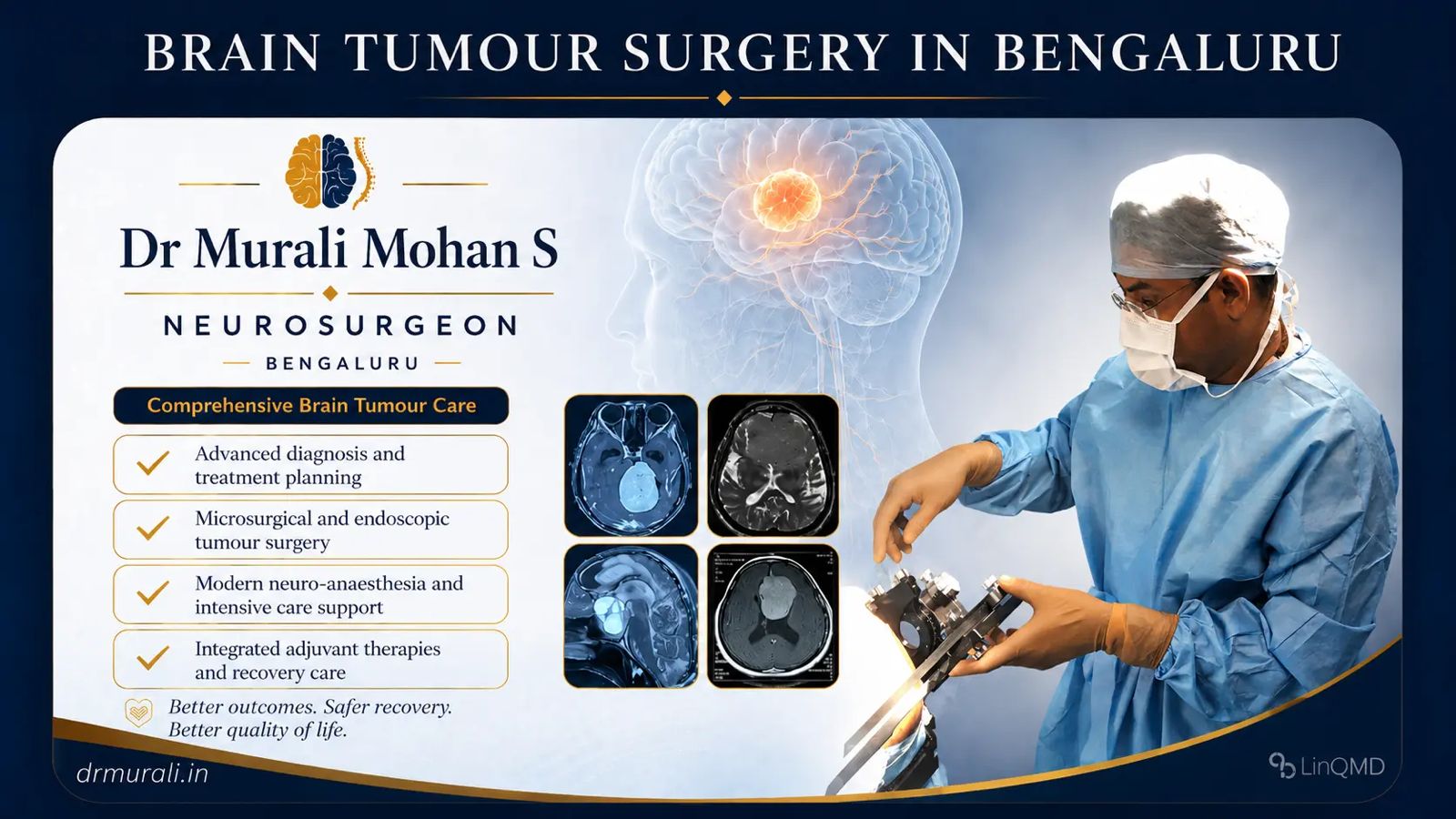
Brain tumour surgery is the treatment of abnormal growths within the brain or its coverings, carried out to remove or reduce the tumour, relieve pressure on the brain, and obtain tissue for an accurate diagnosis. Dr Murali Mohan S provides surgical care for a range of brain tumours in Bangalore, using image-guided planning and, where appropriate, awake techniques to protect healthy brain function. This page explains what the surgery involves, the types of tumour treated, the techniques used, and what recovery looks like.
What brain tumour surgery involves
The aim of surgery is to remove as much of the tumour as can be done safely, while preserving normal neurological function. Planning begins with detailed MRI and CT imaging to map the tumour and its relationship to critical areas of the brain.
Depending on the type and location of the tumour, surgery may be the only treatment needed, or it may be combined with radiotherapy or other therapy. When a tumour cannot be safely removed, a biopsy is performed to obtain a diagnosis that guides further treatment.
Types of brain tumour treated
Meningioma, a tumour arising from the coverings of the brain.
Glioma, a tumour arising from the supporting cells of the brain.
Schwannoma, including tumours of the hearing and balance nerve.
Pituitary tumour, affecting the gland at the base of the brain.
Colloid cyst, which can obstruct the flow of fluid within the brain.
Brain metastasis, a tumour that has spread to the brain from elsewhere.
Techniques used
Neuronavigation-guided surgery uses the patient's own scans as a real-time map during the operation. Awake brain surgery may be used for tumours close to areas that control speech or movement, so that function can be monitored during removal. Stereotactic biopsy allows a precise tissue sample to be taken through a small opening when removal is not the first step.
When surgery is considered
Surgery is considered after assessment of the symptoms, the imaging findings, and the likely tumour type. Common reasons for referral include persistent headaches, new seizures, weakness, or changes in vision or speech. Decisions are usually made in discussion with other specialists involved in the patient's care.
Recovery and follow-up
Recovery depends on the tumour and the surgery performed. It typically includes a period of monitoring in hospital, rehabilitation where needed, follow-up imaging, and, for some tumours, further treatment such as radiotherapy. The care team supports the patient and family through each stage.
Related reading: Meningioma Surgery · Glioma Surgery · Pituitary Tumour Surgery · Awake Brain Surgery · Neuronavigation-Guided Brain Tumour Surgery · Stereotactic Brain Biopsy
Written by Dr Murali Mohan S, [qualifications to confirm], Consultant Neurosurgeon, [hospital to confirm], Bangalore.
To book a consultation with Dr Murali Mohan S in Bangalore, visit linqmd.com/doctors/dr-murali-mohan-neurosurgeon-bangalore