At Royal Preston Hospital, I see many patients referred with neck pain and arm symptoms that have not responded to conservative measures. The cervical spine is a remarkably complex structure that supports the weight of the head, allows movement in multiple directions, and protects the spinal cord and nerves. When natural wear and tear leads to cervical spine compression, the result can be pain, weakness, numbness, balance difficulties, and loss of function significant enough to affect daily life. This guide explains what causes these problems, how they are diagnosed, and when cervical decompression surgery may be the right step.
What makes up the cervical spine?
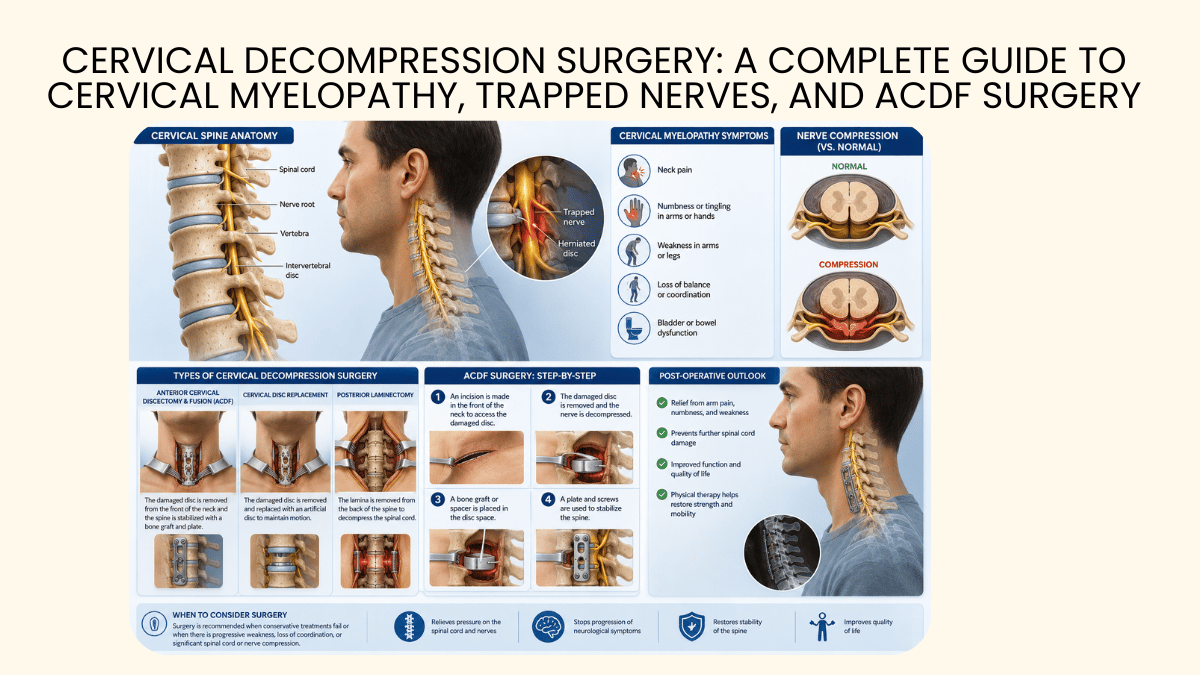
The cervical spine consists of seven vertebrae, labelled C1 to C7, separated by intervertebral discs that act as cushions and allow movement. Running through the centre is the spinal cord, one of the most important structures in the body, transmitting signals between the brain and the arms, legs, bladder, and bowel. Nerves branch from the spinal cord at each level and travel into the shoulders, arms, and hands. Because these structures occupy a limited space, even relatively small changes within the spine can sometimes produce significant symptoms.
What causes cervical spine compression?
Several conditions can narrow the spaces around the spinal cord and nerves. Degenerative disc disease causes discs to lose water content and become less flexible, bulging or collapsing and reducing available space. Disc prolapse occurs when a fragment of disc material protrudes backwards and compresses a nerve root or the spinal cord. Bone spurs, also called osteophytes, narrow the spinal canal or nerve exits. Thickened ligaments add further narrowing. Cervical stenosis refers specifically to narrowing of the spinal canal itself, placing direct pressure on the spinal cord. Many patients have a combination of these changes rather than a single abnormality.
What is a trapped nerve in the neck?
A trapped nerve occurs when a cervical nerve root is compressed, a condition doctors refer to as cervical radiculopathy. Symptoms depend on which nerve is affected but commonly include pain radiating down the arm, pins and needles, numbness, weakness, reduced grip strength, and difficulty using the hand. The pain can be severe and often extends beyond the neck into the shoulder, arm, and fingers. Many patients initially assume they have a shoulder problem when the true cause originates in the neck.
What is cervical myelopathy and why is it more serious?
While a trapped nerve affects an individual nerve root, cervical myelopathy occurs when the spinal cord itself becomes compressed. This is generally considered the more serious condition, since the spinal cord acts as the body's main communication pathway. Compression can interfere with signals travelling between the brain and the rest of the body. Symptoms may include difficulty walking, poor balance, frequent falls, loss of hand dexterity, problems with buttons or handwriting, weakness in the arms or legs, numbness, muscle stiffness, and altered bladder control. Unlike arm pain from a trapped nerve, cervical myelopathy often develops gradually and may be mistaken for normal ageing. Symptoms may continue to worsen if significant spinal cord compression remains untreated.
When should I seek specialist assessment?
You should seek medical advice if you experience persistent arm pain, progressive numbness, weakness in the arms or hands, difficulty walking, loss of balance, reduced hand function, frequent falls, bladder disturbances, or symptoms that fail to improve with treatment. Early assessment is particularly important when spinal cord compression is suspected.
How is cervical spine compression diagnosed?
A specialist will carefully assess your symptoms, their duration, their impact on daily life, previous treatments, and general health. A neurological examination will assess muscle strength, reflexes, sensation, coordination, and balance. These findings often provide important clues regarding the location and severity of compression.
MRI scan is usually the most important investigation, providing detailed images of discs, nerves, the spinal cord, ligaments, and soft tissues, allowing precise identification of where compression is occurring. A CT scan may provide additional information regarding bone spurs, previous surgery, and bony anatomy. Dynamic X-rays may be used to assess spinal alignment, movement between vertebrae, and stability.
Can cervical spine compression be treated without surgery?
Many patients improve without an operation. Treatment options may include physiotherapy, pain medication, neuropathic pain medication, lifestyle modification, and activity adjustment. In patients with cervical radiculopathy, symptoms often improve naturally over time. However, cervical myelopathy is different. Once the spinal cord becomes compressed, surgery is frequently considered because there is a risk of ongoing neurological deterioration without intervention.
When is surgery recommended?
Surgery may be considered when severe arm pain fails to improve despite conservative treatment, when progressive weakness indicates ongoing nerve damage, when significant spinal cord compression is present with clinical signs of myelopathy, when declining mobility and balance problems indicate cord involvement, or when symptoms significantly affect work, independence, or daily activities.
What does cervical decompression surgery involve?
The aim of cervical decompression surgery is to remove pressure from the spinal cord and nerves. The most common procedure performed from the front of the neck is Anterior Cervical Discectomy and Fusion, ACDF. This involves approaching the spine through a small incision in the front of the neck, removing the damaged disc and structures compressing the nerve or spinal cord, restoring disc height, inserting a cage or implant, and allowing the vertebrae to fuse together. Occasionally, a titanium plate is also used for additional stability.
What are the goals of surgery and what improves most reliably?
For cervical radiculopathy, the primary aim is relief of arm pain. Many patients experience meaningful improvement in shooting arm pain shortly after surgery. For cervical myelopathy, the primary aim is often to prevent further deterioration rather than to reverse all existing symptoms. Surgery is frequently performed to stop worsening and preserve existing neurological function. Some patients improve substantially, others experience partial improvement or stabilisation.
Arm pain, tingling, and nerve irritation symptoms are most likely to improve. Weakness, numbness, and balance show variable improvement. Chronic neck pain and long-standing neurological deficits are less predictable. Patients often achieve the greatest benefit when surgery is performed before severe and irreversible spinal cord injury develops.
What are the risks of cervical decompression surgery?
Every surgical procedure carries risks. Although serious complications are uncommon, it is important that patients understand them before proceeding. Specific risks include infection, bleeding, swallowing difficulties, voice changes from vocal cord nerve irritation, injury to the oesophagus or airway, nerve injury, spinal cord injury, stroke, failure of fusion, implant-related problems, and adjacent segment disease. General anaesthetic risks include heart complications, pneumonia, deep vein thrombosis, and pulmonary embolism. Death is a recognised but rare complication of major surgery.
Non-union, where the vertebrae fail to fuse, is more likely with smoking, diabetes, osteoporosis, or multi-level surgery. I discuss all relevant risks with each patient individually before any decision to proceed.
What does recovery look like after cervical decompression surgery?
Most patients remain in hospital for one or two nights. Neurological function is monitored immediately after surgery, pain relief is provided, and early mobilisation is encouraged. Patients are usually walking on the day of surgery or the following morning.
In the first two weeks, neck discomfort and fatigue are common alongside a gradual increase in walking. Between two and six weeks, mobility improves and a return to light activities is possible. From six weeks onwards, continued healing and increasing function allow a gradual return to normal activities. Fusion continues to develop over many months. Driving should only resume when you can safely control the vehicle, neck movement is adequate, you are no longer impaired by pain medication, and you have confirmed compliance with DVLA guidance and your insurer's requirements.
Questions patients ask me most often:
Is cervical decompression surgery successful?
For appropriately selected patients, cervical decompression surgery is a well-established and effective approach to relieving nerve compression and preventing progression of spinal cord dysfunction.
Will surgery cure my neck pain?
Not necessarily. The primary aim is to relieve pressure on nerves or the spinal cord. Neck pain may improve, remain unchanged, or occasionally worsen.
Will numbness disappear?
Numbness may improve gradually but is often slower to recover than pain.
Will I need further surgery?
Most patients do not. However, spinal degeneration can continue as part of the natural ageing process, and future problems at adjacent levels are a recognised possibility.
If you are experiencing arm pain, numbness, weakness, balance difficulties, or symptoms suggestive of cervical nerve or spinal cord compression, I would be happy to assess your situation and discuss whether surgery is the appropriate next step. To book a consultation with Mr. Anantharaju Prasad at Royal Preston Hospital, Preston, call 01772 522740
Written by Mr. Anantharaju Prasad, MBBS, DNB (Neurosurgery), FRCS (SN), Consultant Neurosurgeon, Royal Preston Hospital, Sharoe Green Ln, Fulwood, Preston PR2 9HT, United Kingdom.
Mr. Anantharaju Prasad
MBBS, DNB (Neurosurgery), FRCS (SN)
Royal Preston Hospital, Sharoe Green Ln, Fulwood, Preston PR2 9HT, United Kingdom

Add a Comment