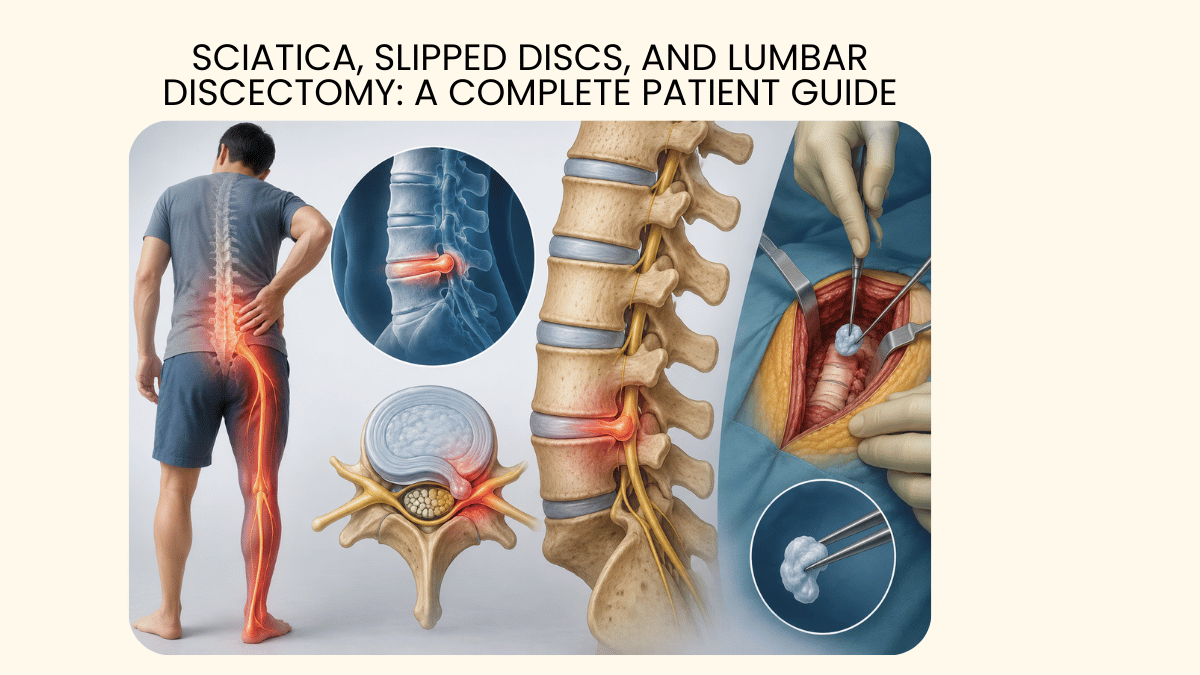
Severe sciatica is one of the most disabling conditions I see at Royal Preston Hospital. Patients describe excruciating pain shooting from the lower back into the buttock, thigh, calf, or foot, severe enough to interfere with walking, sleeping, working, and everyday activities. One of the most common causes is a lumbar disc prolapse, often referred to as a slipped disc, herniated disc, or ruptured disc. While most people improve without surgery, some continue to experience severe symptoms or develop weakness, making surgical treatment a consideration. This guide explains what causes sciatica, how it is diagnosed, and when surgery may be the right step.
What is the lumbar spine and how does it relate to sciatica?
The lumbar spine is the lower part of the back, consisting of five vertebrae, L1 to L5, with the sacrum below connecting the spine to the pelvis. Between each vertebra sits an intervertebral disc that acts as a shock absorber, made up of a tough outer ring and a softer gel-like centre. Nerves travel through the spinal canal before exiting to supply the legs, feet, and pelvic organs. When a disc protrudes or ruptures, it can compress one of these nerves and cause sciatica.
What is a slipped disc?
The term slipped disc is widely used but not entirely accurate. The disc does not actually slip out of place. Instead, a weakness develops in the outer layer, allowing part of the inner material to bulge or protrude. Doctors may describe this as a disc bulge, disc prolapse, disc herniation, or disc extrusion. The protruding disc material can press directly on a nearby nerve root, leading to symptoms in the leg. This compression of a nerve root is what produces the characteristic pattern of "sciatica".
What does sciatica feel like and what symptoms can a disc prolapse cause?
Sciatica refers to pain caused by irritation or compression of the sciatic nerve or the nerve roots that contribute to it. It is a symptom rather than a diagnosis. Patients commonly describe sharp shooting pain, burning pain, electric shock sensations, and pain travelling down the leg that worsens when coughing or sneezing. In many cases, leg pain becomes much more severe than any back pain. Beyond pain, a lumbar disc prolapse can also cause numbness, pins and needles, and muscle weakness, including difficulty lifting the foot, difficulty standing on tiptoes, and reduced leg strength.
When should I seek medical advice?
You should seek medical assessment if you experience severe leg pain, persistent symptoms, numbness, weakness, difficulty walking, or symptoms interfering with daily activities.
Urgent medical attention should be sought if symptoms include loss of bladder or bowel control, numbness around the genital area, or rapidly worsening weakness. These symptoms may indicate cauda equina syndrome, a rare but serious condition requiring urgent specialist assessment.
How is a lumbar disc prolapse diagnosed?
A specialist will discuss the nature of your symptoms, their duration and severity, and previous treatments. Examination assesses muscle strength, reflexes, sensation, straight leg raising, and walking pattern.
MRI scan is the most useful investigation, providing detailed images of discs, nerves, and the spinal canal, identifying disc prolapse, nerve compression, and other causes of symptoms. A CT scan may occasionally provide additional information regarding bone anatomy.
Can sciatica improve without surgery?
Yes. The majority of patients improve without an operation. Many disc prolapses shrink naturally over time. Treatment may include physiotherapy, exercise programmes, pain medication, neuropathic pain medication, activity modification, and pain management interventions. Most patients experience gradual improvement over weeks or months.
When is surgery recommended?
Surgery may be considered when severe leg pain from a trapped nerve persists despite appropriate conservative treatment, when progressive weakness develops indicating ongoing nerve damage, when symptoms significantly affect sleep, mobility, or employment, when imaging confirms nerve compression correlating with symptoms, or when emergency neurological problems develop.
What does lumbar discectomy involve?
Lumbar discectomy is an operation designed to relieve pressure on a compressed nerve. The procedure is performed under general anaesthesia through a small incision in the back. It involves identifying the affected level, accessing the spinal canal, protecting the nerve, removing the prolapsed portion of the disc, and relieving pressure on the nerve root. Only the portion of disc responsible for compression is removed. The remainder of the disc is generally left in place.
What are the goals of surgery and what symptoms improve most reliably?
The primary goal is relief of leg pain. Patients frequently experience meaningful improvement in leg pain soon after surgery. Surgery may also help prevent further neurological deterioration, and successful surgery often allows patients to walk more comfortably, sleep better, return to work, and resume normal activities.
Leg pain, shooting pain, and nerve irritation symptoms are most likely to improve. Numbness, tingling, and weakness may also improve, though recovery can be slower. Chronic lower back pain is less predictable. Lumbar discectomy is primarily designed to improve leg pain caused by nerve compression and is not intended to cure lower back pain. A small number of patients may experience worsening back pain following surgery.
What are the risks of lumbar discectomy?
Every operation carries risk. Serious complications are uncommon, but it is important that patients understand them before proceeding. Specific risks include infection, bleeding, cerebrospinal fluid leak, pseudomeningocoele, nerve injury, paralysis, bladder and bowel dysfunction, residual disc material, recurrent disc prolapse, epidural fibrosis, arachnoiditis, spinal instability, and wrong-level surgery. General anaesthetic risks include heart complications, pneumonia, deep vein thrombosis, and pulmonary embolism. Serious complications and death are recognised but rare risks of major surgery. Recurrent disc prolapse, where a new prolapse develops at the same level following surgery, is one of the most important long-term risks. This may occur months or years later and some patients require additional surgery.
What does recovery after lumbar discectomy look like?
Many patients notice improvement in leg pain immediately after surgery. Most stay in hospital for one night, although some may go home the same day. Walking is encouraged soon after surgery.
In the first two weeks, walking is encouraged alongside wound healing and a gradual increase in activity. Between two and six weeks, mobility improves and a return to light duties is possible. From six weeks onwards, continued recovery allows a gradual return to normal function. Recovery of numbness and weakness may take considerably longer than pain relief. Driving should only resume when you can perform an emergency stop safely, pain is adequately controlled, and you are no longer impaired by medication.
Questions patients ask me most often:
Is lumbar discectomy successful?
For appropriately selected patients with sciatica caused by a disc prolapse, lumbar discectomy is a well-established and effective procedure for relieving leg pain.
Will surgery cure my back pain?
Not necessarily. The operation is primarily designed to improve leg pain rather than back pain.
Can the disc prolapse come back?
Yes. Recurrence is a recognised long-term risk. A new disc prolapse can develop at the same level months or years after surgery.
How long does nerve recovery take?
Pain often improves quickly. Numbness and weakness may continue improving for months.
If you are experiencing severe leg pain, sciatica, or symptoms suggestive of a lumbar disc prolapse, I would be happy to assess your situation and discuss whether surgical or non-surgical management is appropriate. To book a consultation with Mr Anantharaju Prasad at Royal Preston Hospital, Preston, call 01772 522740,
Written by Dr Anantharaju Prasad, MBBS, DNB (Neurosurgery), FRCS (SN), Consultant Neurosurgeon, Royal Preston Hospital, Sharoe Green Ln, Fulwood, Preston PR2 9HT, United Kingdom.

Add a Comment