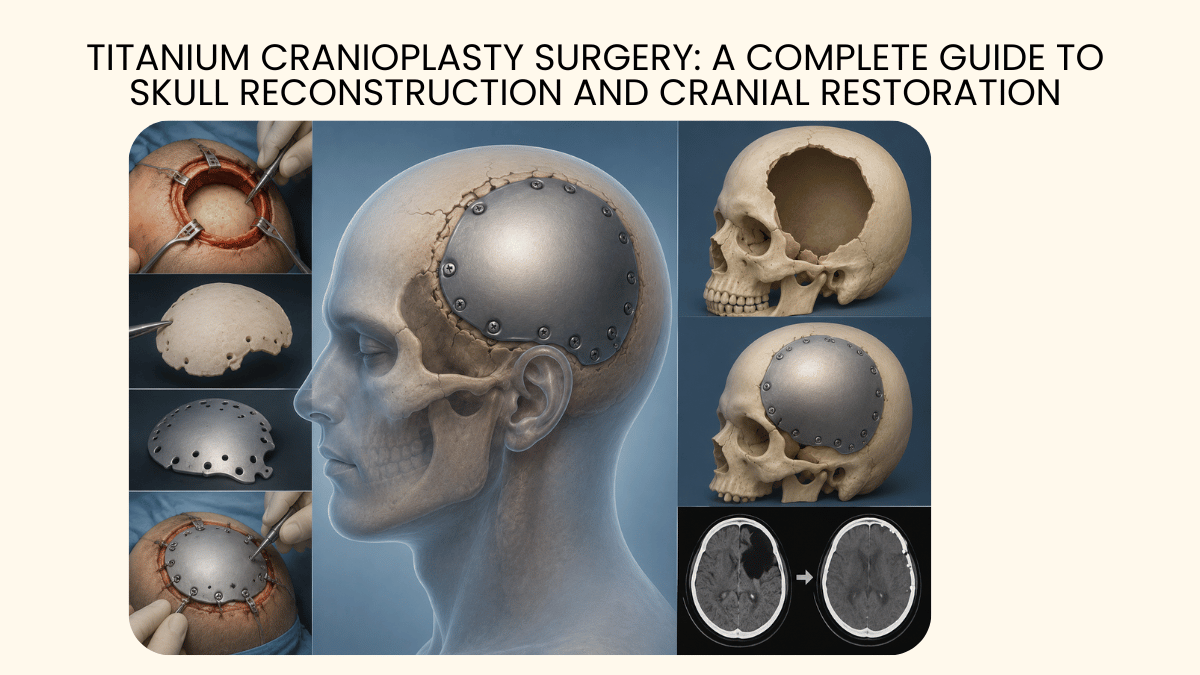
The skull plays a vital role in protecting the brain and contributing to the shape and appearance of the head. At Royal Preston Hospital, I perform cranioplasty surgery for patients whose skull has been partially removed, damaged, or affected by disease. Whether the reason is a previous decompressive craniectomy, trauma, infection, or a congenital condition, reconstructing the skull using a titanium implant restores both its protective function and its appearance. This guide explains when cranioplasty is needed, how the procedure is performed, and what recovery involves.
What is cranioplasty and when is it needed?
A cranioplasty is an operation to repair a defect in the skull, restoring the protective barrier around the brain and recreating the normal shape of the head. The most common reason I perform this operation is following a previous decompressive craniectomy, where a section of skull was temporarily removed to allow a swollen brain to expand safely after a major head injury, stroke, brain haemorrhage, or severe brain swelling. Once the brain has recovered, reconstruction of the skull is considered.
Other reasons cranioplasty may be needed include previous neurosurgical procedures where skull bone was removed, infection requiring removal of affected bone, severe head trauma causing skull fracture or bone loss, and congenital conditions where a skull defect or abnormality is present from birth.
Why is titanium the preferred material for skull reconstruction?
Titanium skull have become the most widely used option for cranial reconstruction because of their strength, durability, and biocompatibility. Titanium is extremely strong while remaining lightweight, the body generally tolerates it very well with rejection reactions being uncommon, and it does not degrade significantly over time. Modern manufacturing techniques allow custom implan implantsts to be designed precisely from CT scans, enabling reconstruction tailored to each individual's anatomy. Titanium has a long and well-established track record in neurosurgery and across other implant-based specialties including joint replacement and dental surgery.
What symptoms can a skull defect cause?
Not all skull defects produce symptoms, but some patients experience significant impact from them. Changes in head shape can be distressing and affect confidence and wellbeing. A missing section of skull leaves the brain less protected from injury. Some patients experience local discomfort or sensitivity at the defect site. In certain situations, cranial reconstruction can improve headaches, fatigue, cognitive function, and neurological performance, although the exact mechanisms behind these improvements remain incompletely understood.
How is a patient assessed before cranioplasty?
A thorough evaluation is required before cranioplasty. I review the patient's full medical history, previous operations, current symptoms, and general health. CT scanning is particularly important, providing detailed information about the size of the defect, skull anatomy, and surrounding bone. For custom implants, CT images are used to manufacture a patient-specific implant that precisely matches each individual's skull contour. Depending on the circumstances, additional imaging or blood tests may also be required.
What does titanium cranioplasty surgery involve?
The procedure is performed under general anaesthesia. The previous surgical scar is usually reopened and the tissues carefully separated to expose the defect. The edges of the skull defect are prepared to allow accurate positioning of the implant, and the custom titanium implant is positioned to restore the normal contour of the skull and secured using specialised fixation systems. The scalp is then carefully closed over the reconstruction. Drains may occasionally be used to reduce fluid accumulation.
What are the goals and benefits of surgery?
The objectives of titanium cranioplasty are to restore a protective barrier around the brain, improve the symmetry and appearance of the head, and where possible support neurological recovery. Many patients report improved confidence and wellbeing following reconstruction.
Potential benefits include improved cranial protection, restoration of normal head contour, enhanced cosmetic appearance, improved confidence and comfort, and potential neurological improvement. However, outcomes vary depending on the underlying condition and the individual's overall neurological recovery. The degree of improvement in neurological function after cranioplasty differs considerably between patients.
What are the risks of titanium cranioplasty?
All surgery carries risk. Serious complications are uncommon, but it is important that patients understand them before proceeding. Infection is one of the most significant complications and may involve the wound, the implant, or the underlying bone. Severe infection may require removal of the implant. Other risks include bleeding, fluid collections beneath the scalp, wound healing problems, implant exposure if the overlying skin breaks down, implant loosening or movement requiring revision surgery, cosmetic imperfections, and seizures. Neurological injury is rare but recognised, with potential consequences including weakness, speech difficulties, sensory changes, and cognitive impairment. Stroke is uncommon but remains a recognised risk. General anaesthetic risks include heart complications, pneumonia, deep vein thrombosis, and pulmonary embolism.
Wound healing problems are more likely in patients with previous surgery, radiotherapy, infection, or poor tissue quality. I discuss all relevant risks individually with each patient before any decision to proceed.
What does recovery after cranioplasty look like?
Following surgery, patients are monitored carefully in the recovery area and on the neurosurgical ward. Hospital stay varies depending on the complexity of surgery, the patient's previous neurological condition, and recovery progress. Many patients remain in hospital for several days, and some may require a longer stay if significant rehabilitation is needed. Recovery after cranioplasty differs considerably between individuals. In the first two weeks, wound healing is the priority alongside management of swelling and a gradual increase in activity. Between two and six weeks, activity levels increase and swelling reduces. From six weeks onwards, most patients return to normal activities and the final cosmetic result continues to improve. The final appearance may take several months to become fully apparent.
What is it like to live with a titanium cranial implant?
Most patients adapt quickly to living with a titanium implant. The implant is designed to remain permanently in place and many patients eventually forget it is present. Routine daily activities can usually be resumed once healing is complete. I advise each patient individually regarding contact sports, MRI scanning, and any future procedures they may need.
Questions patients ask me most often:
Will the titanium implant set off airport security alarms?
Modern implants rarely cause problems at airport security, although this can occasionally occur. Carrying a medical implant card can be helpful when travelling.
Can I have an MRI scan?
In most cases, yes. Titanium is generally MRI compatible, although specific advice should be sought for individual implants, and I advise each patient based on the exact device used.
Will people be able to see the implant?
The implant is placed beneath the scalp. In most patients, the reconstruction produces a natural contour that is not visible externally.
Can the implant wear out?
Titanium implants are designed to be permanent and are highly durable. They do not degrade significantly over time.
Will I need further surgery?
Most patients do not require additional procedures. However, complications such as infection or wound problems may occasionally necessitate further treatment.
If you have a skull defect following previous neurosurgery, trauma, or infection, and would like to discuss whether cranioplasty or titanium skull reconstruction is appropriate, I would be happy to assess your situation. To book a consultation with Mr. Anantharaju Prasad at Royal Preston Hospital, Preston, call 01772 522740
Written by Mr. Anantharaju Prasad, MBBS, DNB (Neurosurgery), FRCS (SN), Consultant Neurosurgeon, Royal Preston Hospital, Sharoe Green Ln, Fulwood, Preston PR2 9HT, United Kingdom.
Mr. Anantharaju Prasad
MBBS, DNB (Neurosurgery), FRCS (SN)
Royal Preston Hospital, Sharoe Green Ln, Fulwood, Preston PR2 9HT, United Kingdom

Add a Comment