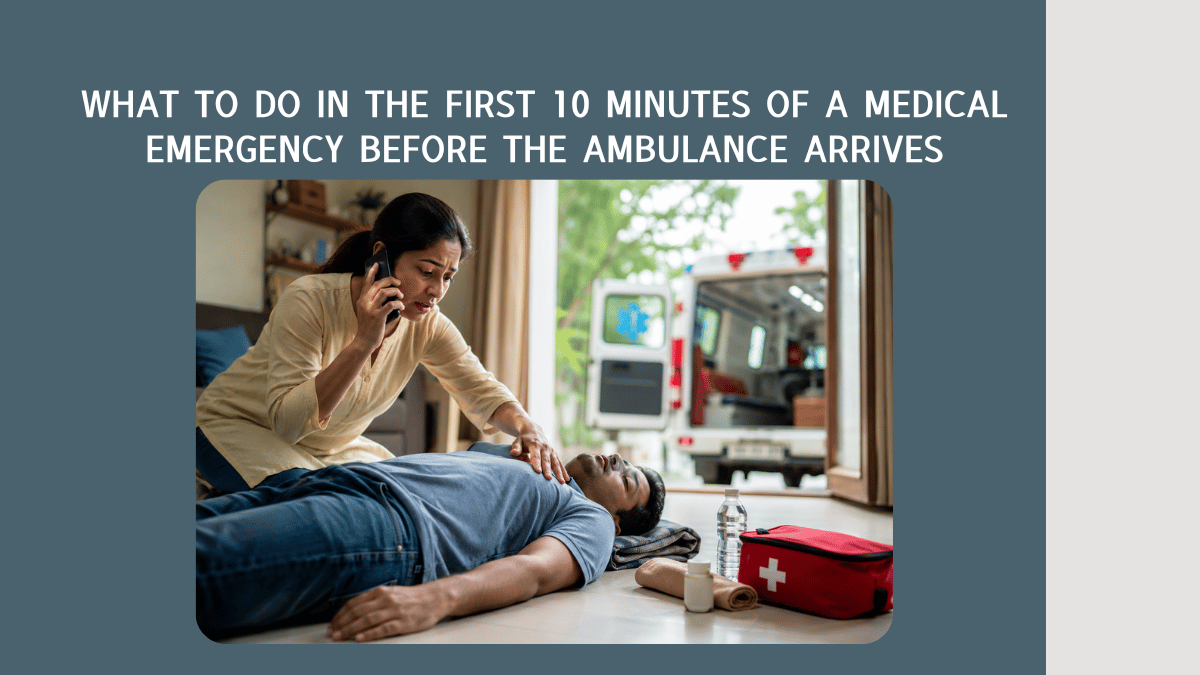
Most people know to call an ambulance when a medical emergency happens. Very few know what to do in the minutes before it arrives. As the Head of Emergency Medicine at SPARSH Hospital, Hennur Road, Bengaluru, and someone who has trained over 30,000 people in emergency response, I can tell you with certainty that what happens in those first minutes is not waiting. It is the most critical window in the entire emergency response chain, and the actions of a bystander in that window can be the difference between life and death, between full recovery and permanent disability. This guide is for everyone. You do not need medical training to use it. You need to read it, remember the principles, and act.
Why the first ten minutes matter more than most people realise
When the heart stops, brain cells begin to die within four to six minutes without oxygen. When an airway is blocked, the same clock starts. When a major blood vessel bleeds, a person can lose enough blood to lose consciousness within minutes. The ambulance in Bengaluru, even with the best response times, takes anywhere from eight to twenty minutes to reach you depending on traffic and location. That gap is yours to fill. Emergency medicine describes the sequence of actions that need to happen for a patient to survive a cardiac arrest as the chain of survival: early recognition, early call for help, early CPR, early defibrillation, and early advanced care. Three of the five links in that chain happen before any medical professional arrives.
I trained over 30,000 people in CPR during a single initiative at Chitradurga, and one of the things that became clear during that programme was that the biggest barrier to bystander action is not lack of knowledge. It is hesitation. People freeze because they are afraid of doing it wrong. What this guide aims to do is replace that hesitation with a clear sequence of actions so that when the moment comes, you move rather than wait.
Step one: Ensure the scene is safe before approaching
Before you do anything else, stop and look at the environment around the person who needs help. This is not an instinct most people have, but it is the first rule of bystander first aid for a reason. If someone has collapsed near a live electrical wire, approaching without cutting the power makes you the second casualty. If there is a gas leak, creating a spark by using a phone inside the building could be catastrophic. If someone has been in a road accident, oncoming traffic is a real and immediate threat.
Assess the scene in under ten seconds. Look for fire, smoke, unstable structures, ongoing traffic, electricity, aggression, or any hazard that could harm you. If the scene is unsafe and cannot be made safe quickly, keep yourself at a safe distance and direct others. A well-meaning rescuer who becomes a casualty makes the situation worse, delays professional help, and diverts resources. Once you have confirmed the scene is safe, approach and assess.
Step two: Check for response
Kneel beside the person and place both hands firmly on their shoulders. Shake gently but firmly and call to them loudly: are you alright? Can you hear me? This takes five seconds. What you are doing is distinguishing between someone who is unconscious and someone who is deeply asleep, intoxicated, or confused. If they respond, even weakly, they are conscious. Stay with them, keep talking, and call for emergency medical help immediately. Ask them where they are in pain, whether they can move, and whether they have any known medical conditions. This information will be critical for the paramedics.
If they do not respond at all, you are dealing with an unconscious person. The next steps are urgent.
Step three: Shout for help and call emergency services immediately
As soon as you confirm the person is unresponsive, shout loudly for help. Do not assume someone else will call. In any crowd, there is a well-documented psychological phenomenon called the bystander effect, where the presence of other people actually reduces the likelihood that any single person will act, because everyone assumes someone else is handling it. Override this. Point directly at a specific person and say: you, call 112 right now and come back to tell me you have done it. Assigning the task to an individual rather than a group dramatically increases the chance it gets done. In India, emergency number 112 covers police, fire, and medical emergencies. In Bengaluru, 108 reaches the ambulance service directly.
When the call connects, state your location as specifically as possible including the landmark, the road name, and the direction you are facing. State that the person is unconscious. Follow any instructions the dispatcher gives you. Many dispatchers are trained to give CPR instructions over the phone, so keep the line open.
Step four: Open the airway and check for breathing
Once the call is made, place the person flat on their back on a firm surface. Tilt the head back gently by placing one hand on the forehead and lifting the chin with two fingers. This simple manoeuvre lifts the tongue away from the back of the throat and opens the airway. Now look, listen, and feel for breathing for no more than ten seconds. Look at the chest for rise and fall. Listen for any breath sounds. Feel for breath on your cheek. Occasional gasps, called agonal breathing, are not normal breathing and should be treated as absence of breathing.
If the person is breathing normally, place them in the recovery position: on their side, lower arm extended, upper knee bent, head tilted back slightly. This keeps the airway clear if they vomit, which is common in unconscious patients. Stay with them and monitor until help arrives. If the person is not breathing, begin CPR immediately.
Step five: Start CPR if the person is not breathing
CPR, cardiopulmonary resuscitation, is the single most important skill a bystander can have. It is not complicated. Place the heel of one hand on the centre of the chest, directly on the lower half of the breastbone. Place your other hand on top, interlace your fingers, keep your arms straight, and lean directly over the person. Press down hard at least five centimetres, roughly two inches, and then release completely. Repeat at a rate of 100 to 120 compressions per minute. The song Stayin' Alive by the Bee Gees is 103 beats per minute and many people use it mentally to pace their compressions. Every compression is manually pumping blood to the brain.
Do not stop to check for breathing until professional help arrives or the person shows clear signs of recovery. Interruptions to CPR are costly. Each time you stop, blood pressure in the brain drops to zero within seconds. If you are trained in CPR with rescue breaths, give two breaths after every thirty compressions. If not, compression-only CPR is highly effective and far better than doing nothing. Continue until the ambulance arrives, until an AED is available, or until someone takes over.
Step six: Use an AED if one is available
Automated external defibrillators, AEDs, are designed to be used by anyone. They are increasingly available in airports, malls, gyms, and corporate offices across Bengaluru. They analyse the heart rhythm and deliver a shock if needed. They do not shock a normally beating heart. You cannot harm a person in cardiac arrest by using one.
If an AED is nearby, send someone to get it without stopping CPR. When it arrives, turn it on and follow the voice instructions. Attach the pads as shown in the diagram, one below the right collarbone and one on the left side of the chest below the armpit. The AED will analyse the rhythm and tell you whether a shock is advised. Stand clear and press the button if instructed. Immediately after the shock, resume CPR. Every minute without defibrillation in a shockable cardiac arrest reduces survival chances by roughly seven to ten percent.
Choking: a different emergency with its own first-minutes protocol
If an adult or child over one year old is choking and cannot cough, speak, or breathe, give five firm back blows between the shoulder blades with the heel of your hand. Then give five abdominal thrusts: stand behind the person, place one fist just above the navel and below the breastbone, grasp your fist with your other hand, and pull sharply inward and upward. Alternate five back blows and five abdominal thrusts until the object is expelled or the person loses consciousness.
If the person loses consciousness, lower them carefully to the ground and begin CPR. For infants under one year, use five back blows with two fingers rather than the heel of the hand, and five chest thrusts, not abdominal thrusts, with two fingers on the centre of the chest.
Bleeding: when to act and how to act
Uncontrolled external bleeding from a major wound is a life-threatening emergency. The body has approximately five litres of blood and can lose about 1.5 litres before shock sets in. Apply direct pressure to a wound immediately using whatever is available: a cloth, a piece of clothing, your bare hand if necessary. Press hard and do not remove the material once it is in place, since removing it disrupts the clot that is beginning to form. If blood soaks through, add more material on top rather than replacing it.
Keep pressing. Continuously. For at least ten minutes. If the bleeding is from a limb and direct pressure is not controlling it, a tourniquet applied tightly above the wound is appropriate and can be lifesaving. Note the time you applied it and tell the paramedics on their arrival. Do not apply pressure to an object embedded in a wound. Stabilise the object from both sides without pressing it deeper.
Stroke: recognising it and acting fast
The FAST acronym exists because it works. Face drooping on one side. Arm weakness, where one arm drifts downward when both are raised. Speech slurred, confused, or absent. Time to call 112 immediately.
Do not give the person food or water. Do not ask them to walk it off or wait to see if it improves. Every minute of untreated stroke sees approximately 1.9 million brain cells die. Lay the person down with their head and shoulders slightly raised, note the time symptoms started, and keep them calm and still until help arrives.
What to tell the ambulance when it arrives
Your observations in the first ten minutes are the most valuable clinical information the paramedics will have. Tell them: when the person was last seen normal, what you witnessed, what you did, and any medications or medical history you know about. If you performed CPR, tell them how long and whether there was any response. If you used an AED, tell them whether a shock was delivered. If there was choking, tell them what was being eaten and whether the object was cleared.
The few sentences you say as the ambulance doors open shape the next thirty minutes of the patient's care.
As a physician who has spent 25 years in emergency medicine and trained tens of thousands of people in emergency response, I want every person reading this to leave with one conviction: in a medical emergency, the bystander who acts is more valuable than the bystander who waits. You will not do it perfectly. Perfectly is not the goal. Acting is the goal. The ambulance is coming. Your job is to keep the patient alive until it arrives.
If you would like to learn hands-on CPR and first responder skills, formal training is available and takes less than half a day. To consult Dr Nilu Sunil or enquire about emergency preparedness training, call +91 9000888624.
Written by Dr Nilu Sunil, MBBS, DEM, FEM, FACEE, FRCEM (A), PGDHHM, PGDMLS, EMDM, MBA, Head of Emergency Medicine, SPARSH Hospital, Hennur Road, Bengaluru.

Add a Comment