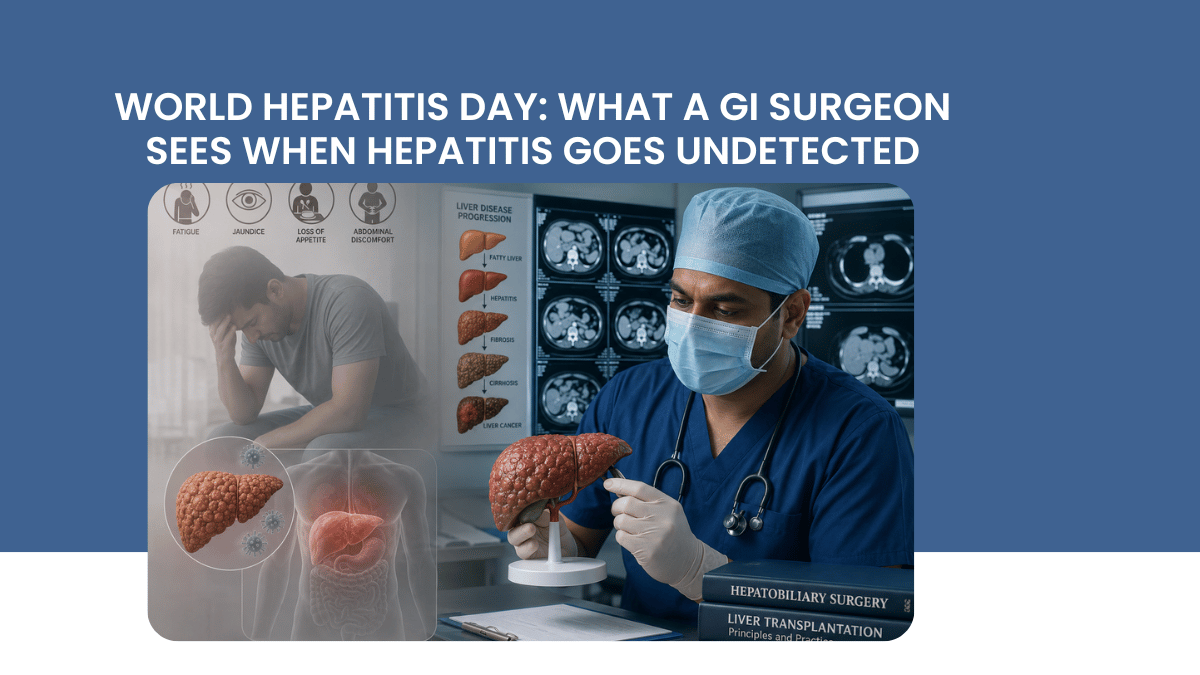
Every 28 July, World Hepatitis Day draws attention to a global problem that kills more than a million people every year. As a GI and Gastrointestinal Oncology Surgeon at NiSH Clinic, Jayanagar, Bengaluru, I want to mark this day by talking about something I see regularly in my practice: patients who arrive with advanced liver disease, having had no idea for years that anything was wrong. Hepatitis B and C are remarkable in their ability to remain silent. A person can carry active infection for a decade or more, feel perfectly well, and then present with cirrhosis or liver cancer at a stage where the surgical options are far more limited than they would have been earlier. This is not a failure of medicine - it is a failure of awareness, and it is one of the reasons World Hepatitis Day matters.
What hepatitis does to the liver - and why it takes so long to notice
The liver is one of the most resilient organs in the body. It has a remarkable capacity to compensate for damage, which is both its strength and its clinical challenge. Hepatitis B and C viruses, when chronic, produce ongoing inflammation in the liver. Over years and decades, that inflammation drives fibrosis - the accumulation of scar tissue - and eventually cirrhosis, where normal liver architecture is replaced by scarring that the organ cannot reverse. The liver can lose significant functional capacity before any symptom appears. By the time jaundice becomes visible, fluid starts accumulating in the abdomen, or a patient notices unexplained fatigue that does not improve with rest, the disease is rarely in its early stage. In my practice as a GI and GI Onco Surgeon, I operate on patients with liver tumours that arose on a background of hepatitis-related cirrhosis. The surgical outcomes in these cases depend enormously on the degree of underlying liver damage - and that damage accumulated silently, long before anyone was looking for it.
The connection to liver cancer that most patients do not know about
The relationship between chronic hepatitis and liver cancer is one of the most clearly established causal links in oncology. Hepatitis B is a direct oncogen - it can integrate into the DNA of liver cells and drive malignant transformation even in the absence of cirrhosis, which distinguishes it from hepatitis C, where cancer risk is primarily cirrhosis-mediated. In practical terms, this means that a patient with chronic hepatitis B requires surveillance for liver cancer even if their liver function tests look normal and their liver has not yet reached the stage of cirrhosis. An abdominal ultrasound and AFP level every six months can identify early hepatocellular carcinoma at a stage where curative surgical resection or ablation is possible. Identified at that stage, the outcomes are genuinely different from those achieved when the tumour is found because the patient is symptomatic. In my surgical practice, I have operated on liver cancers caught early through surveillance, where the patient went home and returned to their normal life. I have also operated on tumours identified late, where the best we could offer was palliative. The difference is not the surgery. The difference is when the diagnosis was made.
What World Hepatitis Day means for patients and surgeons in Bengaluru
India carries one of the highest burdens of hepatitis B and C in the world. Many patients do not know their status. Testing is simple, inexpensive, and available. Vaccination against hepatitis B is highly effective and should be completed in anyone who has not already received it. Antiviral treatments for hepatitis C now achieve cure rates above 95 percent with a relatively short course of oral medication - making hepatitis C a curable disease if it is found. Hepatitis B, while not curable in the same sense, can be managed with antiviral therapy that significantly reduces the risk of progression and cancer.
As a GI surgeon, my message on World Hepatitis Day is direct: get tested, complete the hepatitis B vaccination if you have not already, and if you have a known hepatitis diagnosis, ensure you are under surveillance. The liver's ability to compensate for damage without producing symptoms is not a reassurance - it is the reason the window for intervention closes gradually, without warning. A single blood test and ultrasound can change what is possible. That is a remarkably good return on a simple action. I see the outcomes on both sides of that decision in my operating theatre, and I would much rather perform a curative resection on an early lesion than explain to a family why options are limited by a diagnosis that came too late.
To book a consultation with Dr. Niranjan P at NiSH Clinic, Jayanagar, Bengaluru (Monday to Saturday, 6 PM to 7:30 PM), call +91 9731174360 / +91 9880505311.
Written by Dr. Niranjan P, MBBS (Rajiv Gandhi University of Health Sciences, Karnataka, 2005), DNB General Surgery (National Board of Examinations, New Delhi, 2011), Millennium Gold Medal Best Paper Award 2016, Consultant General, GI, Laparoscopic, Robotic and Bariatric Surgeon, NiSH Clinic, 48, 7th B Main Road, Jayanagar, Bengaluru 560011.
Related reading
Obesity, Diabetes, and Bariatric Surgery: A Complete Guide to Weight Loss Surgery in Bengaluru
Laparoscopic Surgery: Benefits, Recovery Time, and Why It’s the Preferred Choice in Bengaluru


Add a Comment