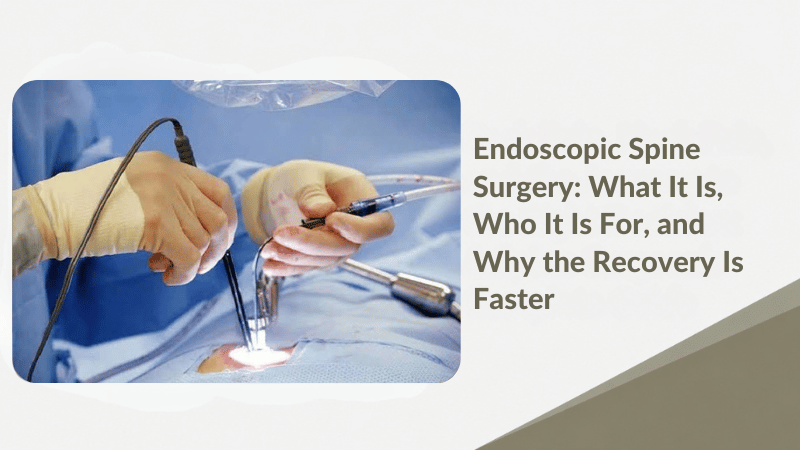
In my complete guide to back pain and neck pain, I briefly described endoscopic spine surgery as a technique that offers the fastest possible recovery for appropriately selected cases. I want to expand that section here, because endoscopic surgery is one of the most frequently asked about and most poorly understood advances in modern spine care. Patients are aware that it exists, but most have never had it explained in a way that allows them to understand what the telescope inside the spine actually does differently, why the recovery is meaningfully shorter than even minimally invasive surgery, and which patients are and are not appropriate candidates. My specific training in bi-portal endoscopy under Prof. Yong Chan Kim at Kyung Hee University, Seoul, South Korea, is the foundation of this part of my practice at SPARSH Hospital, Hennur, Bengaluru. Endoscopic spine surgery is not simply a smaller version of conventional spine surgery; it operates on a different technical principle entirely, and understanding that principle helps patients ask the right questions when it is presented as an option.
From Open to Minimally Invasive to Endoscopic: The Spectrum of Surgical Access
In conventional open spine surgery, the surgeon makes a long incision, moves the muscles aside to expose the spine directly, and works under direct vision with standard instruments. This provides excellent exposure but requires significant tissue disruption. Minimally invasive spine surgery, the technique I also use and described in my complete guide, uses tubular retractors that dilate the muscles rather than cutting them, creating a working channel through which standard instruments are passed. The incisions are significantly smaller, the muscle damage is reduced, and the recovery is shorter than open surgery. Endoscopic spine surgery takes this a step further: rather than a working channel through which the surgeon looks from outside the body, a thin endoscope, a camera-equipped telescope the diameter of a pencil, is introduced into the spine itself, and the surgeon operates while watching a high-definition video monitor. The instruments pass through or alongside the endoscope, working in a space no larger than the endoscope's diameter. The result is a procedure that can treat significant spinal pathology through an incision smaller than one centimetre, with minimal blood loss, no significant muscle damage, and a recovery measured in days rather than weeks.
Bi-Portal Endoscopic Spine Surgery: The Technique I Use
The specific technique I trained in under Prof. Yong Chan Kim is bi-portal endoscopy, which uses two small incisions rather than one: one for the endoscope camera and one for the working instruments. This separation of the camera and the instruments provides greater manoeuvrability and a wider range of motion than single-portal endoscopy, allowing more complex pathology to be addressed while maintaining the benefits of the minimal access approach. The spine is accessed using a continuous saline irrigation system that keeps the operative field clear and provides a degree of haemostasis. The endoscope provides a magnified, illuminated view of the spinal canal and disc space that is comparable to the view through an operating microscope, without any of the access and exposure required to position a microscope over a conventional surgical incision.
Conditions Treated by Endoscopic Spine Surgery
Endoscopic surgery is most established for conditions where the surgical goal is decompression of a nerve or the spinal canal without the need for fusion or implant placement. The principal applications are lumbar disc herniation, where the protruding disc material pressing on a nerve root is removed endoscopically (endoscopic discectomy), and lumbar spinal stenosis, where the narrowed canal is widened endoscopically (endoscopic decompression or laminotomy). These are two of the most common spine operations performed globally, and for carefully selected patients, the endoscopic approach produces equivalent decompression with a significantly smaller surgical footprint. Cervical disc herniation can also be addressed endoscopically in selected cases, and the indications are expanding as the technique and instruments develop. Endoscopic surgery is generally not appropriate for cases requiring spinal fusion, significant instability, or complex deformity, where conventional minimally invasive or open techniques provide the necessary structural correction that endoscopy cannot achieve through its limited access. The selection between endoscopic, minimally invasive, and open surgery is a clinical decision based on the specific pathology, the anatomy, and the goals of the procedure, not simply a ranking of techniques from best to worst.
Recovery After Endoscopic Spine Surgery: What to Realistically Expect
The recovery after endoscopic spine surgery is its most compelling advantage for patients who are candidates. Because the muscle disruption is minimal, post-operative pain is significantly reduced compared to either open or conventional minimally invasive surgery. Most patients who have undergone endoscopic discectomy at SPARSH Hospital, Hennur, Bengaluru are walking the day of surgery, discharged the same day or the following morning, and returning to desk work within three to five days. The resolution of the nerve root pain that brought them to surgery is often immediate: the compressed nerve is decompressed, and the radiating leg or arm pain that had been present for weeks or months is gone on waking from the anaesthetic in the great majority of cases. Physical work and sustained physical loading require a period of rehabilitation and graded return, typically four to six weeks, to allow the disc and surrounding tissues to settle. Not every patient who has endoscopic surgery has this experience: outcomes depend on the duration of the compression, the degree of nerve irritation before surgery, and individual biological variation in nerve recovery. But for appropriately selected patients with disc herniation causing significant sciatica or arm pain that has not resolved with conservative treatment, endoscopic spine surgery offers a recovery that is genuinely different in character from what most people expect surgery to involve.
To book a spine consultation with Dr. Nirdesh H J at SPARSH Hospital, HBR Layout, Hennur Road, Bengaluru 560043, call +91 6363626242.
Written by Dr. Nirdesh H J, MBBS, MS (Orthopaedics), DNB (Orthopaedics), FNB (Spine Surgery, Indian Spinal Injuries Centre, New Delhi), AO Spine Asia Pacific Fellowship (Bombay Hospital, Mumbai, under Dr. Arvind Kulkarni), AO Spine International Fellowship (Kyung Hee University, Seoul, South Korea, under Prof. Yong Chan Kim), Fellowship in Minimally Invasive Spine Surgery (Germany), Consultant Orthopedic Spine Surgeon, SPARSH Hospital, HBR Layout, Hennur Road, Bengaluru 560043. Phone: +91 6363626242.
Related reading
Back Pain, Neck Pain, and the Journey to the Right Decision: A Spine Surgeon's Complete Guide
Minimally Invasive Spine Surgery: A Doctor’s Insight Into Faster, Safer Recovery

Add a Comment