
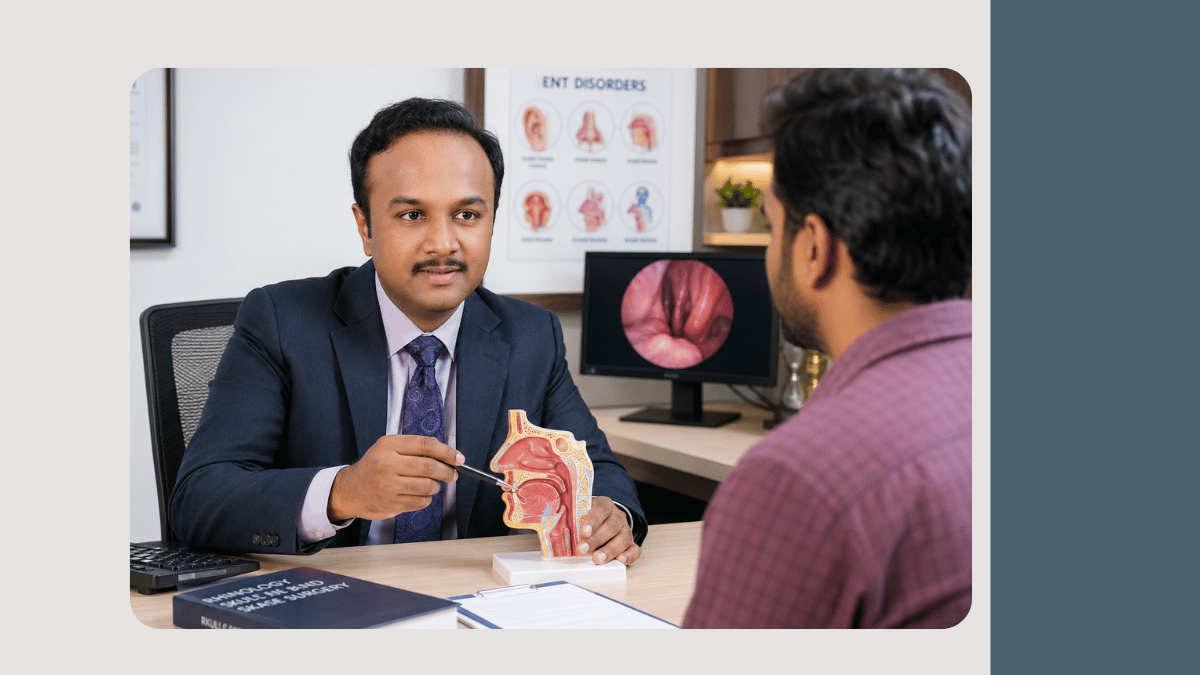
The word rhinology refers to the subspecialty within ENT that focuses specifically on the nose and paranasal sinuses, their diseases, and their surgical management. In my ENT practice at Rajarajeshwari Medical College and Hospital, Kengeri Satellite Town, and Trustwell Hospitals, JC Road, Bengaluru, rhinological conditions represent one of the largest categories of the patients I see: chronic sinusitis that has not resolved with multiple antibiotic courses, nasal polyps producing progressive obstruction and loss of smell, recurrent acute sinusitis with a seasonal or environmental pattern suggesting an allergic component, and in a smaller but important group, conditions involving the anterior skull base that the nose and sinuses provide the natural surgical approach to. Sixteen years of ENT practice and extensive experience with advanced endoscopic rhinology procedures mean that my approach to these conditions is both broad in its clinical scope and precise in its surgical execution.
What Rhinology Covers: From Nasal Polyps to Skull Base Conditions
Rhinology encompasses the full spectrum from medical management of allergic and non-allergic rhinitis, through functional endoscopic sinus surgery for chronic sinusitis and nasal polyps, to endoscopic skull base surgery for conditions that arise in or extend into the anterior cranial base. Functional endoscopic sinus surgery, known as FESS, uses a thin endoscope passed through the nostril to directly visualise the internal nasal anatomy, identify the anatomical and inflammatory causes of sinus disease, and open the sinus drainage pathways under direct vision. Modern FESS is minimally invasive, performed without any external incisions, and in the majority of cases as a day or overnight procedure. It addresses the structural obstruction that allows bacteria to proliferate and sinus infections to recur. But the structural correction it provides does not alter the underlying mucosal inflammatory environment. A patient who has FESS for nasal polyps driven by eosinophilic inflammation and allergen sensitisation and then receives no post-operative allergy assessment and management will experience polyp recurrence: the surgical result and the medical management that maintains it are both essential.
The anterior skull base is the bony floor of the front of the skull that separates the nasal cavity and sinuses from the brain and the structures around it. Conditions that can require rhinological assessment and sometimes surgery in this region include cerebrospinal fluid rhinorrhoea, the leak of cerebrospinal fluid from the skull base into the nasal cavity, which presents as a unilateral clear watery nasal discharge that typically worsens when bending forward or straining. The endoscopic transnasal approach to anterior skull base CSF leaks allows the site of the leak to be identified and repaired using tissue grafts placed endoscopically, without any external incision or brain retraction, and with excellent success rates. Other anterior skull base conditions including encephaloceles, meningoceles, and selected tumours involving the skull base are assessed and where appropriate managed by the rhinological endoscopic approach.
Why Allergy Is Integral to Rhinology Outcomes in Bengaluru
The most important clinical insight in rhinology practice is that surgical treatment of the consequences of allergic mucosal inflammation, without identifying and managing the allergy that is producing that inflammation, produces results that do not last. In Bengaluru, where house dust mite, cockroach, and Parthenium pollen sensitisation are among the most prevalent allergic conditions, the patient presenting with chronic sinusitis, nasal polyps, or recurrent sinus infections is very likely to have an allergic component driving the nasal mucosal inflammation that makes the sinuses susceptible. My AASC qualification reflects specific allergy training that is directly integrated into my rhinology practice: every patient undergoing evaluation for FESS or presenting with chronic rhinosinusitis receives allergy assessment as part of their rhinological workup, not as a separate referral to a different specialist. Identifying the specific allergen through skin prick testing, implementing targeted allergen avoidance, and providing allergen immunotherapy for selected patients where the sensitisation is confirmed and significant, reduces the inflammatory burden on the nasal mucosa and substantially reduces the recurrence rate after rhinological surgery. This integration of rhinological surgical expertise with allergy medicine is the clinical approach that produces durable results, not just relief from the current episode, for patients with chronic nasal and sinus disease at Rajarajeshwari Medical College and Hospital and Trustwell Hospitals, Bengaluru.
To book a consultation with Dr. Rajendran Dinesh Kumar at Rajarajeshwari Medical College and Hospital, Kengeri Satellite Town, Bengaluru (Monday, Wednesday, Friday, 9:00 AM to 4:00 PM) or Trustwell Hospitals, JC Road, Bengaluru (Monday, Wednesday, Friday, 6:00 PM to 8:00 PM), call 9620928650.
Written by Dr. Rajendran Dinesh Kumar, MBBS, MS ENT, AASC (Allergy Asthma Specialist Course), FAAP, Consultant ENT Specialist and Allergy, Asthma Specialist, Rajarajeshwari Medical College and Hospital, 202, Mysore Road, Kengeri Satellite Town, Kambipura, Bengaluru, Karnataka 560074 (Monday, Wednesday, Friday, 9:00 AM to 4:00 PM) and Trustwell Hospitals Pvt. Ltd., 5, JC Road, Vinobha Nagar, Sudhama Nagar, Bengaluru, Karnataka 560002 (Monday, Wednesday, Friday, 6:00 PM to 8:00 PM). 16+ years. 20,000+ patients. Phone: 9620928650.
Related reading
The Journey of Dr. Rajendran Dinesh Kumar: Dedicated to Advanced ENT and Rhinology Care

Add a Comment