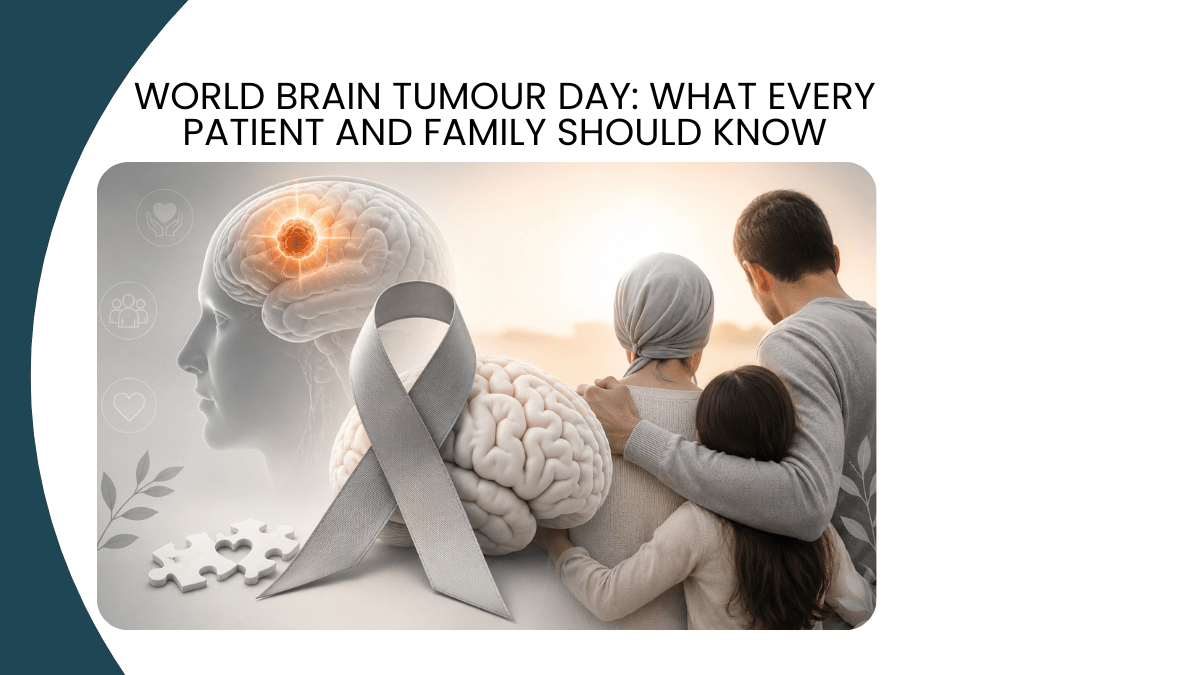
June 8 is World Brain Tumour Day. It is a day to replace fear with facts. Brain tumours affect thousands of Indians every year, and the gap between noticing the first symptom and seeking a specialist evaluation is often the difference between early, manageable treatment and a complex late-stage presentation.
As a neurosurgeon in Bengaluru and consultant at Sparsh Hospital Infantry Road, I want to use this day to share what I believe every patient and family needs to understand.
What I Have Learned From Sitting With Patients After a Diagnosis
In over 18 years of neurosurgical practice, the consultation I remember most is not always the most technically complex case. It is the patient who came to me six months after their family first noticed something was wrong.
A change in personality. A headache that had become part of daily life. A first seizure that everyone hoped would not happen again.
Brain tumour symptoms are often subtle, gradual, and easy to dismiss. That is what makes early awareness so important — not creating panic, but creating the habit of taking neurological changes seriously.
What Are the Warning Signs That Should Prompt Evaluation?
Not every headache is a brain tumour. But certain patterns deserve prompt attention.
The symptoms I advise patients and families to never ignore are:
- A headache that is new, persistent, or consistently worse in the morning
- A first seizure in adults with no prior history
- Unexplained weakness, vision changes, or speech difficulty
- Memory loss or personality change noticed by family members
- Nausea or vomiting without a clear cause, especially with headache
If any of these are present, a neurological evaluation — not a wait-and-watch approach — is the right response.
Are All Brain Tumours the Same?
No. This is one of the most important things I explain to families at the first consultation.
Brain tumours range from slow-growing benign lesions to aggressive malignant tumours that require urgent multimodal treatment. A meningioma discovered incidentally in an elderly patient may require only surveillance. A high-grade glioma in a young adult requires surgery, radiation, and chemotherapy.
The diagnosis on a report means very little without the full clinical picture. What matters is the tumour type, its location, how fast it is growing, and what it is pressing on.
What Does Treatment Involve?
Treatment depends entirely on the diagnosis.
Modern brain tumour treatment includes minimally invasive craniotomy, endoscopic brain surgery, and image-guided resection that allow precise removal while protecting surrounding brain tissue. In selected cases, stereotactic radiosurgery can treat small tumours or residual disease without an incision.
For malignant tumours, surgery is followed by radiation therapy and chemotherapy in a plan designed by a multidisciplinary neurosciences team.
At Sparsh Hospital Infantry Road, Bengaluru, I work within a neurosciences team that brings together neurosurgery, neuro-oncology, radiation oncology, and neuropathology to ensure every patient receives a coordinated, evidence-based treatment plan.
One Thing I Want Every Reader to Take From This Day
Early evaluation saves options.
A brain tumour caught early is a very different clinical conversation from one caught late. The surgery is less complex. The neurological preservation is better. The recovery is faster.
If you or someone in your family has been experiencing any of the warning signs of brain tumour, please book a neurological evaluation. Not next month. This week.
Disclaimer: This article is for informational purposes only and does not constitute medical advice. Please consult a qualified neurosurgeon for diagnosis and treatment decisions specific to your condition.
Written by Dr Robin Gupta, MBBS, MS General Surgery, MCh Neurosurgery, Neurosurgeon and Stroke Specialist, Consultant, Sparsh Hospital Infantry Road, Bengaluru.
Related Reading:
linqmd.com/doctor/robin-gupta/blog/precision-in-brain-tumor-surgery-from-gliomas-to-meningiomas
linqmd.com/doctor/robin-gupta/blog/revolutionizing-stroke-intervention-dr-robin-guptas-journey
To book a consultation with Dr Robin Gupta at Sparsh Hospital Infantry Road, Bengaluru, call +91 85128 35890 or visit linqmd.com/doctor/robin-gupta
Citation:
World Health Organization. Brain Tumours. WHO Fact Sheet, 2023.
Add a Comment