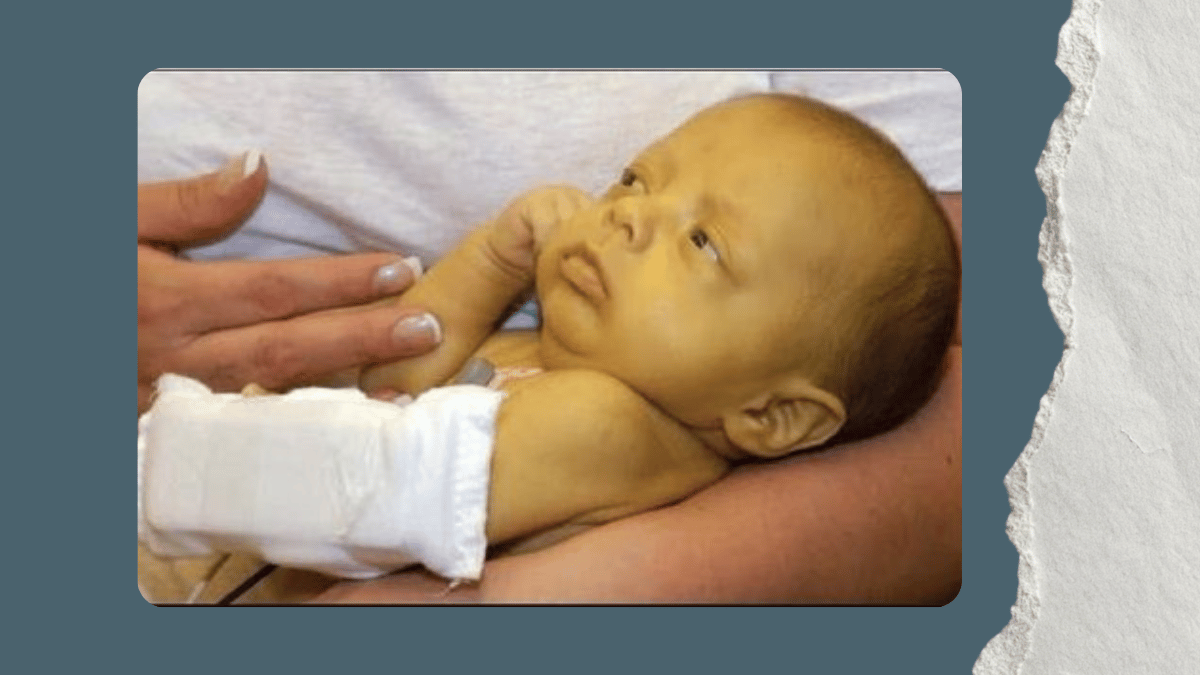
In my complete guide to the first twenty-eight days of a newborn's life, I described neonatal jaundice as one of the most common conditions I see in the neonatal period, affecting more than half of all term babies in the first week of life. It also generates more parental anxiety than almost any other neonatal finding, partly because the yellow colour is visible and alarming, and partly because the feared complication of untreated jaundice, kernicterus, is so serious. I want to address both sides of this directly. Most neonatal jaundice is physiological, benign, and resolves without treatment. But some jaundice is not, and the distinction matters enormously. My published research on bilirubin measurement in preterm neonates using transcutaneous methods, conducted at Shri Shishu Bhawan, Bilaspur, reflects my commitment to minimising blood tests for newborns while maintaining the accuracy of bilirubin monitoring that keeps every baby safe. Understanding the difference between jaundice that can be observed at home and jaundice that requires treatment is the most important thing a parent can take from this guide.
Why Newborns Get Jaundice: The Biology in Plain Language
Bilirubin is a yellow pigment produced when red blood cells break down. Every human produces bilirubin continuously as old red blood cells are recycled. In adults and older children, the liver processes bilirubin efficiently and excretes it through bile into the stool, which is why normal stool is brown. In newborns, two factors combine to create a bilirubin processing challenge. First, the newborn has a higher concentration of red blood cells than an adult, and these red blood cells have a shorter lifespan, so bilirubin is being produced faster. Second, the newborn's liver, while functional, is immature and processes bilirubin more slowly than a mature liver. The combination of higher production and slower processing means bilirubin accumulates in the blood and deposits in the skin, producing the visible yellow colour. Physiological jaundice, the normal kind that follows this mechanism, appears after the first 24 hours of life, peaks between day three and day five, and resolves on its own by two weeks in term babies. The key fact about physiological jaundice is that it does not require treatment in the majority of term babies, and parents should not feel that their baby is unwell because jaundice is visible.
When Jaundice Is Not Normal: The Warning Signs Parents Must Know
Jaundice that falls outside the physiological pattern requires prompt medical assessment. The clearest warning sign is timing: jaundice appearing within the first 24 hours of life is always pathological and always requires urgent evaluation. This early-onset jaundice is typically caused by haemolysis, the accelerated destruction of red blood cells, usually from blood group incompatibility between mother and baby, such as Rh incompatibility or ABO incompatibility. Haemolytic jaundice produces bilirubin far faster than the liver can process, potentially reaching dangerous levels within hours. Other warning signs are jaundice that progresses rapidly after the physiological phase, jaundice that persists beyond two weeks in a term baby, jaundice associated with pale stools and dark urine which suggests a liver or bile duct problem, jaundice in a baby who appears unwell or feeds poorly, and jaundice that spreads to the palms of the hands and soles of the feet, which indicates a high bilirubin level. At Shri Shishu Bhawan, Bilaspur, I use transcutaneous bilirubin measurement as a first-line non-invasive screening tool alongside serum bilirubin levels for confirmation, an approach validated by my own published research in preterm neonates, to monitor jaundice precisely while reducing the number of blood tests a newborn requires.
Phototherapy, Kernicterus, and What Prompt Treatment Prevents
When the bilirubin level reaches a threshold determined by the baby's age in hours and gestational age, phototherapy is started. Phototherapy uses blue-spectrum light to convert bilirubin in the skin to a form that the body can excrete without liver processing, bypassing the processing bottleneck that caused the accumulation. It is safe, effective, and when started at the right time, prevents the bilirubin level from reaching the threshold at which brain injury occurs. Premature babies require phototherapy at lower bilirubin levels than term babies because the immaturity of their blood-brain barrier makes their brain cells more vulnerable. This is one of the reasons preterm neonates in the NICU at Shri Shishu Bhawan are monitored more frequently and with lower treatment thresholds than term babies in the postnatal ward. Kernicterus, the brain injury that occurs when very high bilirubin levels are untreated, causes hearing loss, movement disorder, and intellectual disability. It is entirely preventable with appropriate monitoring and timely phototherapy. For parents whose baby has been told they need phototherapy: this is not a failure. This is the treatment working exactly as it should, catching a rising bilirubin level before it causes harm, and managing it safely and predictably. Neonatal jaundice, when managed correctly, almost never results in any lasting harm. When families come to Shri Shishu Bhawan early, we keep it that way.
To book a neonatal or paediatric consultation with Dr. Shrikant Giri at Shri Shishu Bhawan or MATRIARCH Mother and Child Hospital, Bilaspur, Chhattisgarh (Monday to Saturday 9:00 AM to 5:00 PM and 7:00 PM to 9:00 PM, Sunday 12:00 PM to 2:00 PM), call +91 93009 89803.
Written by Dr. Shrikant Giri, MBBS, MD (Paediatrics), Fellowship in Critical Care (IAP), DPAA, FAAP, Registered NRP Instructor (IAP and NNF), State Basic NRP Coordinator, Regional Advanced NRP Instructor, Director, Shri Shishu Bhawan, Coordinator and Teacher, DNB Postgraduate Institute, Bilaspur, Chhattisgarh. 20+ years. 25,000+ children. Phone: +91 93009 89803.
Related reading
Know Your Doctor: Paediatric Allergy and Asthma Specialist in Bilaspur | Dr Shrikant Giri
The Power of Trust: Building Strong Partnerships Between Parents and Doctors



Add a Comment