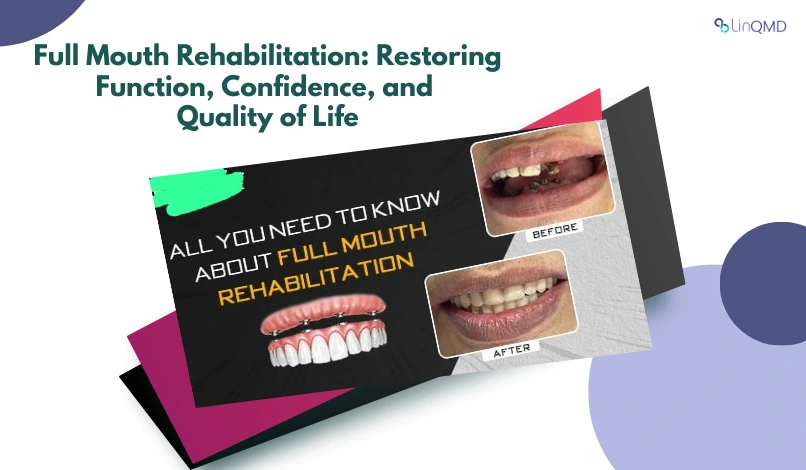
Full mouth rehabilitation is one of the most transformative treatments I perform as a prosthodontist, because it allows patients to reclaim not just their smiles, but their comfort, confidence, and overall well-being. Over the years, I have managed countless complex restorative cases, but full mouth reconstruction remains one of the most rewarding aspects of my practice. Using principles of comprehensive oral rehabilitation, occlusal rehabilitation treatment, advanced prosthodontic rehabilitation, and when required, full mouth dental implants, I aim to restore balance, function, and aesthetics through a personalized, evidence-based approach.
One of the most memorable cases in my experience involved Ms. Sen, a 35-year-old patient who had survived a traumatic accident that resulted in multiple fractured teeth, severe occlusal imbalance, and significant aesthetic concerns. When she first came to me, she was struggling to chew properly, often avoided smiling in social settings, and was overwhelmed by the sudden changes to her facial appearance. Trauma cases like hers require not only clinical expertise but also deep emotional understanding, as patients are often coping with physical and psychological scars.
For Ms. Sen, the treatment process began with a detailed diagnostic phase involving digital scans, occlusal analysis, radiographic evaluation, and full-mouth photographic records. These steps are crucial in any full mouth reconstruction, as they help us understand functional dynamics and structural loss. After evaluating her case, I designed a phased treatment plan combining restorative dentistry, occlusal correction, and prosthetic rehabilitation. Because of the severity of her dental damage, we opted for a strategic combination of crowns, bridges, and implant-supported restorations to rebuild her dentition.
The most essential part of advanced prosthodontic rehabilitation is ensuring that the restored mouth functions harmoniously. We reconstructed her bite using occlusal splint therapy initially, followed by definitive prosthetic restorations once we achieved a stable occlusal scheme. Her full mouth dental implants, placed in carefully selected regions, helped enhance support, load distribution, and long-term durability, all critical factors in patients recovering from trauma.
A major milestone in her journey was the smile try-in appointment. For the first time since her accident, she saw a reflection that resembled her former self, only stronger, more confident, and beautifully restored. The emotional moment that followed reminded me why comprehensive oral rehabilitation is so impactful: it goes far beyond just restoring teeth. It restores identity.
Today, Ms. Sen enjoys a fully functional bite, improved facial aesthetics, and renewed self-esteem. Her case exemplifies how full mouth rehabilitation is not just a clinical procedure but a life-changing transformation, blending science, precision, and artistry.
Conclusion:
Full mouth rehabilitation is a powerful solution for patients experiencing extensive dental damage from trauma, disease, or wear. By combining advanced technologies with a holistic treatment philosophy, we can restore not only oral function but also the patient’s sense of normalcy and confidence. For me, every rehabilitation journey reaffirms that dentistry, at its core, is about healing lives one smile at a time.
Add a Comment