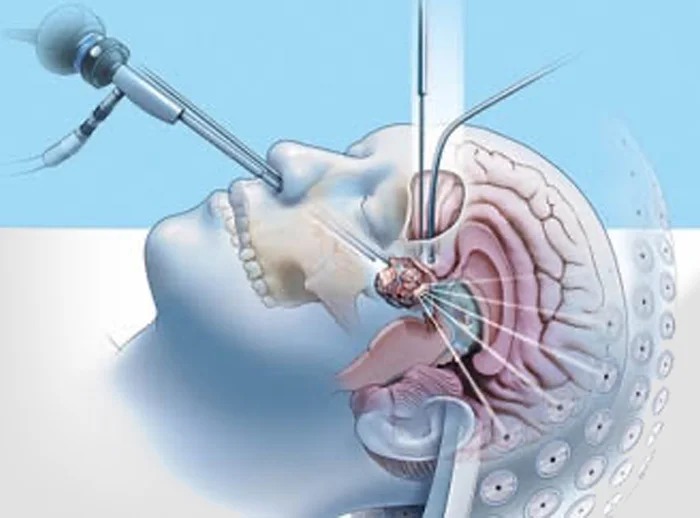
Our Journey with Transnasal Endoscopic Skull Base Surgeries at, SENTHIL MULTIPSPECIALITY HOSPITALS ERODE, SRI NARAYANI HOSPITALS VELLORE, KAUVERY HOSPITALS CONTONMENT TRICHY and now at SRI RAMAKRISHNA HOSPITALS COIMBATORE TAMILNADU.
- By Dr. Vikram M, DNB (Neurosurgery) – HOD, Minimally Invasive Brain and Spine Surgery
- Dr. Rajashanmugam, MS (ENT) – HOD, Senior Consultant Skull Base Surgeon
- Dr Hari Meyyappan MS (ENT) TRICHY
Microneurosurgery was the standard for skull base tumors, after training in neurosurgery with microneurosurgery concepts from 2000 to 2006 When we first began our journey into skull base surgery, we were driven by a single question: Can we reach the most delicate regions of the brain without causing harm on the way? The skull base — that complex foundation cradling the brain and its vital nerves and vessels — has always posed one of the greatest surgical challenges. For decades, open craniotomies were the only path forward, demanding large incisions with brain retraction and magnification offered by microsopes were with cone beam views. But we believed there had to be a better way — one that balanced access with precision, innovation with compassion.
That belief took form through Transnasal Endoscopic Skull Base Surgery (TESBS) — a transformative approach that uses the natural corridor of the nose and sinuses to access deep-seated lesions, sparing patients from external scars and extensive trauma introduced and popularized by Amin Kassam 1, Carl H Snyderman. As a team work of The first time we navigated through the narrow nasal passage to reach a tumor near the pituitary, guided only by a high-definition endoscope, it felt like stepping into a new dimension of neurosurgery — one defined by vision, control, and care.
The Evolution of a Technique:
With every case, our understanding deepened. The intricate anatomy of the sellar, parasellar, and clival regions became a familiar landscape, and each tumor resection or CSF leak repair became a reaffirmation of what modern technology can achieve when guided by skilled hands and thoughtful minds as a team.
Conditions like pituitary adenomas, craniopharyngiomas, chordomas, meningiomas, and orbital pathologies — once managed through large openings in the skull — could now be addressed endonasally with accuracy and grace. The results were remarkable: less pain, quicker recovery, and patients walking home sooner, smiling at the mirror without a single visible scar.
A Team Beyond Individuals:
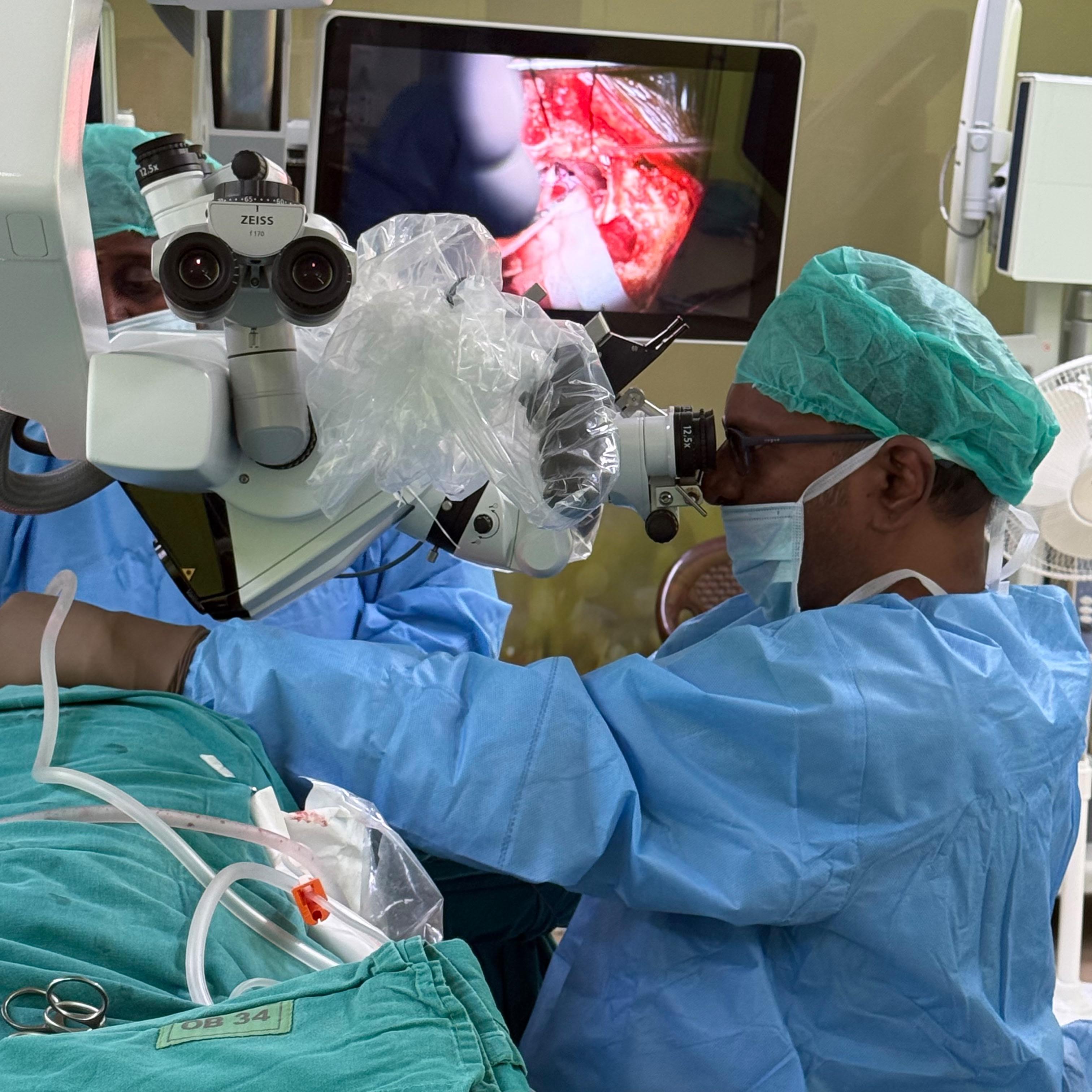
None of this evolution was a solo effort. At Sri Ramakrishna Hospital, our Skull Base Surgery Team embodies the spirit of collaboration. Neurosurgeons and ENT surgeons work shoulder to shoulder with neuroanaesthetists, neurophysiologists, endocrinologists, and intensive care specialists. Each member brings their precision and perspective — a symphony of expertise where every note matters.
With the integration of intraoperative navigation, endonasal CUSA, and neuromonitoring, we have turned surgeries once deemed formidable into safe, structured procedures. But beyond the machines and microscopes, it’s the human connection — the reassurance before surgery, the care afterward — that defines what we do.
Reflections on a Milestone:
Looking back, the journey from open skull base surgery to the transnasal endoscopic approach has been one of discovery and dedication. Every successful outcome strengthens our conviction that innovation and empathy can coexist in the operating room. Today, Sri Ramakrishna Hospital stands as a hub for minimally invasive neurosurgery — not because of technology alone, but because of the passion that drives us to do better for every patient who places their trust in our hands.
Beyond Boundaries:
For us, Transnasal Endoscopic Skull Base Surgery is not just a surgical innovation — it’s a philosophy. It reminds us that the best surgeries are not those that only remove disease, but those that preserve what makes life whole. As we continue to push the boundaries of what’s possible, our vision remains clear: to heal through the smallest pathways, with the greatest precision, and the deepest compassion.
Through the nose, beyond the skull base — and into a future where healing leaves no scars.

Add a Comment