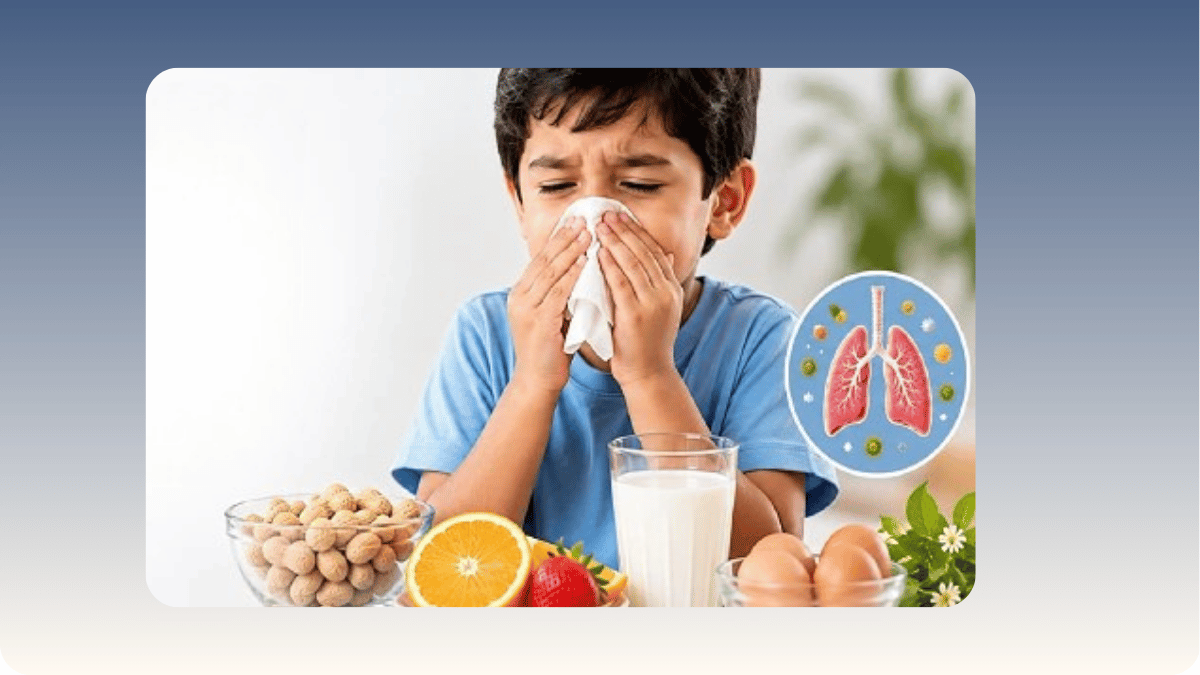
Childhood allergy in Amritsar and across Punjab presents a clinical profile that is distinct from the allergen environment of South Indian coastal cities, and recognising these regional differences is the foundation of allergy management that actually works for children in this part of the country. My DPAA, Diploma in Paediatric Allergy and Asthma from Sir Ganga Ram Hospital, Delhi, and AAAIC, Advanced Allergy and Asthma in Clinical Immunology from the International Asthma Services at the University of Colorado, USA, provide the allergy evaluation and management framework I apply to every child with allergic symptoms at Sparsh Childcare Clinic, Ranjit Avenue, and KMAXX American Hospital, Mall Road, Amritsar. The standard allergy panel developed for national or international use does not capture what drives allergic disease in the Punjab agricultural belt, and an allergy evaluation that misses the regionally specific sensitisers is an evaluation that misses the diagnosis. The allergen environment in Amritsar and Punjab demands a Punjab-informed allergy assessment, not a generic panel applied uniformly.
The Punjab Allergen Profile: What Drives Allergic Disease in Amritsar
Wheat is the most agriculturally dominant crop in Punjab, and wheat pollen sensitisation, released during the spring harvest season, is a clinically important allergen in Amritsar's children that is far more prevalent here than in southern or coastal cities where wheat cultivation is less central to the landscape. A child in Amritsar whose asthma exacerbations cluster in the spring months, or whose rhinitis is most severe in the weeks of the wheat harvest, is very likely sensitised to wheat pollen, and allergy testing that identifies this allows the management plan to specifically address seasonal allergen exposure control and consider immunotherapy for long-term tolerance. Rice cultivation, also significant in Punjab, contributes rice pollen to the late summer and monsoon season allergen burden. Cotton pollen and Parthenium, the invasive plant that has spread widely across Punjab's roadsides, vacant land, and field margins over recent decades, add further pollen layers. Indoor allergen exposure is shaped by Punjab's distinctive winter climate: the dense fog season from December through February significantly reduces outdoor activity and increases time spent indoors, concentrating exposure to house dust mite in mattresses and bedding, and to cockroach allergen in urban households. This winter indoor allergen concentration, combined with the cold air that acts as a direct bronchial trigger, makes the winter months in Amritsar a period of particularly high asthma and rhinitis burden for sensitised children. At Sparsh Childcare Clinic, Ranjit Avenue, and KMAXX Hospital, Mall Road, Amritsar, allergy evaluation includes the Punjab-specific sensitisers that a generic panel misses.
From Skin Prick Testing to Management: The Systematic Allergy Approach
Allergy management begins with the clinical history: the pattern of symptoms, their timing and seasonal variation, the environments in which they are worse or better, and the associated features of eczema, food intolerance, or respiratory symptoms that indicate the breadth of the underlying allergic constitution. The clinical history is the diagnostic tool that determines which allergy tests are actually indicated and which sensitisation is clinically relevant among those that test positive. Skin prick testing with a panel calibrated to Punjab's allergen environment provides results within 20 minutes in the same clinic visit, identifying the specific sensitisations that are driving the child's disease. Management is then built around this information: allergen avoidance guidance specific to the identified triggers in the Amritsar home and school environment, stepwise inhaler therapy with correct spacer technique for the child with asthma, intranasal corticosteroid therapy with technique instruction for allergic rhinitis, appropriate emollient and anti-inflammatory management for eczema, emergency action planning for the child at anaphylaxis risk, and for selected children where confirmed sensitisation is driving significant disease despite pharmacotherapy, allergen immunotherapy as the only treatment that addresses the immune mechanism rather than its downstream consequences. For children in Amritsar with recurring allergy, asthma, or eczema that has not been systematically evaluated, an allergy assessment at Sparsh Childcare Clinic or KMAXX Hospital with DPAA and AAAIC-trained allergy expertise is the starting point for management that goes beyond episodic treatment.
To book a paediatric consultation with Dr. Bharat Mehra at Sparsh Childcare Clinic, Ranjit Avenue, Amritsar (call +91 9878804000) or KMAXX American Hospital, Mall Road, Amritsar (call +91 9878804000).
Written by Dr. Bharat Mehra, MBBS, MD (Paediatrics), FPEM (Fellowship in Paediatric Emergency Medicine, Sir Ganga Ram Hospital, Delhi), IFPCCM (Indian Fellowship in Paediatric Critical Care Medicine, Sir Ganga Ram Hospital, Delhi), DPAA (Diploma in Paediatric Allergy and Asthma, Sir Ganga Ram Hospital, Delhi), AAAIC (Advanced Allergy and Asthma in Clinical Immunology, IAS, Colorado, USA), Consultant Paediatrician, Paediatric Intensivist and Allergy Specialist, Sparsh Childcare Clinic, D-Block, Ranjit Avenue, Amritsar, Punjab 143001 (Monday to Saturday, 5:00 PM to 8:00 PM, +91 9878804000) and KMAXX American Hospital, No. 355, Mall Road, Amritsar, Punjab 143001 (Monday, Wednesday, and Friday, 10:00 AM to 2:00 PM, +91 9878804000). 14+ years. 10,000+ patients.
Related reading
Meet Dr. Bharat Mehra: Where General Paediatrics, Emergency Medicine, and Allergy Care Come Together


Add a Comment