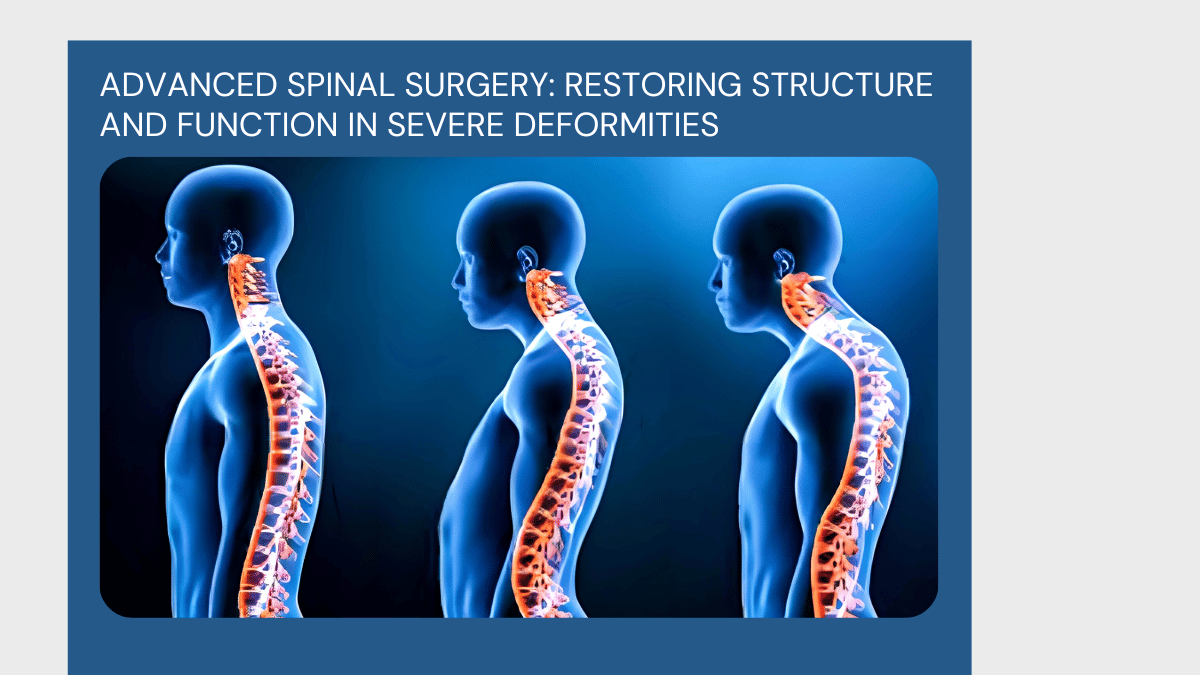
Spinal deformities can be a life-changing condition, affecting not just posture but also overall health and mobility. Having dedicated years to mastering advanced spinal surgeries, I’ve witnessed firsthand how precise intervention can restore both structure and function, significantly improving my patients’ quality of life.
Understanding Severe Spinal Deformities:
Severe spinal deformities like scoliosis, kyphosis, and congenital abnormalities are characterized by abnormal curvatures or misalignments of the spine. These deformities can be congenital—present from birth—or develop over time due to degenerative changes, trauma, or other factors. Often, patients experience pain, numbness, and difficulty maintaining balance, which hampers daily activities and can lead to psychological distress.
A young girl I treated with severe scoliosis had struggled with pain and limited mobility for years. Her case was complex, with a curvature exceeding 70 degrees, but through meticulous planning and advanced surgical techniques, we managed to correct her deformity and significantly improve her posture and well-being.
Causes and Symptoms:
Most severe deformities are idiopathic in nature, especially in adolescents with scoliosis, but congenital deformities stem from abnormal vertebral development. Degenerative conditions, particularly in older adults, can also cause kyphosis or instability. Patients often present with persistent back pain, visible deformity, and nerve symptoms like tingling or weakness in the limbs—alerts that the spinal cord or nerves may be affected. Early diagnosis and intervention are crucial to prevent progression and complications.
Diagnostic Approaches:
Modern imaging plays a vital role in evaluating these conditions. X-rays give us a quick overview of the extent and type of deformity, while MRI scans help assess the spinal cord, nerve roots, and soft tissues, revealing any compression or abnormality. CT scans provide detailed bone architecture, especially when planning complex surgeries. Precise assessment allows us to tailor interventions specific to each patient’s needs.
Surgical Techniques for Deformity Correction:
Treating severe spinal deformities requires a combination of advanced surgical techniques. Spine fixation with rods and screws stabilizes the spine, preventing further progression. Osteotomies—surgical cutting of bones—are often necessary to realign the spine properly, especially in rigid curves. Procedures like Transforaminal Lumbar Interbody Fusion (TLIF) and Anterior Cervical Discectomy and Fusion (ACDF) help decompress nerves and restore stability.
In one challenging case, a middle-aged patient with severe kyphosis underwent a multi-level osteotomy combined with fixation, resulting in a much more natural posture and pain relief. These surgeries demand detailed planning, surgical expertise, and sophisticated technology—roles I am privileged to provide as a spine specialist.
Postoperative Care and Rehabilitation:
The journey doesn’t end in the operating room. Postoperative physiotherapy and diligent follow-up are vital. We focus on strengthening core muscles, improving flexibility, and gradually returning to daily activities. Educating patients about body mechanics and spinal health ensures lasting results and reduces the risk of future issues.
A Patient's Success Story:
Mrs. R, a 48-year-old with severe degenerative kyphosis, came to me after years of debilitating pain and disability. Her MRI revealed significant spinal deformity reducing her height and mobility. After comprehensive evaluation, we performed an advanced corrective surgery with posterior fixation and osteotomies. Today, Mrs. R is pain-free, walking erect, and engaged in her daily routines with renewed confidence—an outcome I cherish as a surgeon.
Future of Spinal Deformity Correction:
Technology continues to evolve, bringing minimally invasive techniques and robotics into our surgical arsenal. These advancements promise even better outcomes, less recovery time, and improved safety profiles. We’re entering an era where correction of severe deformities is safer, quicker, and more precise than ever before.
In my practice, every patient presents a unique challenge. Yet, with a blend of innovation, experience, and compassionate care, I am committed to restoring not just the spine but also the hope and quality of life of my patients.

Add a Comment