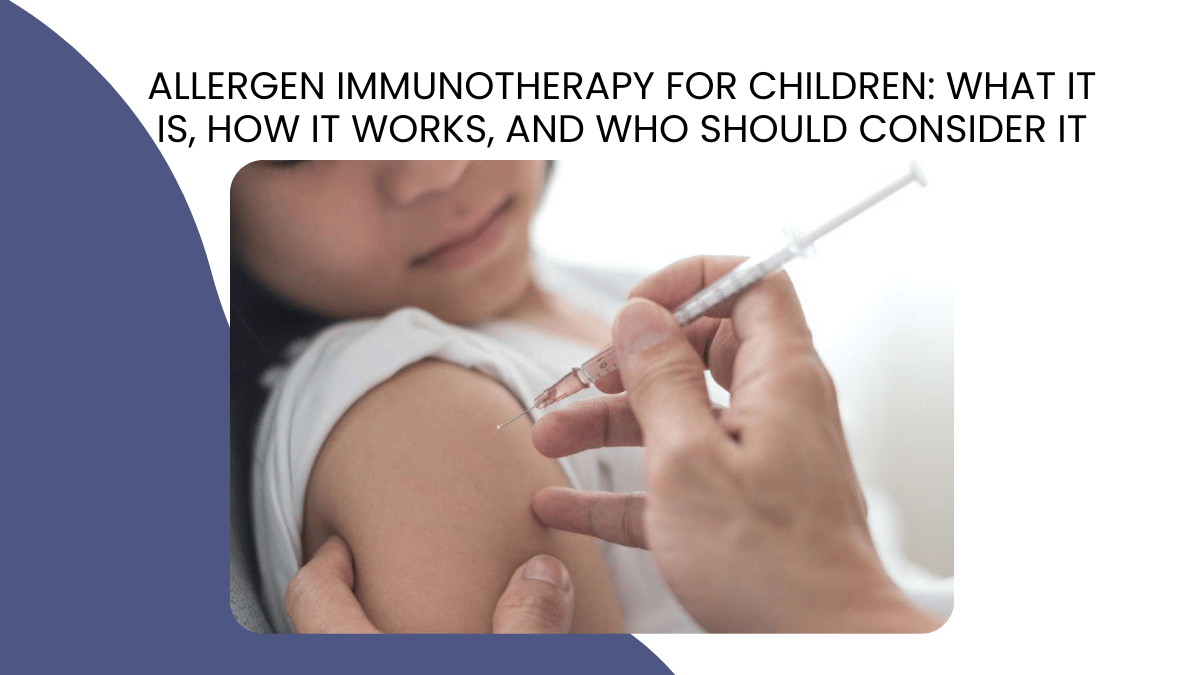
When I explain to parents that there is a treatment option for their child's allergic rhinitis that does not just control symptoms while the medication is being taken but actually changes the underlying allergic response, the most common reaction is surprise. Most parents are familiar with antihistamines and nasal sprays and have come to think of allergy management as an indefinite medication programme. Allergen immunotherapy is different from that, and it is one of the most important treatment options I discuss with parents at Kiran Speciality Hospital, Hassan, once an allergen trigger has been confirmed through skin prick testing. Allergen immunotherapy is the only available treatment that modifies the immune system's response to a specific allergen rather than simply suppressing the symptoms it produces.
How Allergen Immunotherapy Works
The immune system of an allergic child has learned to react to a harmless substance, house dust mite proteins, cockroach allergen, a pollen , as if it were dangerous, triggering the inflammatory response that produces sneezing, nasal obstruction, eye symptoms, and in many children, bronchospasm. Allergen immunotherapy works by gradually re-educating that immune response. Small, incrementally increasing doses of the specific allergen are introduced , either by injection under the skin (subcutaneous immunotherapy, or SCIT) or by drops or tablets under the tongue (sublingual immunotherapy, or SLIT) , over a period of months to years. The immune system progressively develops tolerance to the allergen rather than mounting an inflammatory reaction. This tolerance persists after treatment is discontinued, which is the defining characteristic of immunotherapy: it changes the disease, not just the symptoms. Research has shown that allergen immunotherapy reduces both allergic rhinitis symptoms and the risk of a child with rhinitis going on to develop asthma.
Subcutaneous vs Sublingual Immunotherapy: What Is the Difference?
Subcutaneous immunotherapy (SCIT) involves regular injections of allergen extract administered at the clinic under medical supervision. It is the more established form and has the strongest evidence base, but requires the child to attend the clinic regularly for injections, particularly during the build-up phase when doses are increasing. Sublingual immunotherapy (SLIT) involves placing drops or dissolving tablets under the tongue at home, which is considerably more convenient for families, particularly in a setting like Hassan where travel to the clinic for frequent injections may be a practical consideration. SLIT has a strong and growing evidence base, particularly for house dust mite and grass pollen, and it is administered safely at home after the first supervised dose at the clinic. The choice between SCIT and SLIT depends on the specific allergen, the child's age, the severity of sensitisation, and what is practically feasible for the family.
Who Should Consider Allergen Immunotherapy?
Allergen immunotherapy is considered for children with confirmed sensitisation to a specific allergen , the clinical history fits and the skin prick test is positive , whose symptoms are not adequately controlled with antihistamines and nasal sprays, or who require ongoing medication that the family wants to reduce or eliminate. It is particularly important to consider immunotherapy in children with allergic rhinitis who also have asthma or who are at increased risk of developing asthma, because immunotherapy reduces both the rhinitis and the risk of asthma progression. The combination of allergic rhinitis and asthma, which I see frequently in children presenting at Kiran Speciality Hospital, Hassan, and which I evaluate as a combined airway problem rather than two separate conditions, is one of the clearest indications for immunotherapy as a disease-modifying strategy. A child who has both confirmed allergen sensitisation and either asthma or a strong family history of asthma is a strong candidate for allergen immunotherapy, and I discuss it as an option at the earliest appropriate point rather than waiting for symptoms to worsen.
What Outcomes Can Parents Expect?
Immunotherapy is a commitment of typically three to five years, and the improvements build gradually over the first year. Parents and children who start treatment should understand that this is not a quick fix, but that the long-term outcome, if the course is completed, is significantly better than what medication alone can achieve. Most children completing a full course experience meaningful reduction in symptoms, reduced medication requirement, and improved quality of daily life including better sleep, fewer school absences, and greater participation in sport and outdoor activities. The asthma prevention benefit is an additional outcome with lifelong significance. I review every child's response to immunotherapy at each clinic visit, assess whether the treatment is achieving the expected improvement, and adjust the programme accordingly. The decision to start allergen immunotherapy should be made at a consultation where the specific allergen, the severity of sensitisation, and the child's full clinical picture are discussed in detail.
To book a paediatric allergy or immunotherapy consultation with Dr. H K Kiran Kumar at Kiran Speciality Hospital, Hosaline Road, Hassan (Monday to Saturday, 11:00 AM to 2:30 PM and 6:00 PM to 8:30 PM), call +91 81722 96348.
Written by Dr. H K Kiran Kumar, MBBS, DCH (JSS Medical College, Mysore), Allergy Asthma Specialist Course (MedTrain), Senior Paediatrician and Allergy Asthma Specialist, Kiran Speciality Hospital, near Basaveshwara Kalyana Mantapa, opposite Venkateshwara High School, Hosaline Road, Hassan 573201, Karnataka. 22+ years. 12,000+ patients. Phone: +91 81722 96348.
Related reading
Why Does My Child Keep Sneezing? A Parent's Guide to Identifying Allergic Rhinitis Triggers
Childhood Asthma and Allergic Rhinitis: A Complete Guide for Parents in Hassan


Add a Comment