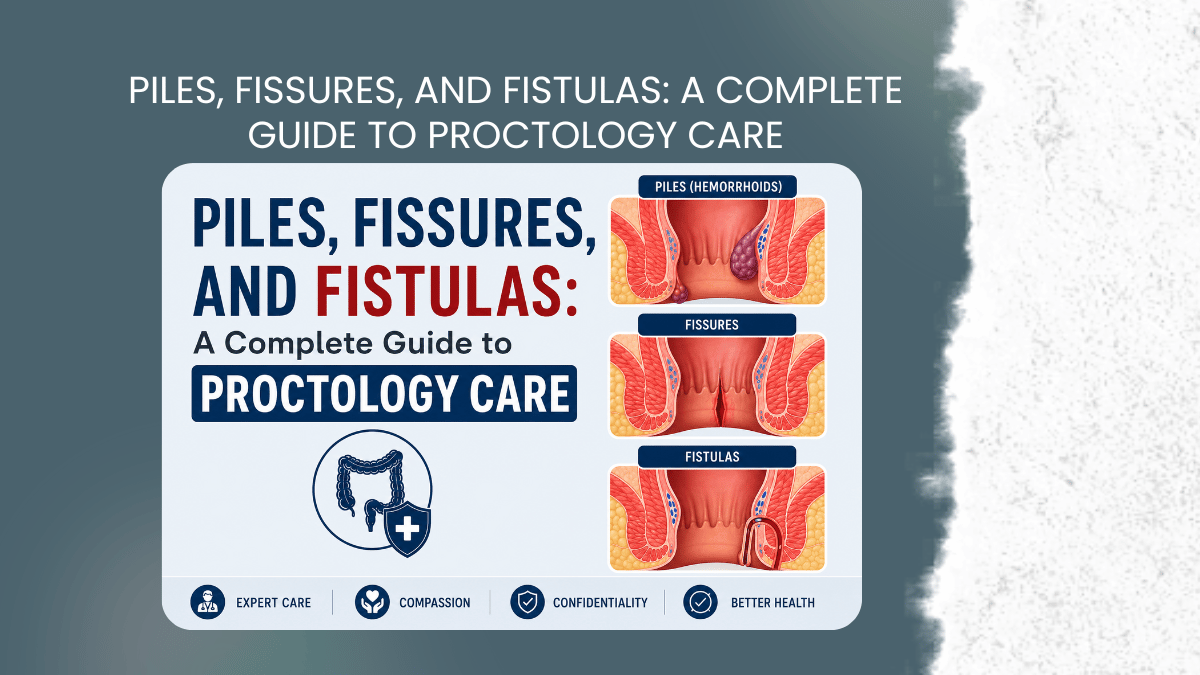
Anorectal problems are some of the most common conditions I see in my practice, and also some of the most delayed. Many patients live with pain, bleeding, or discomfort for months before seeking help, simply because the area feels too embarrassing to discuss. At NiSH Clinic, Jayanagar, I want patients to know that piles, fissures, and fistulas are common, treatable, and nothing to feel embarrassed about.
In my practice, one of the most common concerns I hear is that patients waited too long to seek help because they felt embarrassed discussing anorectal symptoms. In reality, early evaluation often allows simpler treatment and faster recovery, while delays can make conditions more difficult to manage.
This guide walks through what each of these three conditions actually is, how they differ from one another, how they are diagnosed, and what treatment realistically involves, so that patients have a clear picture before they ever step into a consultation.
What are piles and why do they happen?
Piles, also called haemorrhoids, are swollen blood vessels in and around the anal canal. They develop when the veins in this area become engorged, often due to straining during bowel movements, chronic constipation, prolonged sitting, pregnancy, or a low-fibre diet. Piles can be internal, located inside the rectum, or external, located under the skin around the anus, and many patients have a combination of both.
The most common symptoms are painless bleeding during bowel movements, a feeling of fullness or a lump near the anus, itching, and discomfort while sitting. Internal piles often cause bleeding without pain, while external piles tend to be more uncomfortable, particularly if a clot forms within them.
Piles are also commonly graded by severity, from Grade I, which involves no prolapse and bleeds only, through to Grade IV, where the pile remains permanently prolapsed outside the anus and cannot be manually pushed back in. This grading matters clinically, since it directly informs which treatment is likely to be effective. A Grade I or II pile often responds very well to dietary and lifestyle measures alone, while a Grade III or IV pile is far more likely to need a procedural or surgical solution.
What is an anal fissure and how is it different from piles?
An anal fissure is a small tear in the lining of the anal canal, usually caused by passing a hard or large stool. Unlike piles, fissures typically cause sharp, intense pain during and after a bowel movement, sometimes lasting for hours, along with bright red bleeding. The pain often leads to a cycle where patients avoid passing stool, which worsens constipation and makes the fissure harder to heal.
Most fissures are acute and heal within a few weeks with proper management. A fissure that persists beyond six to eight weeks is considered chronic and often requires a more structured treatment approach to heal completely.
One distinguishing feature of a fissure compared to piles is the nature of the pain itself. Patients with a fissure often describe a tearing or burning sensation at the moment of passing stool, followed by a deep ache that can persist for an hour or more afterward, sometimes described as feeling like passing glass. This pattern, sharp pain during defecation followed by a lingering ache, is one of the clearest clinical clues that points toward a fissure rather than piles, even before any examination is performed.
What is an anal fistula and why does it need different treatment?
An anal fistula is an abnormal tunnel that forms between the inside of the anal canal and the skin near the anus, most commonly following an anal abscess that has drained or been treated. Unlike piles or fissures, a fistula will not heal on its own with creams or lifestyle changes. It typically presents with persistent discharge, recurrent swelling, and intermittent pain, and almost always requires surgical treatment to close the tract completely.
Fistulas are assessed carefully before surgery, since the tract's path in relation to the anal sphincter muscles determines which surgical technique is safest and most likely to succeed without affecting continence.
Fistulas are broadly classified based on how their tract relates to the sphincter muscles, ranging from simple, low tracts that cross very little muscle, to complex, high tracts that pass through a significant portion of the sphincter or branch into multiple directions. This classification is not just academic. A simple, low fistula can often be treated definitively in a single straightforward procedure, while a complex, high fistula may need a staged approach specifically to avoid compromising bowel control, which is always weighed carefully against the goal of completely curing the fistula.
How are these conditions diagnosed?
A focused history and a physical examination, including a gentle digital rectal examination, are usually sufficient to diagnose piles and fissures. For fistulas or more complex cases, additional assessment such as proctoscopy or imaging may be needed to map the tract accurately before planning treatment. I always explain what the examination will involve beforehand, since I understand this is an area patients feel particularly anxious about.
For fistulas specifically, imaging such as an MRI fistulogram is sometimes used preoperatively in complex or recurrent cases, since it can reveal branches of the tract that are not apparent on examination alone. Identifying these branches before surgery reduces the chance of an incomplete procedure that leaves disease behind, which is one of the more common reasons fistulas recur after treatment elsewhere.
What treatment options are available for piles?
Mild to moderate piles often respond well to dietary fibre increase, adequate hydration, topical treatments, and correcting the straining habits that caused them in the first place. When piles are more advanced, recurrent, or not responding to conservative measures, minimally invasive procedures or surgical removal may be recommended, chosen based on the grade and extent of the piles rather than a one-size-fits-all approach.
For Grade II and selected Grade III piles, minimally invasive options such as rubber band ligation or sclerotherapy can often be performed in a single outpatient visit, with minimal downtime and a quick return to normal activity. For larger, prolapsed, or recurrent piles, a formal surgical haemorrhoidectomy or a stapled procedure provides a more definitive, longer-lasting result, at the cost of a somewhat longer initial recovery. I walk patients through this trade-off explicitly, since the right choice often depends as much on a patient's tolerance for a longer recovery as it does on the grade of the piles themselves.
What treatment options are available for fissures?
Most acute fissures heal with stool softeners, increased fibre and fluid intake, topical sphincter-relaxant medication, and sitz baths to ease discomfort. Chronic fissures that fail to heal with these measures may require a minor surgical procedure to relax the sphincter and allow the fissure to close permanently.
Topical treatment for fissures typically takes the form of a nitrate or calcium channel blocker ointment applied directly to the anal canal, which works by relaxing the internal sphincter muscle and improving local blood flow, both of which support healing. These topical treatments are given a genuine trial of six to eight weeks before being considered unsuccessful, since healing can be gradual even when the right treatment is being used correctly.
What does fistula surgery involve?
Fistula surgery aims to close the abnormal tract while preserving normal bowel control. The specific technique depends on how much of the sphincter muscle the tract crosses, which is why accurate pre-operative assessment matters so much. Some fistulas can be treated in a single procedure, while complex tracts may require a staged surgical approach to balance complete healing with preserving continence.
For simple, low fistulas, a fistulotomy, laying open the tract so it heals from within, is often curative in a single procedure. For more complex tracts, techniques that preserve more of the sphincter, such as placing a seton, a soft thread left through the tract to allow gradual drainage and controlled healing, are often used as either a staged step toward definitive surgery or, in some cases, as a longer-term solution in itself. The decision between these approaches is individualised, balancing the priority of curing the fistula completely against protecting the sphincter function that governs continence.
When should you see a doctor for these symptoms?
A specialist evaluation is appropriate if you notice rectal bleeding, persistent pain in the anal area, a lump or swelling that does not resolve, discharge or recurrent swelling near the anus, or symptoms that have lasted more than a few weeks despite home measures. Bleeding should never be assumed to be from piles without an examination, since other conditions can present similarly and benefit from being ruled out.
This last point deserves particular emphasis. Rectal bleeding is sometimes the first sign of a condition other than piles, and self-diagnosing based on internet searches or a previous diagnosis of piles years ago can delay identification of something that needs a different kind of attention. A brief examination is a small step that provides genuine reassurance, or catches something early that benefits significantly from early attention.
What can be done to prevent these conditions from recurring?
Maintaining a high-fibre diet, staying well hydrated, avoiding prolonged straining or sitting on the toilet, and treating constipation promptly are the most effective long-term measures across all three conditions. For patients who have already had treatment, these habits also reduce the chance of recurrence significantly.
Prevention is often underestimated by patients who view surgery or a procedure as the complete solution. In reality, the procedure addresses the existing problem, while the underlying habits that contributed to it, whether chronic constipation, prolonged sitting, or insufficient fibre intake, remain unless they are specifically and deliberately changed. I spend time on this conversation at every follow-up, since it is genuinely the difference between a one-time treatment and a recurring cycle of symptoms.
- Aim for a fibre intake that softens stool naturally, through whole grains, fruits, and vegetables, rather than relying solely on supplements
- Drink enough water throughout the day, since fibre alone is less effective without adequate fluid intake
- Avoid sitting on the toilet for prolonged periods, including avoiding reading or using a phone while seated, since this encourages straining
- Respond to the urge to pass stool promptly rather than delaying, since delaying allows stool to harden further
- Stay physically active, since regular movement supports healthy bowel function and reduces prolonged sitting
Questions patients ask me most often
Are piles dangerous?
Piles themselves are rarely dangerous, but persistent bleeding should always be evaluated to rule out other causes of rectal bleeding, particularly in patients over 40 or with a family history of bowel conditions. Most piles are very effectively managed once properly assessed.
Why does my fissure keep coming back?
Recurrent fissures are often linked to ongoing constipation or straining that has not been fully addressed. Treating the fissure itself without correcting the underlying bowel habit frequently leads to recurrence, which is why I focus on both together.
Is fistula surgery painful, and how long is recovery?
Fistula surgery is performed under appropriate anaesthesia, and post-operative discomfort is generally manageable with prescribed pain relief. Recovery time after fistula surgery depends on the complexity of the tract and the specific technique used, ranging from a couple of weeks for simpler fistulas to a longer healing period for more complex cases.
Can these conditions be treated without surgery?
Many cases of piles and fissures respond well to non-surgical management, particularly when caught early. Fistulas are the exception, since they generally require surgical treatment to heal completely.
Will I need to change my diet permanently after treatment?
Yes, in most cases, ongoing dietary fibre and hydration are part of long-term prevention regardless of which treatment was used. Treating the immediate problem without addressing the underlying bowel habits that contributed to it significantly increases the chance of the same issue returning.
Can pregnancy cause piles or fissures, and do they need separate treatment?
Pregnancy-related piles and fissures commonly develop due to hormonal changes, increased pelvic pressure, and constipation that is common in later pregnancy. Most cases that develop during pregnancy are managed conservatively wherever possible, since many resolve or significantly improve after delivery. When symptoms are severe or persist well beyond the postpartum period, a fuller evaluation and discussion of treatment options is appropriate at that stage.
Book a Consultation for Piles, Fissures, or Fistulas in Jayanagar, Bengaluru
If you are experiencing bleeding during bowel movements, anal pain, swelling, discharge, or symptoms suggestive of piles, fissures, or fistulas, consult Dr Moksha Gowda at NiSH Clinic, Jayanagar, Bengaluru, for a detailed evaluation and personalised treatment plan.
Call: +91 9008315624
Visit: linqmd.com/doctor/moksha-g
Written by Dr Moksha Gowda, MBBS, DNB (General Surgery), Consultant General and Laparoscopic Surgeon, NiSH Clinic, Jayanagar, Bengaluru.
Related reading
linqmd.com/doctor/moksha-g/blog/gallbladder-stones-treatment-surgery-jayanagar-dr-moksha-gowda
linqmd.com/doctor/moksha-g/blog/hernia-treatment-tep-vs-tapp-dr-moksha-gowda-jayanagar-Bengaluru
linqmd.com/doctor/moksha-g/blog/laparoscopic-surgery-benefits-procedure-recovery-bangalore-dr-moksha-gowda

Add a Comment