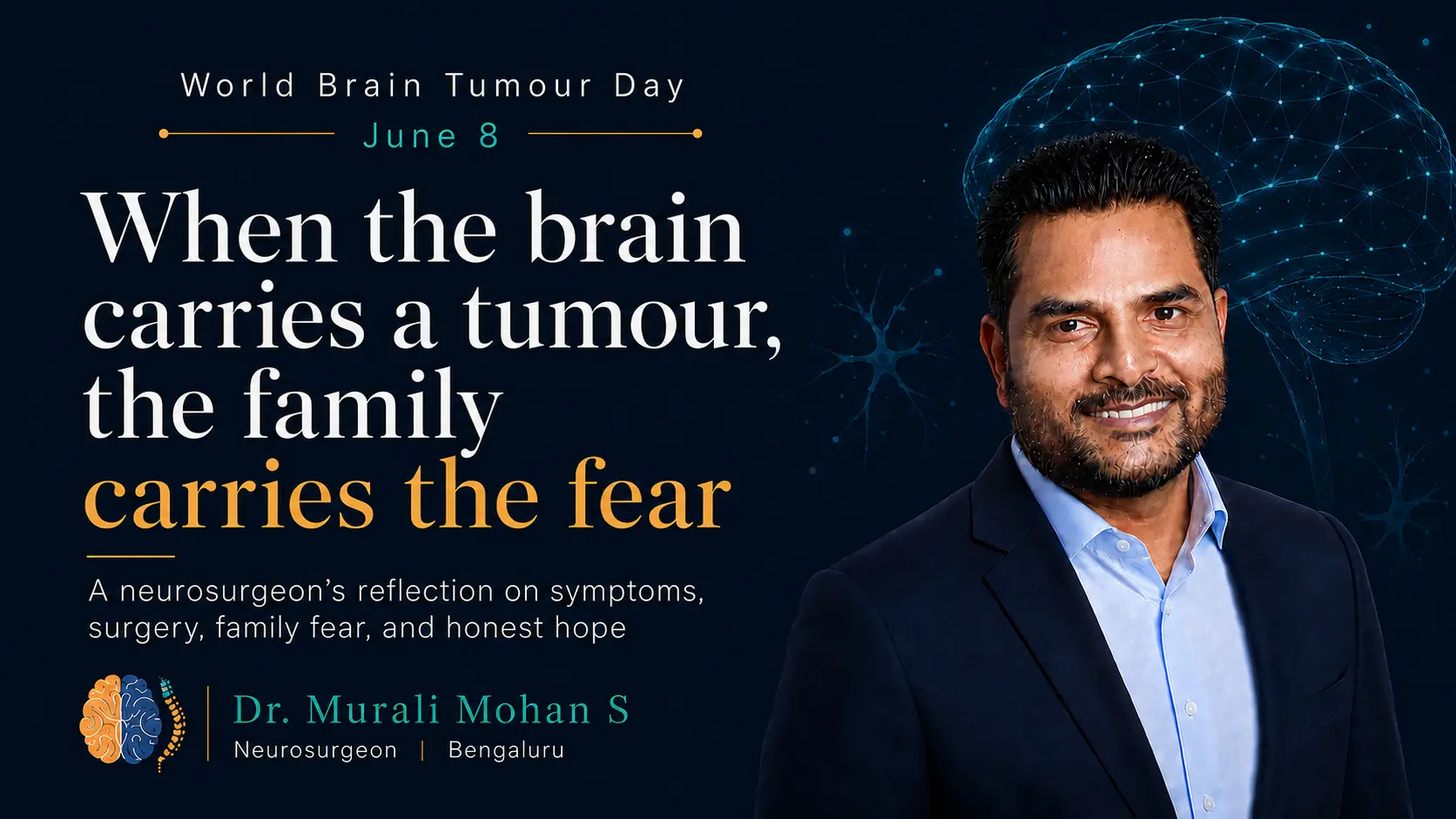
When the Brain Carries a Tumour, the Family Carries the Fear
World Brain Tumour Day, June 8
By Dr. Murali Mohan S
Every year, June 8 reminds us to speak about brain tumours. Not with fear. Not with false reassurance. But with clarity. A brain tumour diagnosis is not just a finding seen on an MRI scan. It is a sentence that suddenly enters the life of a patient and a family. One day, life is moving in its usual rhythm. The next day, there is a scan report, a new word, a room full of questions, and a fear that is difficult to describe.
Is it cancer? Will it grow? Will surgery be needed? Will the person recover? Will memory, speech, movement, vision, or personality change? Will life ever become normal again?
As a neurosurgeon, I have sat with these questions many times. I have seen the silence that follows when a family first hears the word “tumour.” I have seen the strength of patients who are frightened but still trying to understand. I have seen relatives searching the doctor’s face for certainty, when medicine can often offer only probability, experience, and a carefully chosen way forward.
World Brain Tumour Day is important because awareness can reduce fear. But awareness must be truthful.
The numbers themselves are sobering. Data from the Indian Council of Medical Research suggests that central nervous system and brain tumours affect between 5 and 10 people per 100,000 in India, and account for roughly 2% of all malignancies in the country. Globally, the World Health Organization registers more than 300,000 new brain and central nervous system cancer cases every year. Behind every one of those numbers is a person, and a family trying to understand what comes next.
A brain tumour is not one disease. It is a broad group of conditions. Some tumours are benign. Some are malignant. Some grow slowly over years. Some behave aggressively.
What are the warning symptoms of a brain tumour?
Some are located in areas where surgery can be relatively safe. Some sit close to critical regions that control speech, movement, vision, balance, memory, or consciousness. Some require surgery. Some require radiation. Some require chemotherapy. Some require observation and regular follow-up. That is why the first step is not panic. The first step is understanding.
Brain tumour symptoms can present in many different ways. A persistent headache, especially one that is new, worsening, associated with vomiting, or more severe in the morning, needs attention. Seizures in an adult who has never had seizures before should always be evaluated. Weakness of one side of the body, difficulty speaking, imbalance, visual problems, personality change, memory disturbance, or unexplained drowsiness should not be dismissed.
Many of these symptoms can happen due to conditions other than brain tumours. But they deserve proper medical evaluation. The purpose of awareness is not to make every headache frightening. The purpose is to help people recognise when a symptom needs medical attention.
The fear around surgery:
Early diagnosis does not simply mean finding a tumour early. It means giving the patient more options, more time to plan, and a better chance of preserving function and quality of life.
For many patients, brain tumour surgery is more frightening to consider than the diagnosis itself. This is understandable. The brain is not just another organ. It carries memory, movement, speech, emotion, personality, and the sense of who we are. A patient does not ask only, “Will I survive?” A patient asks, sometimes silently, “Will I remain myself?”
This is why counselling is such an important part of neurosurgery. A good discussion before surgery must not be rushed. The patient and family should understand why surgery is being advised, what it aims to achieve, what the possible risks are, what alternatives exist, what recovery may look like, and what further treatment may be needed after the biopsy or tumour removal.
How has brain tumour treatment changed?
The aim of surgery itself varies, from complete removal to safe maximum removal where critical structures must be preserved, from a diagnostic biopsy to determine the tumour type before planning further treatment, to the decision that surgery is not the first step at all. In brain tumour care, the right decision is not always the most aggressive decision. Knowing when to operate is important. Knowing how much to operate is equally important. Knowing when not to operate is also part of neurosurgical judgment.
There was a time when a brain tumour treatment plan carried only dread. Today, the landscape is changing. Modern imaging helps us understand the tumour better. Microscopes, navigation systems, intraoperative monitoring, endoscopy, minimally invasive approaches, better anaesthesia, neuro ICU care, advanced radiation techniques, chemotherapy protocols, targeted therapies, molecular diagnosis, and multidisciplinary tumour boards have all improved the way patients are treated.
Benign tumours when surgically removed, often offer complete cure in most cases such as in Colloid Cyst, Pituitary tumour , acoustic schwannoma, meningioma and others.
The family is also a patient:
Technology alone is not the answer. The best outcomes in brain tumour care come when science, judgment, teamwork, and communication come together. A patient may need a neurosurgeon, a neurologist, a radiation oncologist, a medical oncologist, and a pathologist, along with a wider team of intensivists, rehabilitation specialists, therapists, and trained nursing support at different stages of care.
The tumour may begin in the brain, but the treatment journey involves the whole person.
One truth that is often overlooked is this: when one person has a brain tumour, the whole family is affected. The patient carries the disease. The family carries the fear. They worry about survival, surgery, money, work, children, recovery, disability, recurrence, and the unknown future. They listen to medical words they have never heard before. They search online, often late at night, and find both information and misinformation. They compare stories. They hear frightening examples. They wonder if they are making the right decision.
Life after diagnosis:
Families need guidance, not just instructions. They need someone to explain the scan. They need to know what is urgent and what is not. They need to understand that every tumour is different. They need permission to ask questions. They need honesty, but they also need hope. Hope is not the promise that everything will be perfect. Hope is the confidence that there is a plan.
For many patients, brain tumour recovery is only one part of the journey. Return to walking, speaking, working, studying, parenting, sleeping, eating, thinking clearly, and living with dignity matters. Some patients recover quickly, some take time. Some need rehabilitation, some need long-term follow-up, some need repeat scans. Some live with weakness, seizures, memory concerns, or emotional changes. Some fear every follow-up MRI.
This is where brain tumour follow-up becomes important. Brain tumour care does not end when the surgery is over or when the wound has healed. The patient must know what to watch for, when to return, how often to scan, what medicines to take, what symptoms are warning signs, and how to rebuild life step by step. The goal is not only survival; it is meaningful life.
What World Brain Tumour Day should remind us:
Four reminders carry the day:
- Symptoms that are new, worsening, or unusual deserve early evaluation rather than dismissal.
- Every tumour is different, and the type, location, and behaviour of a tumour shape the treatment that is right for that particular patient.
- Communication, more than anything, reduces fear, and families should leave a consultation understanding the situation well enough to explain it to someone at home.
- Brain tumour care must bring together medical treatment, emotional support, rehabilitation, and family strength, not as separate efforts but as one.
In 2018, I wrote that brain tumours should not create stigma or dilemma, and that timely treatment matters. Years later, I still believe that. In 2024, I wrote about moving from brace to embrace, replacing fear with faith and hope. I still believe that too.
But today, I would add one more thought. A brain tumour is not only a disease to be treated. It is a life event to be walked through carefully.
The patient needs science. The family needs clarity. The doctor needs humility. And everyone needs hope that is honest.
On this World Brain Tumour Day, let us replace panic with awareness, confusion with understanding, and isolation with support. When the brain carries a tumour, the family carries the fear. My duty is to help both. The first step is an early neurosurgeon consultation - where your imaging is reviewed, your options are explained, and you are never left without a plan.
@FB
@Insta
@X Twitter
@LinkedIN
About the Author:
Dr. Murali Mohan S is a consultant neurosurgeon based in Bengaluru and Lead Consultant, Neurosciences at SPARSH Hospital, Hennur. He has worked across the spectrum of brain and spine surgery in children, adults, and older patients, and writes regularly on brain and spine health, neurosurgical care, and the place of communication in medicine.
This piece is for awareness. It is not a substitute for medical advice. Anyone with concerning symptoms should seek in-person medical evaluation.
👉 To book a consultation with Dr Murali Mohan S at SPARSH Hospital, Hennur, Bengaluru


Comments
Kushal
Posted on: June 08,2026 Published
An excellent and informative article that explains a complex topic in a clear and easy-to-understand manner. The insights on brain tumour awareness, early diagnosis, and treatment options make this a valuable resource for patients and caregivers alike. Well written and highly educational.
Pushpa AG
Posted on: June 08,2026 Published
Well written, Dr Murali Sir. The article is easy to understand and communicates the message clearly to a wide audience. Truly excellent Insight sir 👍
Shalini Thiru
Posted on: June 08,2026 Published
A very insightful and impactful read Doctor. Thank you, Dr. Murali Mohan S, for raising awareness about brain tumours and emphasizing the importance of early detection and timely treatment. Your commitment to patient education and neuro care is truly inspiring. Wishing you continued success in transforming lives through knowledge and expertise.
Anantharaju Prasad
Posted on: June 08,2026 Published
Great Article Murali. Thanks for putting it so succinctly and highlighting the bigger picture. Just a brain tumour diagnosis not all doom and gloom. Well articulated, keeping family in the picture as well. All the best.
Amarnath Reddy
Posted on: June 08,2026 Published
It's very important and informative article thank you sir
Ahmed Madheeh
Posted on: June 08,2026 Published
Excellent article highlighting the importance of early diagnosis and awareness of brain conditions. I had the privilege of being treated by Dr. Murali Mohan S in January 2026, when he successfully performed my craniotomy to remove a colloid cyst. Throughout my treatment, he demonstrated exceptional skill, professionalism, and compassion. My experience is a testament to the value of expert neurosurgical care, and I am grateful to Dr. Murali Mohan S and his team for the excellent outcome.
Parimala L k
Posted on: June 08,2026 Published
Dear Dr. Murali, You truly expressed the feelings of our entire family. In difficult times, fear is often the first emotion experienced by loved ones, but the trust and confidence you inspire remain with us forever. The insight are very touching Thank you for standing by our side during a challenging time and for your dedication, care, and commitment to saving lives. Your support, compassion, and expertise have made a lasting impact on our family, and we will always be grateful.
Vinothkumar
Posted on: June 08,2026 Published
I can totally relate the patient's feeling when it comes to surgery and I can totally relate it. Well written thoughts to help improve patients mindset and behaviour
Mechelle D'Rozario
Posted on: June 09,2026 Published
Thank you, Dr. MMS, for taking the time to create such an informative piece. I’m sure this will help many patients and their families gain clarity and a sense of confidence during a difficult time. Truly appreciate and applaud your efforts and dedication toward patient care, awareness and education.
Add a Comment