When patients sit in my dental chair at Dentacure, Kasturi Nagar, Bengaluru, one of the things I hear most often is that they did not realise their gums were a problem until the problem had become significant. Bleeding when brushing, a slight recession at the gum line, a persistent bad taste in the mouth, these symptoms are so commonly minimised or explained away as normal that many people live with moderate gum disease for years before seeking assessment. Periodontal health is the foundation on which everything else in the mouth depends. Strong, healthy gums support natural teeth. They are the environment in which dental implants succeed or fail. They are the tissue that, when diseased, can contribute to cardiovascular disease, diabetes control difficulties, adverse pregnancy outcomes, and systemic inflammatory conditions whose connection to oral health is increasingly recognised by medicine. The most important thing I can offer any patient who comes to Dentacure with a question about their gums is a clear explanation of what is actually happening in their mouth , because understanding gum disease is the first step to preventing and reversing it.
Why Gum Health Is the Foundation of Your Oral Health
The gums are the soft tissue envelope that surrounds and supports the teeth, sealing the space between the crown of the tooth visible above the gum line and the root that extends into the jawbone. Beneath the gum surface, a complex system of connective tissue fibres (the periodontal ligament) and bone (the alveolar bone) anchors the tooth within its socket, providing both stability and the slight, cushioned mobility that allows teeth to withstand biting forces without fracture. When this supporting structure is healthy, teeth are stable, the bite is comfortable, and the barrier between the oral cavity and the bone is intact. When the supporting structure is diseased and breaks down, this cannot always be reversed. Bone that is lost to periodontal disease does not regenerate spontaneously, and teeth that have lost sufficient bone support can become mobile and eventually need to be extracted. This irreversibility is the reason why the earliest stages of gum disease are the most important to recognise and treat, not the advanced stages where treatment has less to rescue.
Beyond the mouth, the bacterial burden and inflammatory mediators generated by periodontal disease can enter the systemic circulation and are associated with increased risk of cardiovascular events, poorer glycaemic control in people with diabetes, premature birth in pregnant women, and links to rheumatoid arthritis and certain respiratory conditions. Treating periodontal disease is therefore not only about keeping teeth. It is about reducing a systemic inflammatory load that has real consequences for general health.
Plaque and Calculus: Where Gum Disease Begins
Gum disease begins with dental plaque. Plaque is a soft, sticky biofilm that forms continuously on all tooth surfaces throughout the day. It is composed of saliva proteins, food debris, and a complex community of bacteria. In healthy mouths, a balanced microbial community lives in the plaque without causing harm. When plaque is allowed to accumulate undisturbed, particularly at the gum margin and between teeth, the bacterial composition shifts toward more aggressive, anaerobic species that produce toxins and inflammatory signals that damage the gum tissue.
The critical point about plaque is that it can be disrupted and removed by effective daily brushing and flossing. The problem arises when plaque is not consistently removed and instead mineralises, incorporating calcium and phosphate from saliva to form calculus, which is commonly known as tartar. Calculus is hard and calcified and cannot be removed by brushing or flossing; it requires professional scaling instruments to disrupt and remove it. Once calculus is present, it provides a roughened surface on which new plaque accumulates preferentially, and it sits below the gum margin where it drives an ongoing inflammatory response in the surrounding tissue. This is why professional dental cleaning is not a luxury but a clinical necessity, regardless of how well a patient brushes at home.
The Stages of Gum Disease: From Gingivitis to Advanced Periodontitis
Gum disease is not a single condition. It exists on a spectrum that begins with inflammation of the gum tissue alone and progresses, in susceptible patients, to destruction of the deeper supporting structures. Understanding the stages helps patients understand both the urgency of treatment and the realistic goals that treatment at each stage can achieve.
Gingivitis
Gingivitis is the earliest and most reversible stage of gum disease. It involves inflammation of the gum tissue in response to bacterial plaque, producing the characteristic signs of redness, swelling, and bleeding on brushing or probing. The bone and connective tissue support of the tooth are not yet involved, meaning that gingivitis, if identified and treated with thorough professional scaling and improved home oral hygiene, is fully reversible. The gums can return completely to health. Gingivitis is extremely common, affecting the majority of adults at some point, and it is the stage that patients most often dismiss precisely because bleeding gums without pain may not feel like a clinical problem that needs attention.
Mild to Moderate Periodontitis
When gingivitis is not resolved, the inflammation progressively extends from the gum tissue into the periodontal ligament and the alveolar bone. Pockets form between the tooth root and the gum as the attachment is lost, and bacteria colonise these pockets below the gum margin where they are inaccessible to routine brushing. Mild to moderate periodontitis produces measurable pocket depths, early bone loss visible on dental X-rays, and gum recession that exposes the root surface. Treatment at this stage involves scaling and root planing, which is a more thorough cleaning of the root surfaces within the pockets to remove plaque and calculus from below the gum margin, combined with antimicrobial management where indicated. Most cases of mild to moderate periodontitis respond well to non-surgical periodontal treatment when followed by consistent home care and regular professional review, though some bone loss is irreversible.
Advanced Periodontitis
Advanced periodontitis involves significant loss of attachment and bone support, deep pockets that may exceed six millimetres, tooth mobility, and in some cases, teeth that can no longer be maintained. Treatment at this stage may require periodontal flap surgery, where the gum tissue is carefully reflected to allow direct access to the deep root surfaces and underlying bone for thorough cleaning and, where appropriate, bone regeneration procedures. Some teeth with advanced bone loss may not be salvageable, and extraction followed by implant or other prosthetic replacement may be the most appropriate outcome. The goal of treatment at the advanced stage shifts from reversal to stabilisation: halting further progression, maintaining the teeth that can be maintained, and managing the periodontium in a way that supports the patient's long-term oral health as effectively as possible.
Professional Cleaning: What It Involves and How Often You Need It
Scaling and polishing is the most fundamental professional periodontal intervention, and it is the foundation of both gum disease treatment and preventive periodontal care. Scaling involves the use of hand instruments and ultrasonic scalers to remove plaque, calculus, and stain from all tooth surfaces, including the surfaces between teeth and below the gum margin. Polishing removes residual surface plaque and stain after scaling and leaves the tooth surfaces smooth, which slows plaque re-accumulation.
For patients with healthy gums and minimal calculus accumulation, scaling and polishing once every six to twelve months, combined with effective daily home care, is typically sufficient to maintain periodontal health. For patients who have been treated for periodontal disease or who accumulate plaque and calculus more rapidly due to their anatomy, saliva composition, or systemic conditions, more frequent professional cleaning at three to four monthly intervals is the standard of periodontal maintenance care. The frequency of professional dental cleaning should be determined by a periodontist based on the patient's individual periodontal risk, not by a universal default interval. At Dentacure, Kasturi Nagar, I assess each patient's periodontal status and recommend the cleaning interval that matches their specific clinical need.
Oral Hygiene: What Effective Home Care Actually Involves
Professional dental cleaning is not a substitute for daily oral hygiene. It addresses the accumulated calculus and below-gum-margin deposits that home care cannot remove. Home care addresses the daily plaque that forms on every tooth surface and that, if consistently disrupted, never gets the opportunity to mineralise into calculus or trigger the gum inflammation that begins gum disease.
Effective toothbrushing requires reaching all tooth surfaces with the bristles angled toward the gum margin, covering two minutes at a minimum, twice daily. Electric toothbrushes with oscillating or sonic action produce more consistent plaque removal than manual brushes for most patients, particularly those who find sustained brushing technique difficult to maintain. The spaces between teeth are inaccessible to toothbrush bristles, regardless of technique, and this is where interdental cleaning becomes essential. Dental floss, used correctly, disrupts the plaque between each pair of adjacent teeth. Interdental brushes, which come in varying sizes to fit different gap widths, clean the space between adjacent teeth effectively and are often more practical than floss for patients with larger interdental spaces, especially around implants and fixed prostheses. Mouthwash as an adjunct reduces overall bacterial load but should not substitute for mechanical cleaning with brush and floss, because it does not disrupt the biofilm the same way physical contact does.
Gum Disease Prevention: Building Long-Term Periodontal Health
Prevention of gum disease is considerably more achievable than its treatment once it has progressed, and the inputs required are straightforward: effective daily oral hygiene, regular professional cleaning at the appropriate interval, avoiding tobacco (which is one of the strongest modifiable risk factors for periodontitis), and managing systemic conditions that affect periodontal health, particularly diabetes, which both predisposes to more severe periodontitis and is made harder to control by ongoing periodontal inflammation. Pregnancy requires particular attention to periodontal health, as hormonal changes in the second and third trimesters significantly increase gum susceptibility to inflammation, producing pregnancy gingivitis in many women who were previously free of gum problems. This requires professional cleaning during pregnancy rather than avoidance of dental care, which is a common but unhelpful misconception. Nutritional status, stress, and certain medications that cause gum overgrowth or dry mouth also influence periodontal risk and should be part of the clinical discussion. The most effective prevention strategy for any patient is a personalised periodontal risk assessment that identifies their specific risk factors and matches the prevention plan to those factors.
Maintenance After Periodontal Treatment: Why the Work Does Not Stop
One of the most important concepts in periodontal care, and one that patients sometimes find surprising, is that periodontal disease is a chronic condition that requires ongoing management rather than a one-time cure. Active periodontal treatment, whether non-surgical scaling and root planing or surgical periodontal flap surgery, achieves a significant improvement in periodontal health by reducing bacterial burden, pocket depths, and inflammation. But bacteria re-colonise treated root surfaces and the biofilm that drives gum disease begins to reform from the day after professional cleaning. Without sustained professional maintenance and consistently effective daily oral hygiene, the disease will progress again.
Periodontal maintenance therapy, also called supportive periodontal therapy, is the structured long-term programme of professional cleaning, clinical review, and patient education that sustains the results achieved through active treatment. At each maintenance visit, pocket depths are measured, the gum status is assessed, plaque and calculus are removed from all surfaces including below the gum margin, and any change in the patient's periodontal status is identified early so that active treatment can be reinstated if needed before significant further progression has occurred. The frequency and content of periodontal maintenance should be tailored to the patient's disease history, current periodontal status, and home care compliance, and it should be the framework within which all future dental treatment for that patient is planned.
When to Consult a Periodontist: Signs That Should Not Wait
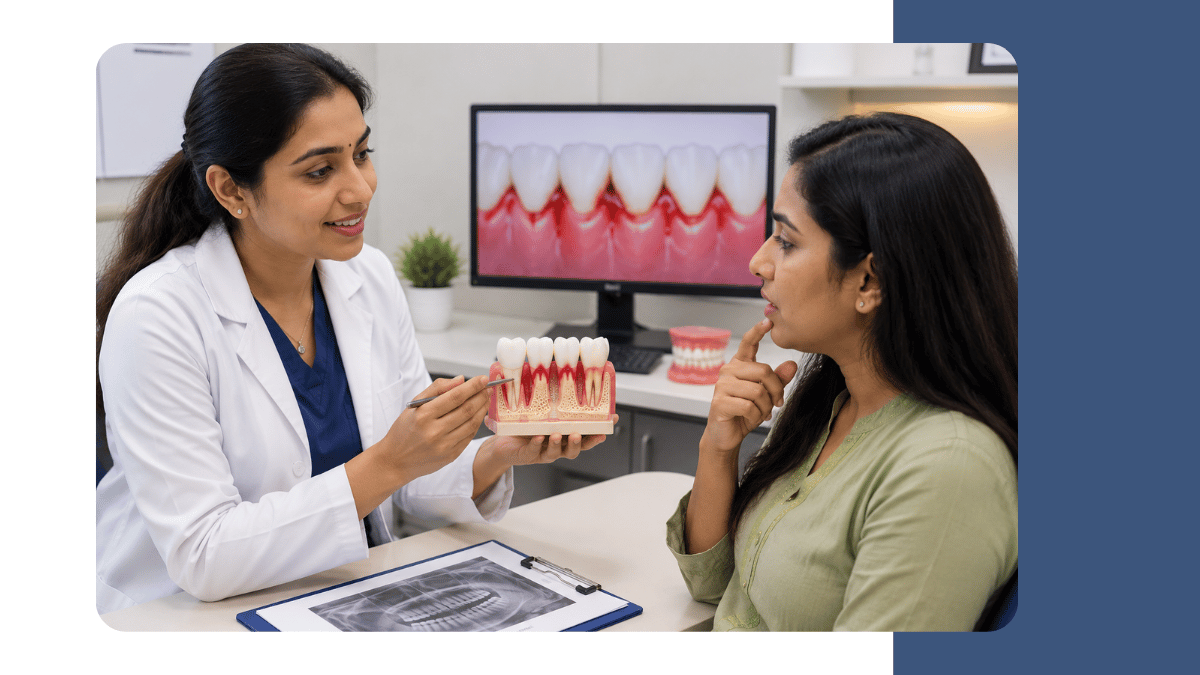
The following signs should prompt a periodontal assessment rather than a routine wait-and-see approach. Bleeding gums during brushing, particularly if it occurs consistently, is the most common early sign of gingivitis and should never be normalised. Gum recession, where the gum line is visibly moving downward exposing the root surface and making teeth appear longer, indicates loss of gum attachment. Persistent bad breath or a bad taste in the mouth that is not explained by diet or general health may indicate a bacterial burden in the gum pockets. Loose or shifting teeth, or a change in the way the teeth bite together, can reflect significant bone loss. Pain or swelling around a specific tooth or along the gum line needs prompt evaluation. And any patient with a diagnosis of diabetes, cardiovascular disease, or who is planning pregnancy should have their periodontal status formally assessed, as the relationship between systemic health and gum health runs in both directions. At Dentacure, Kasturi Nagar, Bengaluru, I provide a comprehensive periodontal assessment that covers the full clinical picture, from gum pocket depths and bone status on X-ray to the patient's systemic risk factors and home care habits, and I develop a treatment and maintenance plan personalised to each patient's individual periodontal needs.
To book a periodontal or dental consultation with Dr. Prerana G.K. at Dentacure Multispeciality Dental Clinic and Implant Centre, Ground Floor, No. 217, 2nd Main Road, East of NGEF Layout, Kasturi Nagar, Bengaluru 560043 (Monday to Saturday, 9:30 AM to 8:00 PM), call +91 7259967999.
Written by Dr. Prerana G.K., BDS, MDS (Periodontology, Distinction), Consultant Periodontist, Implantologist and General Dental Practitioner, Dentacure Multispeciality Dental Clinic and Implant Centre, Ground Floor, No. 217, 2nd Main Road, East of NGEF Layout, Kasturi Nagar, Bengaluru, Karnataka 560043. Monday to Saturday, 9:30 AM to 8:00 PM. 8+ years. 5,000+ patients. Phone: +91 7259967999.
Related reading
Bleeding Gums: When Should You See a Periodontist?
Dental Implants for Missing Teeth: What Should You Know Before Treatment?


Add a Comment