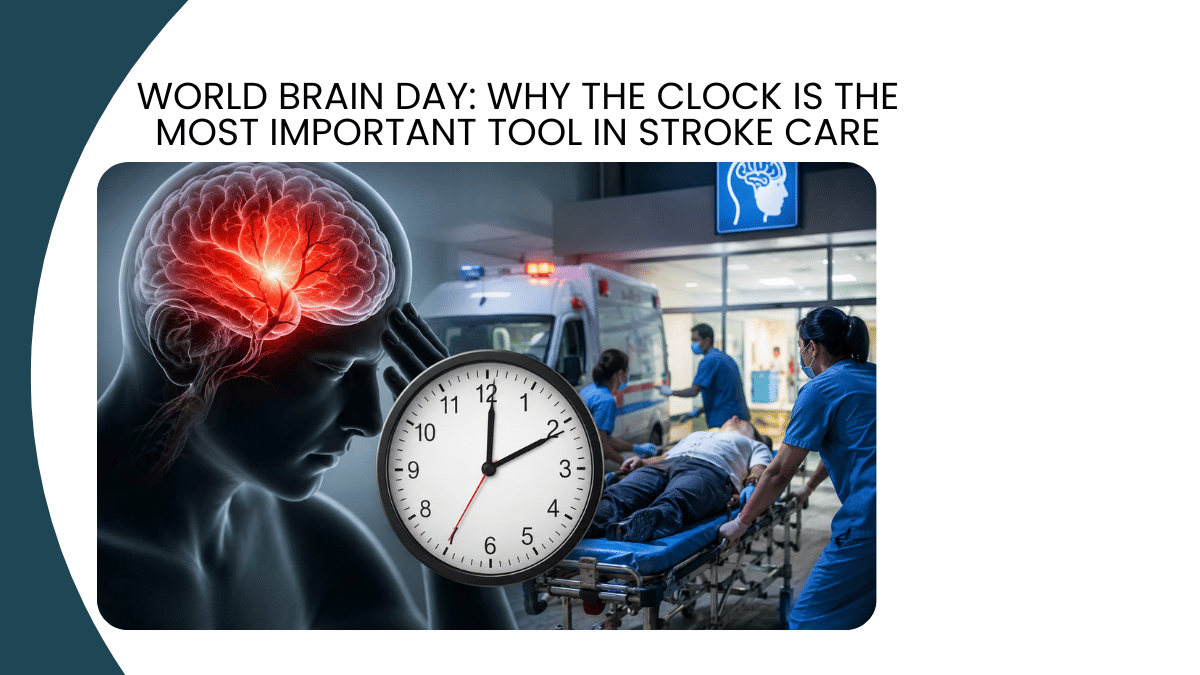
Every 22 July, World Brain Day is a reminder that the brain is our most vital organ, and that protecting it begins with understanding when it is under threat. This year, I want to write specifically about stroke, because stroke is the condition where the gap between what patients understand and what the evidence tells us actually costs lives. As a neurosurgeon and stroke interventionist in Bengaluru, the patients I see too late are not the ones who did not care. They are the ones who did not recognise what was happening, or who waited to see if things would improve on their own.
Time is brain — what this means in practice
Every minute of a major stroke, the brain loses approximately 1.9 million neurons. This is not an abstraction. It is the reason the phrase 'time is brain' entered clinical neuroscience. An ischaemic stroke — the most common type, caused by a blood clot blocking a cerebral artery — stops oxygen delivery to the territory that artery supplies. Brain tissue in that territory does not negotiate. It begins to die within minutes of the blockage. The outer zone, the penumbra, survives longer on collateral supply, but that margin closes rapidly. Mechanical thrombectomy, the endovascular procedure in which a catheter is passed through the arterial system to reach and remove the clot directly from the blocked vessel, can restore blood flow to the penumbra and recover function that would otherwise be lost. But it is time-dependent. In appropriate patients, treatment within six hours of symptom onset offers meaningful recovery. Beyond that window, recoverable tissue becomes irreversible infarct.
Recognising stroke — the FAST test and what families miss
The FAST test, Face drooping, Arm weakness, Speech difficulty, Time to call emergency services, is the public-facing version of stroke recognition. It is a good starting point but it misses a significant proportion of strokes. Posterior circulation strokes, those affecting the back of the brain, can present with sudden severe vertigo, double vision, unsteady walking, or difficulty swallowing, without the classic facial or limb weakness pattern. These cases are among the most commonly delayed presentations I see. The sudden onset is the key feature: a symptom that was not there one moment and is clearly present the next, even if it seems mild, warrants immediate evaluation rather than a wait-and-see approach.
In my practice at SPARSH Hospital, Hebbal, Bengaluru, I have performed endovascular thrombectomies and aneurysm coilings on patients who arrived within the treatment window, and the outcomes are substantially better than anything available to the previous generation of stroke patients. The technology exists. The training exists. The window is the variable that families control. Knowing the symptoms, calling for help immediately rather than waiting for the situation to declare itself, and arriving at a hospital with 24-hour neurointerventional capability is what connects a patient to the treatment that can make the difference. This World Brain Day, that is the message I want every family to carry.
To book a consultation with Dr Robin Gupta at SPARSH Hospital, Hebbal, Bengaluru.
Written by Dr Robin Gupta, MBBS (MGIMS Wardha), MS General Surgery (MGIMS Wardha), MCh Neurosurgery (GB Pant Hospital, MAMC, New Delhi, 2018), Lead Consultant Endovascular Neurosurgeon and Stroke Interventionist, SPARSH Hospital, Hebbal, Bengaluru.
Related reading
World Brain Tumour Day: What Every Patient and Family Should Know
Add a Comment