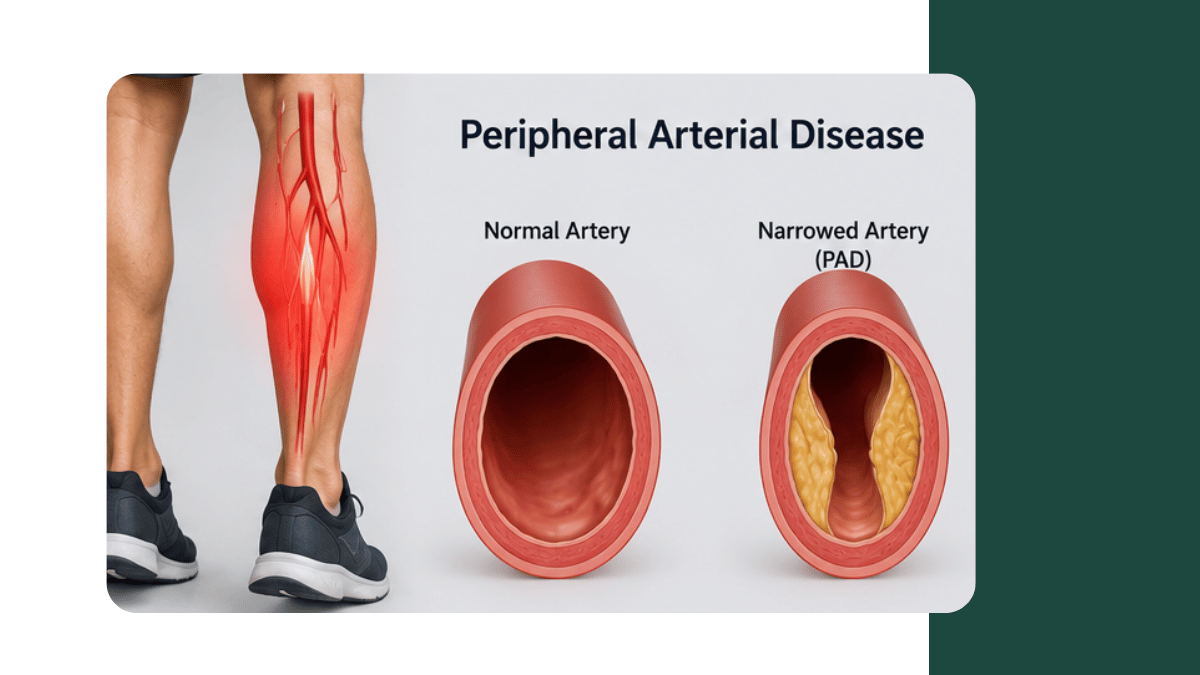
In my vascular practice at SPARSH Hospital, Hennur, Bengaluru, peripheral arterial disease is one of the conditions I am most determined to diagnose earlier. It is common, it is underdiagnosed, it causes real harm when missed, and it is frequently dismissed by patients and sometimes by non-specialist doctors as an inevitable consequence of ageing. Leg pain that comes on with walking and eases with rest is not simply a sign of being older. It is a symptom with a specific name - intermittent claudication - and it represents arterial narrowing that is both diagnosable and treatable.
What peripheral arterial disease is and why it develops
Peripheral arterial disease occurs when the arteries supplying blood to the legs become narrowed or blocked by atherosclerosis - the same process that causes coronary artery disease and stroke. Fatty plaques accumulate within the arterial wall, gradually reducing the internal diameter of the vessel. As the narrowing increases, the muscles of the leg receive less oxygenated blood than they need during exertion. The result is the characteristic cramping or aching pain in the calf, thigh, or buttock that develops during walking and is relieved by a short rest - intermittent claudication.
The same risk factors that drive coronary disease drive PAD: smoking is the most powerful, followed by diabetes, hypertension, high cholesterol, increasing age, and a family history of cardiovascular disease. Patients with diabetes are at particular risk because peripheral neuropathy coexists with arterial disease, meaning that pain - the warning signal - may be blunted or absent even when arterial disease is already severe. This is one of the reasons diabetic patients with foot problems can deteriorate rapidly.
Diagnosis - what investigations matter and what they show
The first step in diagnosing PAD is a simple, non-invasive measurement called the Ankle-Brachial Index - the ratio of blood pressure at the ankle to blood pressure at the arm. An ABI below 0.9 is diagnostic of significant arterial narrowing. Duplex ultrasound can then map the location and severity of disease in the leg arteries without contrast or radiation. CT angiography provides detailed anatomical information about the entire arterial tree from the aorta to the foot, and is the primary imaging modality I use when planning an intervention. Digital subtraction angiography is reserved for the time of the procedure itself, where imaging and treatment are combined.
PAD severity is classified from mild intermittent claudication through to critical limb ischaemia - where the blood supply to the limb is so severely reduced that pain occurs at rest and tissue begins to break down. Critical limb ischaemia with rest pain, non-healing ulcers, or gangrene is a limb-threatening emergency. The distinction between stable claudication and critical ischaemia drives the urgency and nature of treatment.
Treatment - from lifestyle through to intervention
For patients with stable claudication and no critical ischaemia, the starting point is aggressive risk factor modification - supervised exercise, smoking cessation, antiplatelet therapy, and control of blood pressure, diabetes, and cholesterol. These measures slow disease progression, reduce cardiovascular event risk, and in some patients produce meaningful improvement in walking distance. However, they do not reverse existing arterial narrowing.
When symptoms significantly limit daily life, or when critical ischaemia is present, revascularisation is required. Endovascular intervention - angioplasty with or without stenting - is the first choice for most lesions in the leg arteries. Using catheter-based techniques, I can dilate a narrowed or blocked artery from within, restoring blood flow without a surgical incision, typically through a small puncture in the groin or wrist. For longer or more complex occlusions, or where endovascular treatment has not succeeded, vascular bypass surgery creates a new route for blood flow around the blockage using the patient's own vein or a synthetic graft. The goal, in all cases, is restoring enough circulation to relieve symptoms, heal tissue, and preserve the limb. At SPARSH Hospital, I approach every PAD patient with the aim of limb salvage, and the most satisfying outcomes are those where a limb that appeared destined for amputation can be saved with timely, technically precise revascularisation.
To book a consultation with Dr. Abhilash V at SPARSH Hospital, HBR Layout, Hennur Road, Bengaluru 560043 (Monday to Saturday, 9 AM to 4 PM), call +91 76766 84611 / +91 88842 70333.
Written by Dr. Abhilash V, MBBS (Kempegowda Institute of Medical Sciences, Bengaluru, 2010), MS General Surgery (Bangalore Medical College and Research Institute, 2015), DrNB Vascular and Endovascular Surgery (National Board of Examinations, New Delhi, 2022), Consultant Vascular and Endovascular Surgeon, SPARSH Hospital, DivyaSree Avance, Hennur Bagalur Main Road, HBR Layout, Bengaluru 560043. Phone: +91 76766 84611 / +91 88842 70333.

Add a Comment