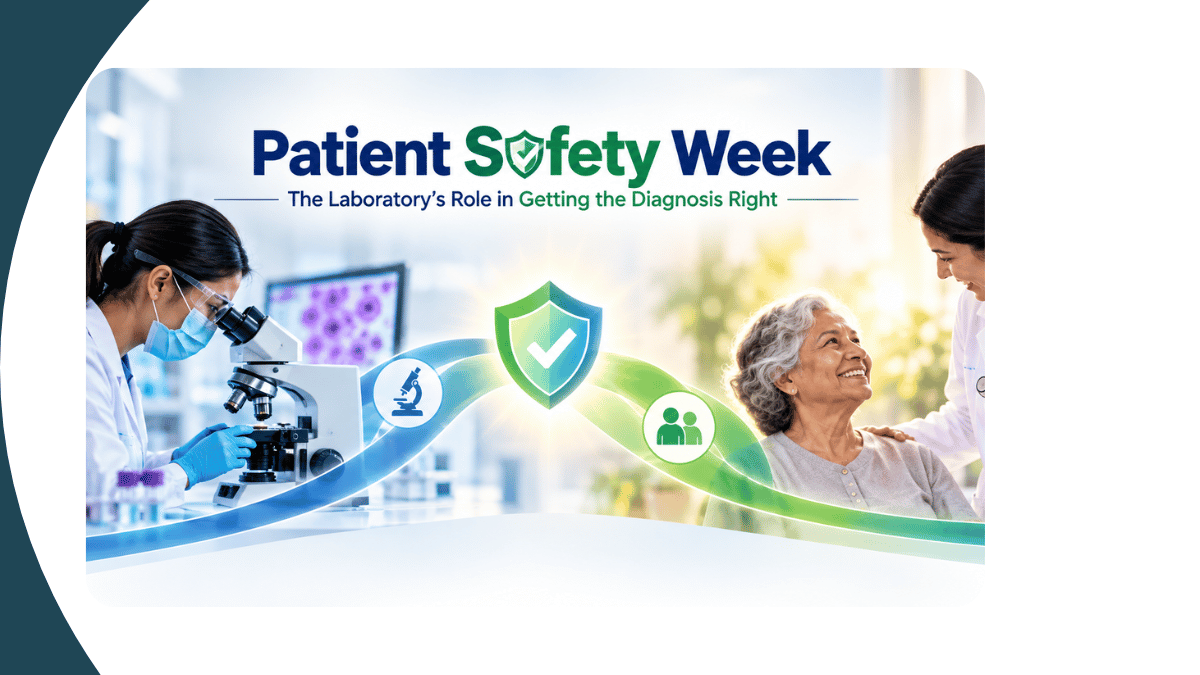
Every year, World Patient Safety Day, observed on 17 September, serves as a reminder that safety in healthcare is not limited to what happens in an operating theatre or at a patient's bedside. Safety begins the moment a clinical decision is made, and many of the most consequential clinical decisions are made on the basis of a laboratory or pathology report. As a Pathologist and ISO 15189 Laboratory Assessor with over 17 years of experience at PESIMSR, Kuppam, I have seen what happens when laboratory quality fails, and I have seen what rigorous quality systems protect against. Patient safety and diagnostic accuracy are not separate subjects. They are the same subject.
Where Diagnostic Errors Happen: The Three Phases of Laboratory Testing
Laboratory errors do not occur only at the microscope. They are distributed across three phases of the testing process, and each phase carries its own risks.
The pre-analytical phase encompasses everything that happens before the sample reaches the laboratory: specimen collection, labelling, transport, and storage. This phase accounts for the majority of laboratory errors. A mislabelled specimen, a sample collected in the wrong tube, tissue left too long before fixation, or a biopsy submitted without adequate clinical information can all compromise the diagnostic result before any analysis has begun. Preventing pre-analytical errors requires standardised collection protocols, staff training, and systematic verification at each step.
The analytical phase is where the actual testing occurs: the processing of tissue, the staining, the microscopic examination, the interpretation of results. Quality at this stage depends on reagent quality, equipment calibration, validated staining protocols, and the competence of the pathologist interpreting the slide. Immunohistochemistry, in particular, requires rigorous controls at every run to ensure that results are reliable.
The post-analytical phase covers reporting, communication, and clinical application of results. A correct diagnosis that is communicated unclearly, sent to the wrong clinician, or misinterpreted in the clinical context can still lead to patient harm. The pathology report is not the end of the diagnostic process. It is the beginning of clinical decision-making, and it must be written with clarity and precision.
Why ISO 15189 Is a Patient Safety Standard
As an ISO 15189 Assessor with experience in laboratory quality management, I want to address a common misconception: accreditation is sometimes seen as an administrative process, a box-ticking exercise for institutional compliance. It is not. ISO 15189 certification is a structured patient safety framework. It requires a laboratory to define, document, and verify every step of the testing process. It mandates internal quality controls, external quality assessment, equipment maintenance records, staff competency evaluation, and a systematic approach to identifying and correcting errors.
When a laboratory operates under a quality management system compliant with ISO 15189, a clinician ordering a test has a meaningful basis for trusting the result. When a laboratory does not, the clinician is working with an unknown degree of risk in every result they receive. Patient safety, in the diagnostic context, is directly proportional to laboratory quality.
The Pathology Report as a Patient Safety Document
A histopathology or cytopathology report is not a bureaucratic formality. It determines whether a patient receives surgery, chemotherapy, radiotherapy, or watchful waiting. It determines whether a tumour is treated as low-risk or high-risk. It determines whether a margin is considered clear or involved. Every word in a pathology report carries clinical weight.
This means that the quality standards governing how a report is produced, verified, and communicated are patient safety standards. At the Department of Pathology at PESIMSR, Kuppam, every report is reviewed against quality criteria before issue, and correlation with clinical and imaging findings is considered an integral part of the diagnostic process.
What Clinicians and Patients Can Do
Patient safety in diagnostics is a shared responsibility. Clinicians can contribute by providing complete and accurate clinical information on pathology request forms, ensuring specimens are collected and transported according to standard protocols, and reading pathology reports carefully rather than acting only on a summary conclusion.
Patients can contribute by asking their clinician whether the laboratory processing their biopsy operates under a recognised quality standard such as ISO 15189, by ensuring that specimens are sent promptly after collection, and by asking for a second pathology opinion whenever a diagnosis will determine a major treatment decision.
On World Patient Safety Day, I want to make one point as clearly as possible: laboratory quality is patient safety. Every quality system, every accreditation standard, every internal audit in a diagnostic laboratory exists because a correct diagnosis, delivered reliably and clearly, protects patients. That is what we are here to do.
To learn more about diagnostic pathology, laboratory quality services, or to seek a second opinion, visit Dr. A S Ramaswamy at PES Institute of Medical Sciences and Research (PESIMSR), NH-219, Kuppam, Nalagampalle, Andhra Pradesh 517425, call +91 9493726494, or WhatsApp: +91 8861191019.
Written by Dr. Anikode Subramanian Ramaswamy, MBBS (M. S. Ramaiah Medical College, Bengaluru), MD Pathology (JJM Medical College, Davangere), Professor and Head, Department of Pathology, PES Institute of Medical Sciences and Research (PESIMSR), NH-219, Kuppam, Nalagampalle, Andhra Pradesh 517425. ISO 15189 Assessor. 75 peer-reviewed publications. 17+ years. Phone: +91 9493726494.
Related reading
Why Quality Management Is the Foundation of Safe and Effective Healthcare
Histopathology and Cancer Diagnosis: How Tissue Analysis Guides Treatment Decisions



Add a Comment