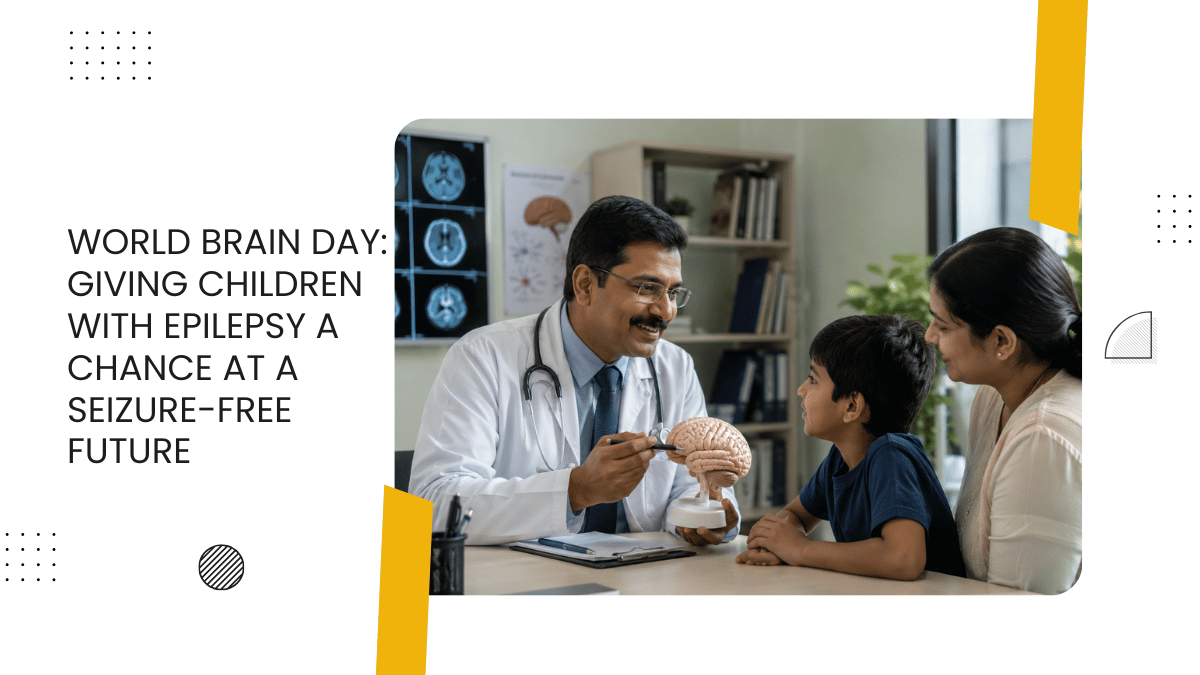
On World Brain Day, conversations often focus on stroke, dementia, and brain injuries. However, one neurological condition that deserves greater attention - especially in children - is epilepsy. For many parents, the word 'brain surgery' evokes fear. Understandably, epilepsy surgery is often viewed as the treatment of last resort - considered only after years of uncontrolled seizures and multiple failed medications. Unfortunately, this misconception delays life-changing treatment for many children.
As a neurosurgeon, I have seen children whose lives were transformed after epilepsy surgery. I have also seen children referred far too late, after years of recurrent seizures had already affected their learning, behaviour, and development. On this World Brain Day, it is time to change the way we think about epilepsy surgery.
When Medicines Fail, Time Matters
Nearly 60% of children with epilepsy achieve good seizure control with anti-seizure medications. However, about one-third continue to have seizures despite appropriate treatment. A child is considered to have drug-resistant epilepsy when seizures persist despite trials of two appropriately chosen and tolerated anti-seizure medications.
At this stage, the question should no longer be, 'Which medicine should we try next?' Instead, it should be: 'Is this child a candidate for epilepsy surgery?' Unfortunately, many children continue trying medication after medication for years before being referred to an epilepsy surgery program. During this period, every uncontrolled seizure may interfere with the developing brain.
Every Seizure Has a Cost
Unlike the adult brain, a child's brain is still rapidly developing. Frequent seizures can disrupt critical periods of brain maturation, affecting:
- Language development
- Memory and learning
- Attention and behaviour
- Academic performance
- Social and emotional development
Repeated seizures may also increase the risk of injury, emergency hospital visits, and psychological stress for the entire family. This is why timely intervention is as important as effective intervention.
Surgery Is Not the Last Step — It May Be the Right Step
Modern epilepsy surgery is not reserved for desperate situations. Guidelines from the International League Against Epilepsy (ILAE) recommend early evaluation for children with drug-resistant epilepsy because surgery offers the best chance of seizure freedom in carefully selected patients. Successful surgery can:
- Eliminate or significantly reduce seizures
- Improve developmental outcomes
- Reduce dependence on multiple medications
- Enhance cognitive and behavioural function
- Allow children to participate more fully in school and daily life
- Improve the quality of life for the entire family
For many children, surgery offers not only seizure control but also the opportunity for a more normal childhood.
Not Every Child Needs Surgery — But Every Eligible Child Deserves an Evaluation
Epilepsy surgery is never recommended without a comprehensive assessment. A multidisciplinary epilepsy team carefully evaluates each child using advanced investigations such as:
- Video EEG monitoring
- High-resolution MRI
- PET or SPECT imaging when indicated
- Neuropsychological assessment
- Functional brain mapping in selected cases
These investigations help determine whether surgery is appropriate and identify the safest and most effective treatment strategy.
Advances Have Made Epilepsy Surgery Safer Than Ever
Over the past decade, epilepsy surgery has evolved from conventional open procedures to highly precise, minimally invasive interventions. Modern epilepsy surgery combines advanced neuroimaging, neuronavigation, intraoperative neurophysiological monitoring, and microsurgical techniques to maximise seizure freedom while preserving normal brain function.
At AIIMS, New Delhi, we have been at the forefront of advancing minimally invasive epilepsy surgery for children with drug-resistant epilepsy. Through our clinical research and surgical innovation, we developed and refined endoscope-assisted hemispherotomy, endoscopic total corpus callosotomy, the ablative disconnection of deep-seated lesions — Hypothalamic hamartomas, Periventricular nodular heterotopias — and recently the ROTCH (RObot-guided ThermoCoagulative Hemispherotomy) technique, performed just through small holes (2.5mm diameter) in the skull. The ROTCH is a percutaneous technique representing a novel evolution in disconnective epilepsy surgery, using robotic precision to perform hemispherotomy with minimal disruption to normal brain tissue. Along with our work in robotic-guided stereoelectroencephalography (SEEG), these innovations have expanded the possibilities of minimally invasive epilepsy surgery.
Our published research has demonstrated that these techniques can achieve seizure outcomes comparable to conventional surgery while reducing blood loss, minimising tissue trauma, shortening hospital stay, and facilitating faster recovery. These advances have made epilepsy surgery not only more effective but also safer and less invasive for children.
A Message to Parents and Healthcare Providers
If a child continues to have seizures despite two appropriate anti-seizure medications, do not wait years hoping that the next medicine will work. Ask for a referral to a comprehensive epilepsy centre.
An epilepsy surgery evaluation does not mean surgery is inevitable. It simply ensures that every evidence-based treatment option is considered before valuable years of brain development are lost.
This World Brain Day, Let’s Change the Conversation
The greatest misconception surrounding epilepsy surgery is that it should be considered only after every other option has failed. In reality, epilepsy surgery should not be the last resort — it should be considered at the right time.
Every seizure-free day is an opportunity for a child to learn, grow, and achieve their full potential. By recognising drug-resistant epilepsy early and referring children promptly for specialised evaluation, we can offer many young patients not just seizure control, but the promise of a brighter future.
To book a consultation with Dr Ramesh Doddamani at All India Institute of Medical Sciences (AIIMS), Sri Aurobindo Marg, Ansari Nagar, New Delhi 110029, call +91 8861191019 or visit linqmd.com/doctor/ramesh-doddamani
Written by Dr Ramesh Doddamani, MBBS (Mysore Medical College), MS General Surgery (PGIMER Chandigarh), MCh Neurosurgery (PGIMER Chandigarh), Professor and Core Faculty, Epilepsy and Functional Neurosurgery Fellowship Program, Department of Neurosurgery, All India Institute of Medical Sciences, New Delhi. Secretary, Society for Epilepsy Neurobiology and Neuromodulation Surgery (SENNS). Section Editor, Epilepsy and Pain, World Neurosurgery.
Related reading
Robotic Thermocoagulative Hemispherotomy
Endoscopic Total Corpus Callosotomy and Pan Commissurotomy
Robotic-Guided Radiofrequency Ablative Disconnection of Hypothalamic Hamartoma
Add a Comment