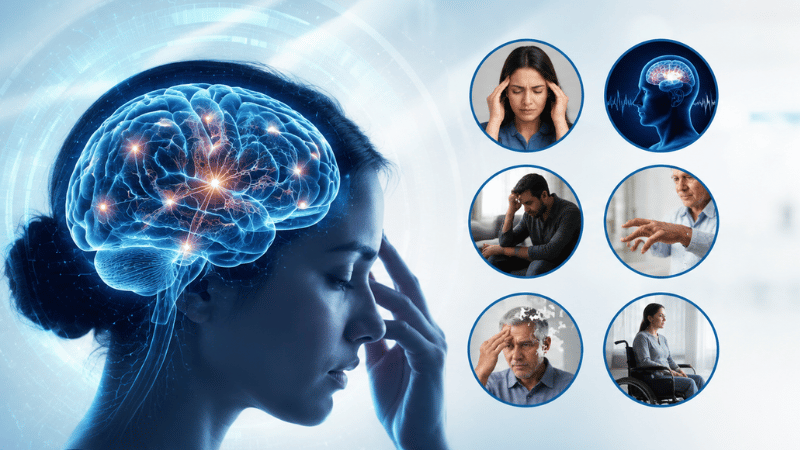
Every 22 July, World Brain Day asks us to consider not just the conditions we know about, but the ones we overlook. In my 25 years of neurosurgical practice in Coimbatore, the conditions I find most underdiagnosed are not the dramatic emergencies. They are the progressive neurological disorders that arrive quietly, are attributed to ageing or stress for years, and by the time patients reach me, have already significantly reduced their quality of life. Parkinson's disease, essential tremor, and dystonia are at the top of that list — and they are among the conditions that modern functional neurosurgery can genuinely transform.
What functional neurosurgery does — and why most patients never hear about it
Functional neurosurgery is not about removing a tumour or repairing a ruptured vessel. It is about modifying the function of specific brain circuits to treat the neurological symptoms that arise when those circuits malfunction. Deep brain stimulation is the most established and transformative procedure in this field. Electrodes are placed with millimetre precision into target structures deep within the brain — the subthalamic nucleus for Parkinson's, the ventral intermediate nucleus of the thalamus for essential tremor — and connected to a pulse generator beneath the skin. Electrical stimulation through these electrodes resets the abnormal signalling that produces tremor, rigidity, and slowness. The result, in appropriate patients, is often dramatic: a hand that trembled continuously at rest becomes steady. A patient who could not write, button a shirt, or hold a cup of tea regains those abilities. I completed my Fellowship in Stereotaxy and Functional Neurosurgery at Jaslok Hospital, and DBS surgery in Coimbatore at Sri Ramakrishna Hospital is an area of specific focus in my practice.
The gap between who needs this treatment and who receives it
The challenge in South India is not that the technology is unavailable. It is that patients and their families do not know to ask for it. A patient with Parkinson's who has been on maximum medication for several years and whose symptoms are no longer well controlled on tablets is often a candidate for DBS — but that conversation rarely happens. Families see tremor as an inevitable part of ageing. Patients accept a progressively reduced life because they believe nothing else is possible. The neurological assessment that determines whether a patient is a good DBS candidate is straightforward, and for appropriate patients the difference between life on maximum medication and life after DBS is not incremental. It is transformative.
This World Brain Day, my message is directed specifically at families in Coimbatore and across Tamil Nadu who are managing a relative with Parkinson's disease, drug-resistant essential tremor, or dystonia: medication is not the only option. A functional neurosurgery assessment is a conversation worth having before symptoms progress further and the window for the best surgical outcome narrows. The brain's circuits can be modulated. The quality of life that has been eroded can, in many cases, be substantially recovered.
To book a consultation with Dr Vikram Muthu Subramanian at Sri Ramakrishna Hospital, Coimbatore, or The Clinic, Peelamedu, call +91 7548-820720.
Written by Dr Vikram Muthu Subramanian, MBBS (Sri Siddhartha Medical College, 1999), DNB Neurosurgery (Dr Achanta Laksmipathi Neurosurgical Centre, VHS Hospital, Chennai, 2006), Fellowship in Stereotaxy and Functional Neurosurgery (Jaslok Hospital, 2006), MBA Hospital Administration (PSG IIM, 2012), Senior Consultant Neurosurgeon and HOD Minimally Invasive Brain and Spine Surgery, Sri Ramakrishna Hospital, Coimbatore.
Related reading
World Brain Tumour Day: Brain Tumour Symptoms Every Patient and Family Should Know


Add a Comment