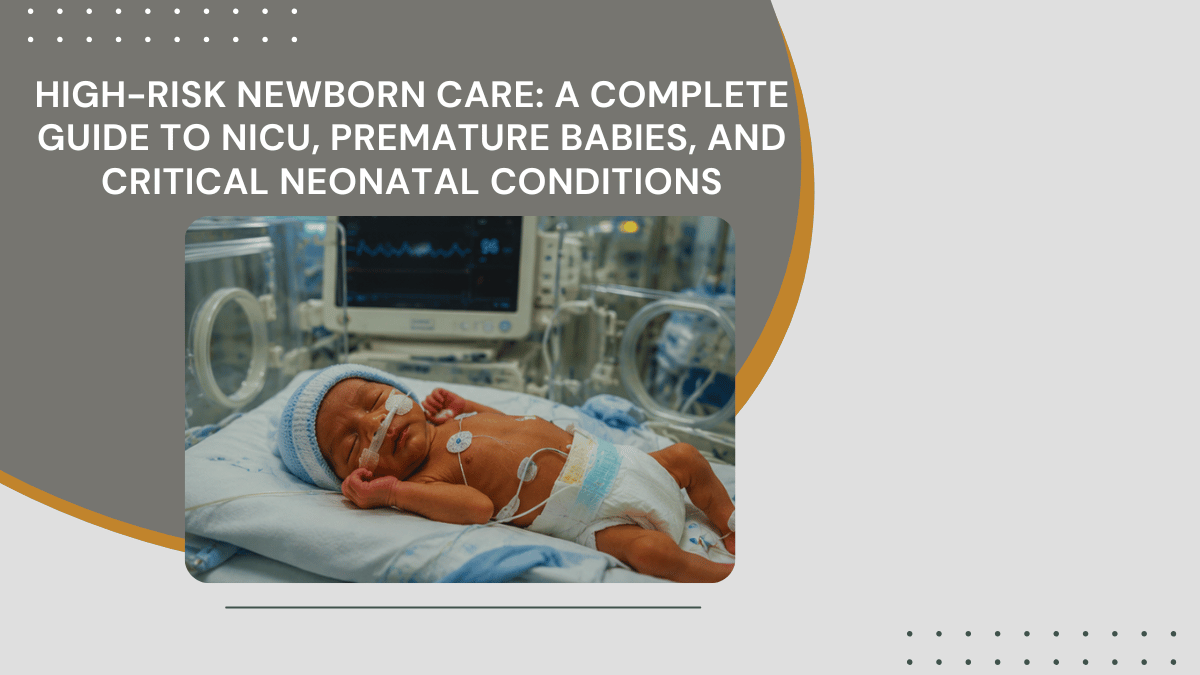
When a newborn needs intensive care, it is one of the most frightening experiences a parent can face. As a Neonatologist with NNF-accredited fellowship training, I have spent years managing critically ill newborns in the NICU, and I have seen how much it helps parents to understand what is happening to their baby and why each intervention matters. This guide walks through the conditions, procedures, and decisions that shape high-risk newborn care, so that families facing this experience have a clearer picture of what lies ahead.
What makes a newborn high-risk?
A newborn is considered high-risk when factors before, during, or after birth increase the chance of complications that require close monitoring or intervention. This includes babies born prematurely, those with low birth weight, babies who experienced distress during delivery, and those born to mothers with conditions such as diabetes, hypertension, or infections during pregnancy. Multiple births, birth asphyxia, and congenital conditions identified at birth also place a newborn in this category.
Being classified as high-risk does not mean a poor outcome is expected. It means the baby needs a level of monitoring and care that anticipates problems early, often preventing them from becoming serious.
The degree of risk also varies considerably within this category. A baby born at 35 weeks with no other complications faces a very different course than one born at 26 weeks with respiratory failure at birth. Part of my role in the first hours after admission is establishing exactly where a baby sits on this spectrum, since that assessment shapes every decision that follows, from the intensity of NICU monitoring to the specific interventions offered.
What is respiratory distress syndrome and why does it affect premature babies?
Respiratory distress syndrome, or RDS, occurs when a baby's lungs have not produced enough surfactant, a substance that keeps the tiny air sacs in the lungs open. This is most common in babies born before 34 weeks, since surfactant production matures late in pregnancy. Without enough surfactant, the lungs struggle to stay expanded, and the baby works much harder to breathe.
RDS is managed with respiratory support ranging from gentle non-invasive methods to more advanced ventilation, along with surfactant replacement therapy administered directly into the airway in more severe cases. Most babies with RDS improve significantly within days as their lungs mature and treatment takes effect.
When a premature delivery is anticipated, antenatal steroids are sometimes given to the mother beforehand to accelerate the baby's lung maturity, which can meaningfully reduce the severity of RDS after birth. This is one of the clearest examples in neonatology of antenatal care directly shaping a newborn's first hours, and it is a conversation I encourage every family expecting a preterm delivery to have with their obstetric team.
Why does neonatal jaundice need to be monitored so closely?
Neonatal jaundice, the yellowing of a baby's skin and eyes, is extremely common and usually harmless, caused by the normal breakdown of red blood cells producing more bilirubin than a newborn's immature liver can immediately process. In most babies, it resolves on its own or with phototherapy, which uses light to help break down bilirubin so it can be eliminated from the body.
The reason jaundice is monitored closely, particularly in high-risk newborns, is that very high bilirubin levels can affect the brain if left untreated. This is why bilirubin levels are checked regularly in the NICU, and treatment is escalated promptly if levels rise faster than expected rather than waiting to see if they settle on their own.
Premature babies are at particularly high risk of significant jaundice, partly because their livers are even less mature than a term baby's, and partly because they are more likely to need blood transfusions or have other conditions that increase red blood cell breakdown. For this reason, bilirubin trends, not single readings, guide treatment decisions. A level that would be acceptable in a term baby may warrant treatment in a premature one, simply because the trajectory and risk profile differ.
What is neonatal sepsis and why is it treated so urgently?
Neonatal sepsis is a serious bloodstream infection that can develop in newborns, particularly those born prematurely or with low birth weight, whose immune systems are not yet fully developed. It can present subtly, with signs such as poor feeding, lethargy, temperature instability, or breathing changes, rather than the more obvious fever seen in older children.
Because sepsis can progress rapidly in a newborn, treatment with antibiotics often begins as soon as it is suspected, based on risk factors and early signs, rather than waiting for laboratory confirmation. This urgency is one of the defining features of NICU care, where early intervention significantly changes outcomes.
Sepsis in newborns is broadly divided into early-onset and late-onset sepsis, the former occurring within the first 72 hours and usually linked to organisms passed from mother to baby around the time of delivery, and the latter occurring after this window and often related to the hospital environment or invasive lines and tubes. Each pattern carries a different set of likely organisms and risk factors, which shapes both the antibiotic choice and how long treatment continues once cultures and the baby's response are known.
What does respiratory support in the NICU actually involve?
Respiratory support exists on a spectrum, matched to how much help a baby's breathing needs. Non-invasive options such as CPAP provide gentle continuous pressure to keep the airways open without a breathing tube. When a baby needs more support, invasive ventilation through a breathing tube takes over the work of breathing more fully.
In the most severe cases of respiratory failure, high-frequency oscillatory ventilation, HFOV, delivers very rapid, small breaths that can support extremely fragile lungs while minimising the pressure-related injury that conventional ventilation can sometimes cause.
The choice of support is reassessed continuously as a baby's condition changes, with the goal of providing exactly the support needed at each stage and stepping down as soon as the baby is ready.
Weaning a baby off respiratory support is approached gradually and deliberately. Moving too quickly risks a setback that can prolong the overall NICU stay, while moving too slowly carries its own risks, including lung injury from prolonged ventilation. I assess readiness through a combination of blood gas trends, the baby's effort and stability on lower settings, and how they tolerate brief trials off support, rather than relying on any single measurement.
What other procedures are common in high-risk newborn care?
Several procedures are routine parts of NICU care for critically ill newborns. Umbilical catheterisation places a thin tube into the umbilical vessels, allowing reliable access for fluids, medications, and blood sampling without repeated needle pricks.
Exchange transfusion, used in selected cases of severe jaundice or certain blood conditions, gradually replaces a portion of the baby's blood to rapidly lower bilirubin or correct other abnormalities. Total parenteral nutrition, TPN, delivers nutrition directly into the bloodstream for babies who cannot yet tolerate feeding through the gut, ensuring growth continues even when the digestive system needs time to mature.
Lumbar puncture and central line insertion are two further procedures sometimes needed in high-risk newborns, the former to investigate suspected infection of the central nervous system, and the latter to provide more durable vascular access for babies requiring prolonged intravenous treatment. Each procedure carries its own specific indications, and I discuss with parents exactly why a particular procedure is being recommended for their baby rather than performing it as a routine step.
What happens during neonatal resuscitation at birth?
Some babies need immediate support to begin breathing effectively at birth, particularly after a difficult delivery or in cases of birth asphyxia. Neonatal resuscitation follows a structured, stepwise protocol, beginning with warming, drying, and stimulating the baby, and escalating to airway support and ventilation if the baby does not respond. Trained teams are present at high-risk deliveries specifically so that this support can begin within the first critical minute of life, since prompt resuscitation has a significant bearing on long-term outcomes.
The first minute after birth, sometimes called the golden minute, is when most decisions in resuscitation are made and most interventions, if needed, begin. This is why every member of a resuscitation team has a defined role agreed before the delivery even begins, allowing the team to move through warming, stimulation, and if necessary, ventilation, without delay or confusion at the bedside.
How do birth asphyxia and its effects get managed in the newborn period?
Birth asphyxia refers to a lack of adequate oxygen delivery to a baby around the time of birth, which can affect multiple organs, most significantly the brain. Babies who experience moderate to severe asphyxia are monitored closely for signs of hypoxic-ischaemic encephalopathy, a pattern of brain injury that can range from mild and fully recoverable to more significant and longer-lasting.
In selected cases identified within the first hours of life, therapeutic hypothermia, carefully cooling the baby's body temperature for a defined period, is used to reduce the extent of brain injury following asphyxia. This treatment has a narrow window in which it is effective, which is part of why early recognition and prompt referral to a centre equipped to provide it matters so much.
What should parents expect during a NICU stay?
A NICU stay can feel overwhelming, with monitors, tubes, and a level of medical activity most parents have never experienced. I make a point of explaining what each piece of equipment is doing and why, since understanding the purpose behind the wires and alarms makes the experience considerably less frightening. Parents are encouraged to be involved as much as the baby's condition allows, including skin-to-skin contact, participating in feeding decisions, and being present for daily updates on progress.
The length of stay varies enormously depending on the reason for admission, from a few days for monitoring to several weeks for extremely premature babies, and I provide realistic timeframes rather than fixed promises, since every baby's recovery follows its own pace.
Many parents find the unpredictability of a NICU course more difficult than any single piece of bad news, since progress in intensive care rarely moves in a straight line. A baby may improve steadily for several days and then have a setback unrelated to anything done differently, simply reflecting the underlying fragility of a very premature or critically ill system. I try to prepare families for this pattern early, since expecting some non-linear progress makes the inevitable difficult days easier to weather.
What role does nutrition play in a high-risk newborn's recovery?
Nutrition is one of the most important and sometimes underappreciated aspects of NICU care. Premature and critically ill babies have higher energy requirements relative to their size than healthy term infants, yet are often the least able to tolerate full feeds early on, creating a genuine clinical balancing act. Feeding typically progresses in stages, beginning with intravenous nutrition where needed, advancing to small trophic feeds that prime the gut without demanding much of it, and gradually increasing volume as the baby shows tolerance.
Breast milk, where available, is strongly preferred in this population for its protective effects on gut health and infection risk, and I work closely with mothers to support milk expression even when a baby cannot yet feed directly.
What follow-up does a high-risk newborn need after discharge?
Discharge from the NICU is not the end of monitoring. High-risk newborns, particularly those born prematurely, benefit from structured developmental follow-up to track growth, feeding, and developmental milestones, since these babies may reach milestones on a slightly different timeline than babies born at term.
Vaccination schedules are sometimes adjusted for prematurity, and I review this individually with each family. Regular follow-up allows any emerging concerns, whether related to growth, vision, hearing, or development, to be identified and addressed early.
Specific follow-up needs depend heavily on what a baby experienced in the NICU. A baby who needed prolonged ventilation may need closer respiratory follow-up. A baby who had significant jaundice or asphyxia may need additional developmental screening. I tailor the follow-up schedule to each baby's individual course rather than applying a single generic plan, since the risks and priorities genuinely differ between, for example, a baby who spent three days in the NICU for monitoring and one who spent six weeks recovering from extreme prematurity.
How can parents support a high-risk newborn's recovery once home?
- Follow the feeding plan provided at discharge closely, including any specific fortification or volume targets, since these are tailored to your baby's growth needs
- Keep all follow-up appointments, even when your baby appears to be doing well, since some concerns only become apparent through structured assessment over time
- Maintain the adjusted vaccination schedule discussed with your paediatrician rather than assuming the standard calendar applies unchanged
- Watch for the specific warning signs discussed at discharge for your baby's particular condition, since these vary depending on what was treated in the NICU
- Reach out early with concerns rather than waiting for the next scheduled visit, particularly in the first weeks after discharge when adjustment to home is still underway
Questions parents ask me most often
Will my premature baby catch up to other children developmentally?
Many premature babies catch up to their peers over the first one to two years, though the timeline varies depending on how early they were born and what complications occurred. Developmental assessment is corrected for prematurity-adjusted age in the early months, comparing a baby's progress to their adjusted age rather than their birth date, and this is something I track closely at follow-up visits.
Is it safe for me to hold my baby while they are on respiratory support?
In many cases, yes, including skin-to-skin contact, even with certain types of respiratory support in place. The NICU team will guide you on what is appropriate for your baby's specific condition and equipment, since safety considerations vary based on what support the baby is receiving.
Why does my baby need so many blood tests?
Frequent blood tests in the NICU allow the team to track bilirubin levels, blood counts, infection markers, and other values that can change quickly in a critically ill newborn. Catching small changes early often prevents them from becoming larger problems, which is why monitoring is more frequent than it would be for a healthy term baby.
What can I do to help while my baby is in the NICU?
Being present, participating in care tasks the team encourages, providing breast milk if you are able to, and asking questions whenever something is unclear all genuinely help. Your presence and involvement matter to your baby's care, even when much of the medical work is being done by the team around you.
How will I know when my baby is ready to go home?
Readiness for discharge is judged against a set of milestones rather than a fixed number of days, including stable temperature regulation outside an incubator, consistent weight gain, the ability to take all feeds by mouth, and stability off respiratory and other support. Once these are met consistently, discharge planning, including follow-up arrangements, begins in earnest.
Written by Dr Kabir Nanda, MD (Pediatrics), Fellowship in Neonatology (NNF Accredited), Diploma in Pulmonology, Allergy and Immunology, Pediatrician, Neonatologist, Allergist and Immunologist, Sukhmani Hospital, Safdarjung Enclave, and Westend Hospital, Tilak Nagar, New Delhi.
Related reading
linqmd.com/doctor/kabir-nanda/blog/weak-immunity-in-kids-causes-symptoms-prevention
linqmd.com/doctor/kabir-nanda/blog/vaccination-preventive-healthcare-building-a-strong-foundation-for-lifelong-child-health
linqmd.com/doctor/kabir-nanda/blog/childhood-asthma-allergies-recurrent-wheezing-early-diagnosis-and-long-term-control
To book a consultation with Dr Kabir Nanda at Sukhmani Hospital or Westend Hospital, New Delhi, call +91 8076178418.



Add a Comment