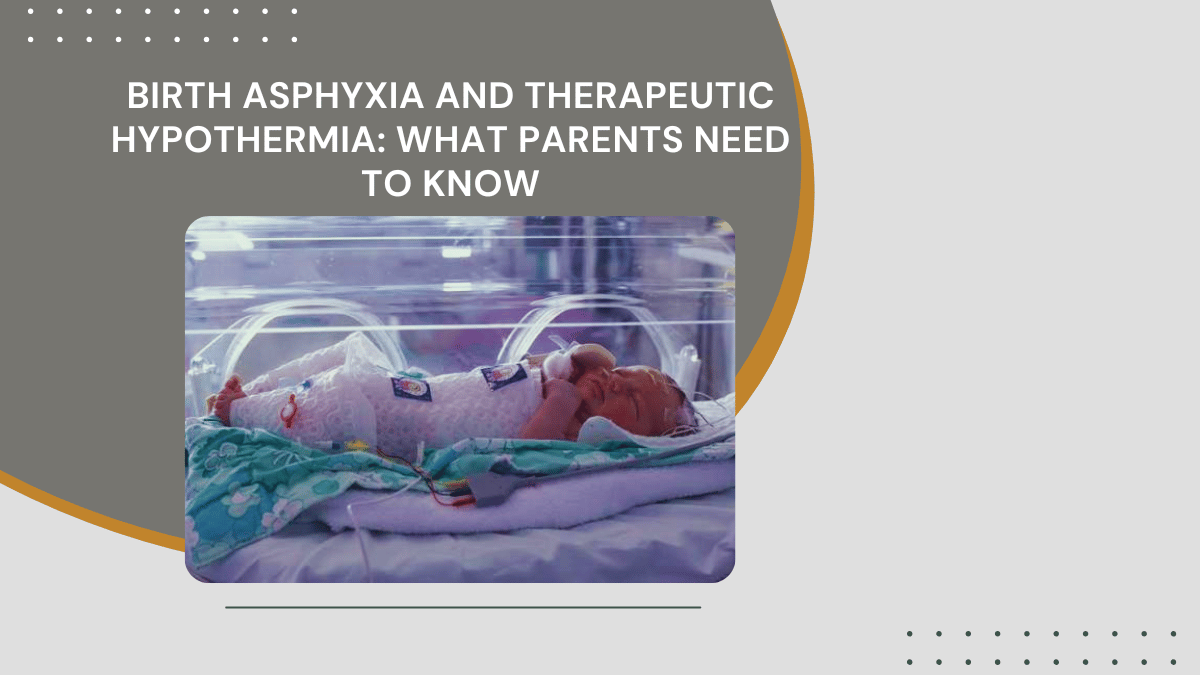
In my complete guide to high-risk newborn care, I described birth asphyxia and therapeutic hypothermia as one of the most time-sensitive situations in neonatology, where prompt recognition and referral to a centre equipped to provide cooling treatment has a significant bearing on a baby's long-term outcome. I want to expand that section here because birth asphyxia is one of the most frightening diagnoses a family can receive in the newborn period, and the fear is often made worse by incomplete information arriving in fragments during a crisis. Understanding what has happened, what the treatment involves, and what the realistic range of outcomes looks like does not remove the fear, but it makes it more manageable. Birth asphyxia is not a uniform diagnosis with a single outcome; its severity, the speed of recognition, and access to appropriate treatment together determine what a baby's recovery looks like.
What Is Birth Asphyxia and How Does It Happen?
Birth asphyxia occurs when a baby's brain and other organs are deprived of adequate oxygen around the time of delivery. The causes include placental abruption, where the placenta separates from the uterus before birth; prolonged compression of the umbilical cord cutting off the blood supply; a very prolonged or complicated labour that reduces oxygen delivery during contractions; and maternal conditions such as very low blood pressure or severe haemorrhage that reduce the amount of oxygen-carrying blood reaching the placenta. In most cases, a brief period of reduced oxygen delivery does not cause lasting harm because the newborn brain has some capacity to tolerate short periods of stress. The concern arises when the reduction in oxygen is severe or prolonged enough to overwhelm this capacity. The immediate marker that guides the clinical team in the first minutes after birth is the baby's condition at delivery: their colour, muscle tone, heart rate, and response to stimulation, assessed through the Apgar score. A low Apgar score at five minutes, a need for prolonged resuscitation, or abnormal results on blood gas testing in the first hour all prompt the neonatology team to assess for birth asphyxia.
What Is Hypoxic-Ischaemic Encephalopathy (HIE)?
Hypoxic-ischaemic encephalopathy, or HIE, is the term for the pattern of brain injury that can follow birth asphyxia. It occurs when the reduction in oxygen delivery is sufficient to injure brain cells, and it is classified as mild, moderate, or severe based on the neurological examination in the first hours of life. Mild HIE often resolves without specific treatment and may have no long-term consequences. Moderate HIE carries a variable prognosis that therapeutic hypothermia has substantially improved over the past two decades. Severe HIE carries the greatest risk of significant long-term neurological impact. The classification is made through careful clinical neurological assessment, sometimes supplemented by an EEG to measure brain electrical activity, and it is this classification that determines whether therapeutic hypothermia is appropriate for a specific baby.
Therapeutic Hypothermia: The Treatment and Why the Six-Hour Window Matters
Therapeutic hypothermia works by carefully cooling a baby's core body temperature from the normal 37 degrees Celsius to approximately 33.5 degrees Celsius for a period of 72 hours. This controlled cooling slows the cascade of cellular injury that continues in the hours after oxygen deprivation, a period called secondary energy failure, during which further brain cell damage occurs even after oxygen supply has been restored. By slowing cellular metabolism and inflammatory processes during this window, hypothermia reduces the extent of brain injury and improves neurological outcomes in babies with moderate to severe HIE. The evidence supporting therapeutic hypothermia is robust, making it the standard of care for eligible newborns across major neonatal units. The six-hour window from birth within which cooling must begin is not arbitrary. The secondary energy failure phase that hypothermia targets begins within hours of birth, and the treatment becomes significantly less effective if started after this window has closed. This is why early recognition of birth asphyxia and prompt transfer to a centre equipped to provide hypothermia, if the delivering unit cannot, is one of the most urgent decisions in neonatology.
What Parents Can Expect During and After Cooling Treatment
During the 72-hour cooling period, the baby is cared for in the NICU on a specially designed cooling blanket or mattress that maintains the target temperature precisely. Sedation is provided as needed for comfort. The baby is monitored continuously, including brain electrical activity through aEEG, to track how the brain is responding. After 72 hours, the baby is rewarmed slowly over several hours. MRI brain imaging, typically performed in the first week, provides information about the pattern and extent of any injury and helps guide what follow-up assessments will be needed. Long-term developmental follow-up is essential for all babies treated with hypothermia, since the outcomes of moderate HIE in particular are genuinely variable, with many babies going on to develop normally and others having specific areas of difficulty that benefit from early therapeutic intervention. The purpose of follow-up after hypothermia is not to confirm how much damage has been done, but to identify early any areas where targeted support can make a meaningful difference to the child's development.
To book a neonatology or paediatric consultation with Dr. Kabir Nanda at Sukhmani Hospital, Safdarjung Enclave, or Westend Hospital, Tilak Nagar, New Delhi, call +91 8076178418.
Written by Dr. Kabir Nanda, MD Paediatrics, Fellowship in Neonatology (NNF Accredited), Diploma in Pulmonology, Allergy and Immunology, Pediatrician, Neonatologist, Allergist and Immunologist, Sukhmani Hospital, Safdarjung Enclave, New Delhi, and Westend Hospital, Tilak Nagar, New Delhi. 8+ years. 8,000+ patients. Phone: +91 8076178418.
Related reading
High-Risk Newborn Care: A Complete Guide to NICU, Premature Babies, and Critical Neonatal Conditions
Why Is My Child Always Sick? Understanding Weak Immunity in Kids
Vaccination & Preventive Healthcare: Building a Strong Foundation for Lifelong Child Health

Add a Comment